
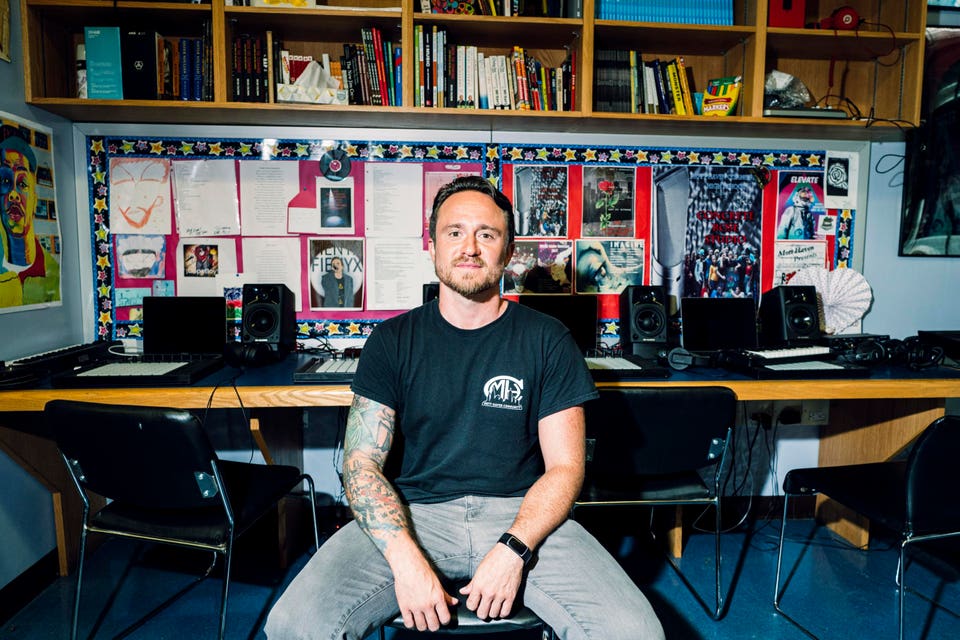
J.C. Hall, School Social Worker, Hip Hop Therapy Studio Directo, 2024 David Prize Winner
J.C. Hall
In third grade, J.C. Hall was already in love with language. He’d write poems in school, fascinated by the way words could compress truth into something beautiful. Then the Fugees dropped The Score, and Lauryn Hill’s mastery of the English language — catchy, brilliant, technically ferocious — unlocked something deeper. Hip hop, Hall realized, had more real estate than any other form. More room to say something that mattered.
That insight would become the foundation of Hip Hop Therapy — a program inside a second-chance high school in the South Bronx that has nearly doubled graduation rates, earned Hall the $200,000 David Prize, and inspired an award-winning short documentary, Mott Haven.
And it all started with saving his own life.
A Lifeline Disguised as Art
Between the ages of 13 and 15, Hall hit the floor. Alcoholism, addiction, major depression. By 15, he had active plans not to make it to 16. What pulled him back wasn’t therapy — his early experiences with psychiatrists left him cold, sleeping on their couches, collecting prescriptions, saying nothing. It was hip hop. “It was almost like this life vest that came around that I didn’t know I needed,” he says. Writing down the madness swirling in his head, making it rhythmic, performing it — suddenly peers were responding. A kid who had felt terminally alone, unreachable, incomprehensible to anyone, found connection.
The mental health system, meanwhile, barely noticed him. Therapists saw his love of hip hop and treated it as a symptom, associating the culture with criminality. “They saw my love of hip hop and identification with it as part of the problem,” Hall recalls. “They associated hip hop culture with criminality and violence and gangs — and they never tried to understand it.” Rehab followed rehab. Relapse followed relapse. The music was always there, keeping him afloat long enough to finally find someone who got it.
The Therapist Who Saw Poetry
That person was Dr. Stuart Lerner, a therapist Hall met during one of his stints in treatment. Lerner wasn’t a hip hop fan. But he recognized something. “It’s poetry, man,” he told Hall. “I used to write poetry.” That simple act of respect — not endorsement, just recognition — cracked the door open. Hall began to trust the therapeutic relationship. And therapy, paired with the music he’d always turned to, began to work.
Later, in graduate school at Fordham University, Hall came across the name Dr. Edgar Tyson while Googling “Hip Hop Therapy” — a term he’d half-invented in his own mind, barely believing such a thing could exist. When he found peer-reviewed journal articles and kept seeing Tyson’s name, he sent the professor what he describes as “a novel of an email.”
Tyson turned out to be on Fordham’s faculty. The day they met, Tyson showed up behind the school in a suit, a Yankee fitted cap, and a diamond cross chain. “I felt like, oh man, this guy’s going to get me,” Hall says. “People would laugh when I would say I wanted to do Hip Hop Therapy. It just wasn’t a thing.” Tyson took him under his wing, mentored him through his master’s, and became a close friend and colleague. They were co-writing a book when Tyson died suddenly in 2018. Hall launched hiphoptherapy.com to ensure his mentor received credit as the field’s originator.
In 2013, Hall brought everything he’d learned to Mott Haven Community High School
GMAThe Studio in Mott Haven
In 2013, Hall brought everything he’d learned to Mott Haven Community High School, a second-chance transfer school in the South Bronx. He started by meeting with a handful of students during the day and after school, bonding over music. Word spread organically. Kids who hadn’t been showing up to school were suddenly impossible to get out of the building. The principal noticed that attendance was climbing, grades were improving, and behavioral incidents were dropping. She offered him a budget. Hall built a professional recording studio — equipment comparable to what you’d pay hundreds of dollars an hour for in Manhattan — available to students for free.
The model is now dual-track. During the day, Hall holds individual therapy sessions, which may involve talking, recording, or both. After school, groups of eight to twelve students gather to make music together — beats, recordings, freestyles — building community and sparking dialogue about what’s happening in their lives. “I think there’s something therapeutic in the expression and creation in and of itself,” he says.
The results are hard to argue with. The program has nearly doubled graduation rates compared to similar schools in the borough.
Ephraim’s Song
One story captures it. A student — call him Ephraim — arrived after a suicide attempt, weeks out of a psych ward. He wouldn’t speak to adults. Other therapists couldn’t reach him. Hall asked what music he liked. The student pulled up Joey Badass. They listened, talked about lyrics. Gradually, Ephraim revealed he wrote poetry — really, raps he’d never thought to call raps. Hall helped him record. He joined group sessions. His attendance went from 29% to 92%. He passed every class.
Then, late in the school year, Ephraim was jumped and stabbed ten times. His spleen and kidney were punctured. When he regained consciousness in the hospital, his first thought, Hall recalls with quiet disbelief, was that he was going to miss the studio on Monday. He came back. He wrote a song about healing. He graduated.
Making the Case to Scale
In 2024, Hall received the David Prize — $200,000, no strings attached — a recognition that validated years of work that institutions had often dismissed. He’s been deliberate about spending it, conscious of the responsibility. The goal now is larger. He wants to build a training infrastructure: a formal pathway so that someone in Nevada, or Australia, or South Korea can search for a local Hip Hop therapist and actually find one. “I think anywhere the identification with hip hop and appreciation of it exists, so too should Hip Hop Therapy,” he says. “Which is everywhere.”
Hip Hop is over fifty years old. Its practitioners and devotees span generations, continents, and tax brackets. The culture that once kept a teenager from Long Island alive in his darkest moments has taken root across the globe. “Oppression exists everywhere,” Hall says simply. “So wherever oppression exists, hip hop is being used as a tool to confront the status quo and push for equality and human rights.”
The studio at Mott Haven is proof of concept. The question Hall is now sitting with — the one Tyson’s death forced him to take seriously — is how you replicate something that works, and get it to the people who need it before they stop looking.
Hall sees a powerful role for brands in helping scale the impact of Hip Hop Therapy. Rather than seeking traditional sponsorships, he is looking for mission-aligned partners that can provide the tools young people need to create, connect, and heal through music. Many of the studio’s laptops, speakers, software licenses, headphones, and production tools have been in use for more than a decade and are beginning to age out.
Hall points to opportunities for companies such as Spotify, Live Nation, Beats by Dre, and music technology providers to donate equipment, software, or educational resources that would directly support students. Beyond product donations, he believes brands can help raise awareness of hip-hop therapy and invest in training programs that expand access to this innovative mental health approach in schools, communities, and eventually around the world.
The receipts, as Hall puts it, are there. It’s time for brands to get involved.