
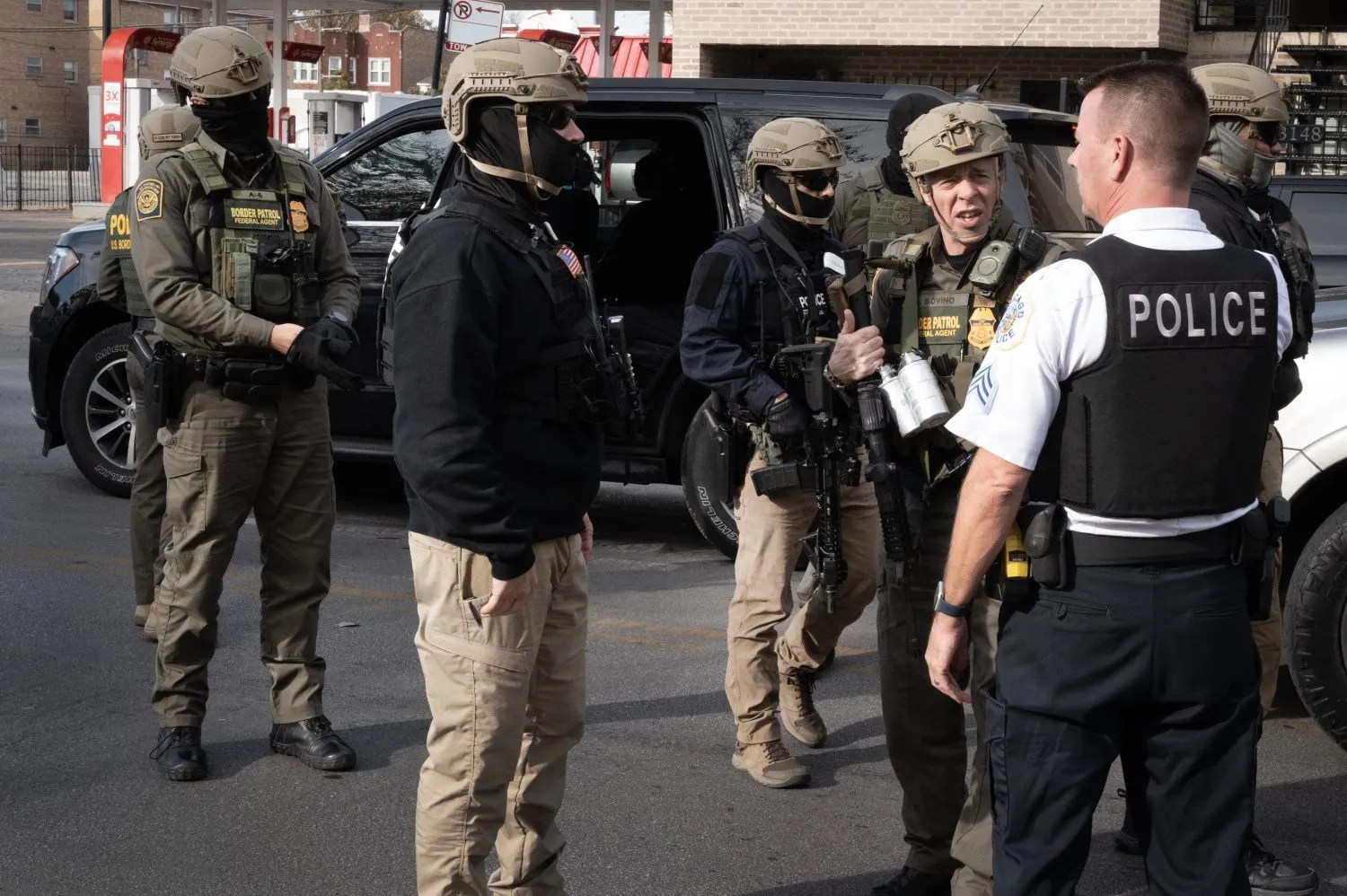
Former Border Patrol chief Greg Bovino speaks with a Chicago Police officer while searching for undocumented immigrants in a southwest side neighborhood on November 06, 2025.
Scott Olson/Getty Images
This op-ed on the negative effects of ICE detention on families was written by Sindy Benavides, the founding executive director of Aquí: The Accountability Movement, and Cheryl Aguilar, a nationally recognized mental health clinician, researcher and advocate and submitted by OtherWords.org.
Last fall, families in Wilder, Idaho gathered for horse races when helicopters and armored trucks suddenly descended. Immigration and Customs Enforcement (ICE) agents — armed with guns, flashbang grenades, and rubber bullets — stormed the event, terrifying children and parents alike.
Agents zip-tied Juana Rodriguez’s hands — and even kept her from feeding her three‑year‑old. “What happened turned our outing into a nightmare,” said the U.S. citizen. The government claimed it was targeting five people for illegal gambling. Instead, 105 people were arrested — all on civil immigration charges.
Did anyone consider the children’s trauma before approving the raid?
Sign up for the This Week’s Top Stories newsletter to get the latest stories delivered to your inbox
THANK YOU!
You’re all set.
CLOSE
Children’s mental health is deteriorating — and children from immigrant families are especially at risk. In Texas, some 2.5 million children have at least one immigrant parent, according to the Vera Institute — that’s one third of all kids in the state. What’s more, the state’s detention facilities — particularly Dilley — have been key to the growth of child detention.
Economic instability, bullying, and hateful rhetoric from political leaders worsen the stress many of these children are already facing. When leaders demean people based on ethnicity, religion, gender or gender identity, or immigration status, it fuels hostility by others.
One in five child deaths now results from suicide. In 2021, pediatric and psychiatric associations declared a national emergency in children’s mental health, and immigration‑related fear has only intensified those concerns.
The suicides of Jocelynn Rojo Carranza (of Gainesville, Texas) and Gabriela Aparicio Ortega (of Durham, North Carolina), 11 and 13 years old, respectively, and both bullied about their parents’ perceived immigration status, show the human cost. Latina adolescents now report some of the nation’s highest suicide attempt rates, according to the CDC.
Dreamers — people born abroad but raised in this country from a young age — continue to live with instability as the future of DACA, an Obama-era program to protect Dreamers from deportation, remains uncertain. Forced to reapply for protection every few years, they live life in four‑year increments, tied to a government application’s approval. That’s its own source of chronic stress.
Meanwhile, family separations persist. Arlit Maria Martinez of Salisbury, Maryland was detained by ICE on her way to work. Two days later, her 15‑year‑old son died of cancer. She never got to say goodbye. Her surviving children are living a nightmare.
ICE has detained more than 6,200 children nationwide, some as young as two years old. Each arrest inflicts lasting psychological harm. Even children who simply witness such actions internalize the idea that safety is conditional.
Parents, too, carry trauma and guilt. Immigration enforcement functions as a community‑wide stressor, and fear seeps into everyday life — determining where families go, what they say, and whether they seek help. When people are afraid to approach mental health professionals, distress becomes structural.
Our collective nervous system is under strain.
Latino communities have always drawn strength from family, faith, and collective care. But our resilience should not replace public investments in mental health infrastructure. We must create systems that make help accessible, affordable, and culturally responsive.
Local governments can invest in trusted community partnerships. Prince George’s County, Maryland, offers a model through The Hope Center for Wellness and the City of Hyattsville — a collaboration that funds local providers, simplifies referrals, and ensures residents don’t face endless waitlists.
State governments must strengthen the bilingual, culturally competent workforce by improving reimbursement rates, supporting training pipelines, and streamlining licensing.
The federal government must also protect loan forgiveness programs that keep social workers and therapists in community‑based roles, and invest in workforce development, community‑based care, language access, and equity.
Let’s be clear: immigration policy is mental health policy. Reducing detention and prioritizing family unity are not just moral or political acts — they are public health interventions. If we continue to tell people to “seek help” while maintaining systems that harm them, we aren’t closing the gap — we’re widening it.
If you or someone you love is struggling, support is available. Call the SAMHSA National Helpline: 1‑800‑662‑4357 (free, confidential, English & Spanish, 24/7). Or text HELLO to 741741 to reach the Crisis Text Line.