
Dark purple. I see the chat bubble in the top left corner of the electronic health record on my screen flip colors. The change in hue represents a new message: urgent, perhaps, or just another patient who cannot sleep. As one of only two psychiatry providers overnight in the psychiatric emergency room, I know it is most likely a message beamed into the ether by a nurse located 15 feet away from me, locked inside a fishbowl similar to mine.
A long row of eight desktop screens glows in the dim of the workroom. I am a third-year psychiatry resident, and my supervising attending psychiatrist and I sit at opposite ends of the worktop that runs lengthwise across the room. Decades of experience and the heavy scent of stale papers and bleach hang in the balance between us. Behind the dusty screens, a cork bulletin board is crammed with instructionals on how to fill out involuntary hold paperwork, draped communal stethoscopes, and grayscale printouts showcasing the staff’s pets. The occupational therapist’s bug-eyed goldfish and my attending’s regal twin tabbies, Sasha and Mischa, stare back at me from the wall. They are the only living things in the room that look relaxed.
Then, a scream ruptures the quiet. I click on the pulsating purple, but I already know the message: “J punched the tech.” This is a psychiatric emergency.
With a 4-inch locked door between the doctors and the patients, sound is the first clue of something gone awry. In my disjointed sensory puzzle, the CCTV screens hold the next. Clustered beside the orange panic alarm light in the top right corner of the room, the TV monitors flick between hallways and milieu every 10 seconds. A mass of guards and nurses grows on the screen. I look at my attending, who continues to type and gives a slight nod. This is my problem.
I open the patient’s chart and toggle through the data: diagnosis, medication timeline, vitals, EKG, labs, and allergies. I preemptively order Thorazine 50 milligrams to be given intramuscularly. It is a potent, 75-year-old antipsychotic, yet J does not have psychosis. He does not hear the voices that Thorazine was designed to dampen. Thorazine is a heavy-handed chemical tool sometimes used not to treat an underlying illness, but to sedate an acute behavioral crisis. I sign the order, feeling the clinical weight of the trade-off: I am trading his autonomy for the safety of the room — and of him.
Emergency departments are not equipped to help patients with dementia
J is young, about 20, with a sheepish grin and thick curls spilling out of his chart profile picture. He has an intellectual disability and autism spectrum disorder. He was wheeled into the emergency department by his mother after punching her, again. His case is a frustratingly common occurrence: a patient without a primary psychiatric illness dropped off by a caregiver following an incident of aggression. It is a mix of safety concerns and a desperate need for respite.
It’s been 121 hours since his mother left him at triage.
Every morning, the provider covering his case calls his mother, asking her to take him home, and each day, she promises tomorrow. She has resisted residential placement for years. The idea of sending him away feels impossible. So does bringing him home like this.
J’s mother isn’t a villain. She is a casualty of a system that has quietly collapsed around families like hers. I look back at Mischa and Sasha one last time, then head for the door.
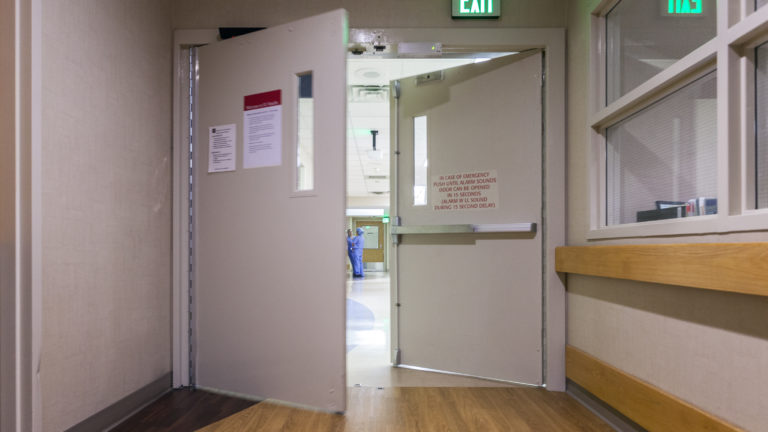
All door handles in the ward are metal levers flush with the door, rather than protruding, to prevent patients from using them as ligature points. I push on the lever and see a crowd about 10 feet away, gathered around the open door of J’s extended observation room. These rooms are reserved for high-risk patients who require a technician or security guard to watch them at all times.
Three nurses and one technician flank the doorway. Eleven hours into my night shift, the fleshy light of dawn fans out from the room. The technician’s cheeks are wet. She is holding her hand, inspecting three linear scratches with fresh blood oozing from the edges. I apologize for what transpired and instruct her to go to triage for a medical assessment.
I step across the threshold into the 5-by-8-foot beige room. Crushed Cheerios and torn-out coloring book pages are strewn across the wooden bedside table. There are faint smudges of pastel crayon on the wall and carved profanities with paint chips revealing the previous cerulean walls. SpongeBob cackles on a television lodged behind shatterproof glass.
The nurses fill me in. Minutes earlier, J had abruptly ended a call with his mother on the unit phone, ran toward the technician, punched her in the chest, and raked his fingers across her hand. I tell the nurse to draw up the Thorazine.
J is supine on the bed with three security guards hovering over him, pinning his lanky limbs to the mattress. The white sheets are littered with tears, revealing the dark blue mattress — the remnants of a previous emergency. One guard holds each wrist, and another holds both of his thighs just above the knobby knees poking through his purple scrub pants. I scrutinize the officers’ grips to ensure they are not injuring him and that there is no risk of asphyxiation.
Exposed and invisible in an ER hallway bed
Their brows are beaded with sweat. Dressed in all black, the guards look indistinguishable from police officers. Their holding of all four of the patient’s limbs constitutes a four-point manual restraint. I check my watch: 7:01 a.m. I will need a separate order to document the hold, which the State Office of Mental Health audits to uphold patient rights.
“What time was the hold initiated?” I ask.
“6:58 a.m.,” huffs one of the officers. They do not take their eyes off J, who is defiantly wriggling his hips.
Restraints are a last resort, and the goal is to minimize the time they are utilized. I walk toward him with my palms open and bend down to get on his eye level. I launch into the protocol that, as a third-year resident, has become second nature: verbal de-escalation, empathic listening, and environmental modification. I motion for a nurse to turn off the TV so J can concentrate on my voice.
“J,” I begin in a low, tranquil voice. I am a foot away from him. “We are going to do three deep breaths together. Then, the officers are going to let you go. But you need to stay still when they let go.”
“Yay, deep breaths, yay,” J squeals, as if it is a game.
I lead us through three breaths and instruct the guards to release their hold. J lies there still. Everyone is holding their breath. I check my watch again: 7:02 a.m.
“Hitting people in the hospital is not an acceptable behavior. I can tell you are really upset, and we are going to give you a medication to help you feel calmer. Which arm would you like it in?”
J points to his right buttocks, a place where he must be used to getting injections — a reminder of psychiatry’s more invasive past. I ask him what song he likes. He says “Old MacDonald Had a Farm.”


Sign up for Weekend Reads
Informed, thought-provoking stories to start your weekend right
I open Spotify on my phone and begin singing along. J joins in, and then the three security guards join, too. I am squatting a foot away from J while the guards chant in their damp clothes. Light streams through the frosted glass, catching flecks of dust.
When applying to medical school, I pictured medicine as a clean transaction — diagnosis, treatment, discharge. Tonight, a syringe, a song, four guards in damp clothes represent a more common reality: the strange, cramped intimacy of mismatched resources in a failing system.
The nurse reappears and cocks her head, baffled by the singing. She refocuses on the syringe, flicking it so the microscopic bubbles cluster at the top. She has an open Band-Aid pinned to her purple nitrile glove, sealed to her hand with perspiration. I point to his buttocks, and she rips a patch of his scrub pants to reveal dimpled flesh, which she cleans with an alcohol swab. As she pushes the medication in, we all continue to sing.
I ask J why he was so upset. “Mom not coming today,” he says. I sigh.
Turning to leave, I tell the nurses I will meet them in their workroom for a debrief. We need a space to unpack the weight of these emergencies: the sight of a human in such extreme distress that we are forced to trade his autonomy for his safety. It is a necessary transaction in this building, but it is one that leaves a mark on everyone involved. Before I can finish my shift, I must still conduct a physical exam to check J for injuries, file the incident report for the injured technician, enter the manual hold order, and sign the emergency medication note detailing the morning’s events.
As I walk down the linoleum hallway, I see the patient phone — a bulky mounted contraption resembling a pay phone — dangling from the wall. The receiver hangs by its silver cord, swaying slightly in the wake of someone passing by.
One hundred and twenty-two hours since his mother left him at triage.
J’s story is just one version of the “resource mismatch” that defines my nights. On any given shift, the psychiatric emergency room serves as a final harbor for everyone the social services landscape has failed to catch. We are a detox center for those with no safe place to withdraw, a warm shelter for those escaping a blizzard, and a respite center for caregivers at their breaking point.
In these moments, our advanced psychiatric medications and diagnostic algorithms are secondary. Our primary role is simpler and more ancient: We are helpers providing safety and care. It is a fundamental part of being a doctor, even if the “treatment” we provide is just a sandwich or a song in a system that has run out of options.
Ashley Andreou, M.D., M.P.H., is a third-year psychiatry resident training in New York City, with a master’s in health policy from Yale.