
 4 min read
Take a moment to realize how incredible our lives are right now. Back just 30 years ago, if I wanted to order my dad his favorite Italian almond cookies (that aren’t available in the U.S.) for his birthday, I would have to go to every Italian importer I could find to get a private hookup that could take weeks. Today, I can open an app on my smartphone and, in four clicks, my Pops has his almond cookies with his coffee two days later.
And that’s not all you can do with your smartphone. You can wake up late to your phone alarm, realize you’ve slept through your early morning flight because you were out late enjoying yourself the night before, purchase a new plane ticket in a foreign city where you don’t speak the language, and order coffee and breakfast to the door of your rental apartment while you request a late checkout from your Airbnb host. Then, you can call a taxi right to your door within minutes, the cab ride being just enough time to ask your AI to proofread your 30-page proposal for typos so you can submit it to your boss in time for a critical deadline. With the Wi-Fi on the plane, you can upload all your Instagram and TikTok content to pay your bills, reschedule your rental car at your destination, make your dinner reservations, and tuck yourself in for the rest of the flight with sleepy music and soothing vibes to make sure you’re well rested in your new time zone.
That’s just a few examples, let alone cars and planes and smartphones themselves, and the astounding effort and millions of people it took to discover the centuries of science needed to build them. It’s simply stunning how much work and human collaboration across millions of people over the years were required to build a car…and to give us all a hope of having one someday.
Yet, despite the extraordinary level of convenience and comfort for which our forefathers and foremothers fought tooth and nail so that all future generations could have easier lives, we now find ourselves, in this current generation, on the brink of not only losing it all, but of complete self-annihilation of our species (i.e., by creating conditions whereby the earth is no longer hospitable for human life).
Did we become so comfortable that we forgot certain critically important parts about being human beings? What happened to collaboration itself, play, empathy, and connection? The components of which greatness is built. The very stuff that helped us to finally achieve the tremendous victory of becoming the most comfortable generation in human history. Was too much convenience toxic to the human brain? I had to find out for myself, but one thing I did know for certain: if one of us doesn’t figure this out quickly, we’re in for a very uncomfortable ride, to say the least.
Hunter S. Thompson once wrote, “Buy the ticket, take the ride.” What he didn’t say is that the ride is now on subscription, auto-renewing monthly.
Fear is supposed to keep us alive. In this current version of real life, it’s keeping us from living.
The new madness is sanity itself, or at least its imitation. Everyone’s so busy appearing balanced that they’ve forgotten what balance feels like. They meditate to perform calmness. They journal to prove self-awareness. They microdose to make their anxiety more productive.
You start to realize that what we call “mental health” and “wellness” have become a social performance, an algorithmic dance between public neurosis and private collapse. Our institutions reward dysregulation. Our technologies monetize attention. And our culture celebrates exhaustion as a kind of sacrament.
I see it clinically every day. Most of the patients who come to me aren’t looking for truth.
They’re looking for relief from the absurdity of pretending to have it all together.
What they really need, though most don’t know it, is permission to stop running. To feel their bodies again. To remember that peace isn’t a prize at the end of the productivity marathon. It’s the default state beneath the noise.
We’ve medicalized discomfort and industrialized distraction. The tobacco companies sell nicotine; the pharmaceutical companies sell serotonin; the tech companies sell dopamine; the spiritual influencers sell oxytocin. In between them all is the human animal, sweating, scrolling, and wondering why life feels like a panic attack in slow motion.
When I look at the data, not the wearable kind, but the deep, biological kind, the problem is clear. We’re overstimulated primates with undernourished nervous systems. Our ancestors faced tigers; we face email. Same amygdala, different jungle.
Fear is supposed to keep us alive. In this current version of real life, it’s keeping us from living.
This is the Human Zoo.
A place where ancient biology is trying its very best inside a world built by caffeinated apes with broadband. Where we confuse stimulation for aliveness and exhaustion for importance. Where rest feels like failure and presence feels unproductive.
Here’s the paradox: nothing about this makes you weak.
It makes us exquisitely human. I say “us” because we’re all in this zoo together.
Your nervous system is not broken.
It’s over-informed, overstimulated.
It has been asked to track more social signals in a single morning than our ancestors encountered in a week in the 1950s.
I’m not here to scold you for struggling.
I’m here to sit beside you on the enclosure floor.
To slide you a banana and say, “Yeah…this place is loud.”
To remind you that many of the zoo’s cage bars are imaginary.
And to help you remember what safety actually feels like in a body.
Because beneath the buzzing, the striving, the cortisol-marinated ambition and endless self-monitoring, there is a calm, wise animal inside you.
One who knows how to breathe.
One who remembers stillness.
One who values connection more than performance.
One who never asked to become a notification receptacle.
That animal isn’t gone.
It’s just been waiting for you to notice it again.
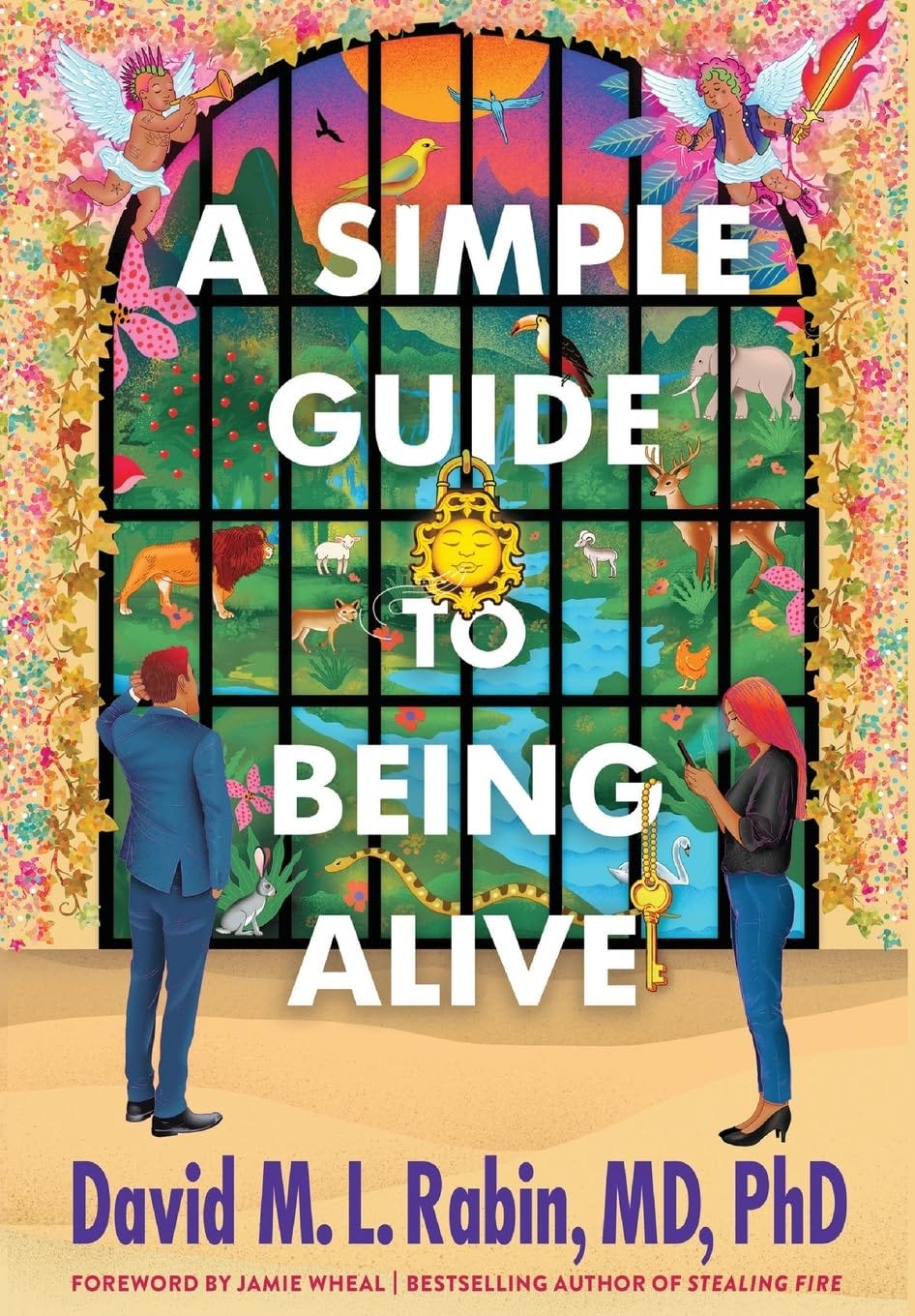
Excerpted from A Simple Guide to Being Alive by David M.L. Rabin, MD, PhD, courtesy of Merack Publishing.
Member Exclusive: Read Our Trending Wellness Stories


David M.L. Rabin, MD, PhD, is a translational neuroscientist, psychiatrist, entrepreneur & inventor who has been studying the impact of chronic stress in humans for over 20 years, with a focus on trauma, addiction, and human performance. He is a Senior Research Scientist at the Institute for Human and Machine Cognition, the Chief Medical Officer and co-founder at Apollo Neuroscience, the Executive Director of The Board of Medicine nonprofit medical board, and Medical Director of The Apollo Clinic. In addition to hosting The Psychedelic Report and Your Brain Explained podcasts, Dr. Rabin regularly serves as an expert for news outlets such as The New York Times, Vogue, CBS News, The Washington Post, and The Wall Street Journal. In his spare time, he enjoys cooking, dancing, volleyball, sailing, and hikes with his wife Kathryn and their son Sammy.