
On Oct. 6, 2024, a graduate student in Duquesne University’s psychology department amplified a social media post celebrating the murder, rape, mutilation and kidnapping of Israeli civilians by terrorists on Oct. 7, 2023, and calling for “greater violence.”
The incendiary post, one of several on the student’s account, read, “happy Oct. 7 eve.” Other posts praised Yahya Sinwar, the Hamas architect of the Oct. 7 massacre.
The sole Jewish professor in the department was horrified that a psychology student — who presumably would go on to provide community mental health services — was celebrating the terrorist attack, which left 1,200 people dead and saw more than 250 abducted to Gazan tunnels.
But what was even more appalling to Alex Kranjec, a tenured psychology professor at Duquesne, was the response of his colleagues when he brought the social media posts to their attention.
“The content of these statements crossed the line,” Kranjec told the Chronicle, “because it’s so vile and so obviously racist, and just sort of celebrating genocide. For any kind of reasonable person, it crosses a line.”
The faculty’s “immediate” reaction to his complaint about the graduate student’s posts, Kranjec said, was “defensiveness, and to attack me for bringing it to their attention.”
After raising the issue, the Jewish professor was beset by a series of indignities that he described as “retaliation.”
For example, a course was created as an “alternative” to a required class taught by Kranjec without his knowledge or consultation, and counter to protocol; graduate students were encouraged to “report” him for any behavior they deemed unacceptable; and his office was “targeted in a way that sort of racialized my identity and served as a means to quiet my criticism of antisemitism in the department,” he said.
Last semester, Kranjec was removed from a Jewish graduate student’s exam committee. Kranjec was told he was removed because the student is “working through his Jewish identity, and because my ‘ideology’ was inconsistent with his. I got no explanation for what that meant.”
The pattern of behavior, Kranjec said, has “racialized” his identity as a Jew “in a particular way that discriminates against me, to isolate me, to remove me from academic life — to purge me from the intellectual life of the department.”
Kranjec is not alone. Antisemitism, anti-Zionism and other forms of Jew-hatred have permeated the mental health professions, leaving Jewish practitioners, students and patients with feelings of isolation, marginalization and discrimination.
The Duquesne student who celebrated Oct. 7 subsequently restricted access to her X account, then deleted it. But she did not deny the posts, Kranjec said. Her adviser responded to Kranjec’s complaint by indicating that the posts were within an acceptable range of opinions about the Israel/Hamas conflict.
“Were I to scour social media, the social media presence of all of our students and alumni, I am pretty confident I find a range of opinions, emphases and outrage at the Hamas attacks, as well as Israel’s response,” her adviser wrote in an email to Kranjec.
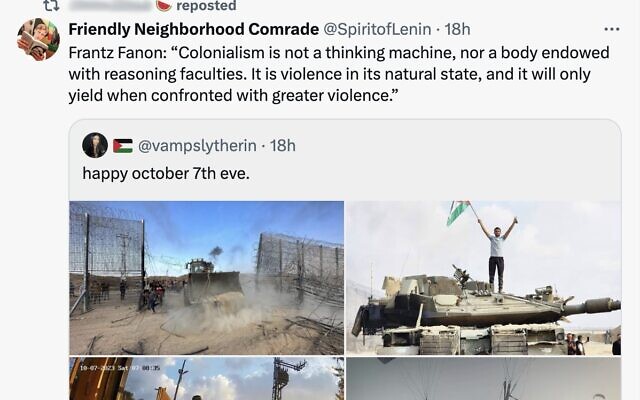
Screenshot of one of the incendiary social media posts re-posted by a Duquesne University graduate student on Oct. 6, 2024
After receiving that response, Kranjec emailed members of the psychology department, explaining what had transpired and expressing his surprise that the graduate student’s support of terrorism was “considered a normal opinion.”
Only one member of the Duquesne community sided publicly with Kranjec, former graduate student Rachel Floyd. In response to Kranjec’s email, Floyd, who graduated in 2023, wrote: “I want to echo his concern and implore the Duquesne community to publicly decry the celebration of violence in any form, whether in classroom discussions, informal conversations in the department kitchen, or on public platforms.”
“Hate is a cultural trend right now, and as phenomenological–existential psychologists, we should be capable of holding a bigger-picture, deeply humane perspective. … Silence can be misinterpreted as complicity, and I hope others will join me in voicing support.”
Citing privacy interests, Duquesne spokesperson Gabriel Welsch declined to comment on Kranjec’s allegations other than to say, “the University is currently looking into concerns raised by him consistent with our internal non-discrimination policies and procedures.”
Welsch also noted that the university “takes proactive measures to prevent antisemitism and other discriminatory behavior and has a robust process for investigating complaints of discrimination raised by our community members.” He added that “over the past several years,” the university has offered and participated “in a variety of educational opportunities addressing antisemitism, including a workshop presented last year by the Holocaust Center of Pittsburgh.”
Floyd, who is not Jewish, told the Chronicle that the Duquesne student who posted the pro-terror social media posts is “not the only one talking like this. It’s quite unbelievable. It’s a social thought virus.”
That “virus” has infected many mental health spaces, and it began before Oct. 7.
The ‘social justice’ rationalization
Andrea Goldschmidt is a clinical psychologist and a professor of psychiatry at the University of Pittsburgh School of Medicine. While she has not experienced overt antisemitism or anti-Zionism in the workplace, she has observed it in professional organizations and on social media.
“I think largely it’s because the mental health professions — the healing professions, really — increasingly, over the past couple decades, have seen it as part of their job description to fight for social justice. And I think they really see this as a social justice cause, like fighting for the oppressed. They definitely do not see Jews as an oppressed group, which probably goes without saying. But I think that’s largely where this shift has come from. And what I think is the most troubling is there is not a diversity of opinions.”
While people can hold various perspectives on the Middle East and nationalism, Goldschmidt said, she has observed — particularly among younger people — a “lack of tolerance for any viewpoint that they perceive as being aligned with oppression. And I think there’s a lot of lack of education, too, about, what Judaism is, what Israel is, what Zionism is. So I think some of it’s coming from a well-intentioned place, but clearly, is very problematic — especially, I think, for patients that are seeking care.”
Many patients who support Israel, she said, feel the need to search “listservs of therapists who are Zionists, because they don’t want to be placed with an anti-Zionist therapist who might let their political views impede the therapeutic relationship. I think that’s a huge problem, too.”
Goldschmidt said an anti-Israel narrative has found its way into some mental health programming for professionals. She pointed to webinars and other events hosted by professional organizations that, she said, “seem to be intentionally selecting keynote speakers who have anti-Israel platforms, and are using their speeches at these conferences to promote anti-Israel ideology.”
While she is hesitant to call the organizers of these programs antisemitic, “oftentimes, what comes out of their mouth is perceived as antisemitic by Jews,” she said.
“I don’t think that these are people that would overtly say, ‘I hate Jews … . They don’t think that they’re saying anything against Jews. They think they’re really, truly saying they just hate Zionists, as if the two things can be teased apart.”
Recognizing, and addressing, the problem
In 2021, Julie R. Ancis, a distinguished professor in the Department of Informatics and founding director of the Cyberpsychology Program at the New Jersey Institute of Technology, launched an organization to address the problem: Psychologists Against Antisemitism.
An impetus for creating the organization, Ancis told the Chronicle, was the silence of the American Psychological Association in response to complaints about antisemitism and anti-Israel propaganda in the field. As a decades-long leader in the APA, Ancis was disturbed by the organization’s apparent indifference to Jew-hatred.
There are now about 1000 members of Psychologists Against Antisemitism, including faculty members and clinicians. The group has held several webinars on psychology and antisemitism, and in February 2025 composed a public letter to the leadership of the APA regarding its lack of attention to complaints about antisemitism on listservs and during conferences.
The letter, which garnered about 4,000 signatures, noted the documentation of “extensive evidence of antisemitic discourse and concerning behavior across APA divisions,” including “statements from APA council members, leaders of APA divisions, and member postings on APA-hosted listservs that collectively demonstrate insensitivity toward Jews, a lack of concern regarding antisemitism, minimization of aggression towards the Jewish people, and outright hostility and prejudice toward Jews and Jewish heritage.”
The APA did not respond to the letter, Ancis said.
But after U.S. Rep. Richie Torres of New York wrote to the APA about the issue — thereby making it public — the House Committee on Education in the Workforce began “investigating APA for antisemitism” Ancis said. “And this is major, and really unfortunate at the same time, that we’ve had to get to this point.”
The APA said it “unequivocally condemns antisemitism in all its forms” in a response to the investigation. Yet some of the discourse on APA listservs, Ancis said, has been “pro-Hamas,” while silencing Jewish voices.
“There is absolutely no empathy for the victims of Oct. 7 or any subsequent antisemitic, anti-Jewish hate and violence,” she said.
There are psychology professors at several universities — who also hold leadership positions within major psychological organizations — “who are pushing for boycott, divestment, sanctions, who are pushing this propaganda,” Ancis said. “These are the professors in these leadership positions who are teaching these students. So you can imagine how Jewish students who identify as Zionists are completely silenced. They can’t speak out — you know, they won’t get their letter of recommendation. They’re afraid of their grades. They’re afraid of the attitudes of their peers and being excluded. And I have friends who are Jewish and psychologists in academic programs — and some that are not Jewish, but are Zionists — and it’s really challenging for them. Faculty meetings where you have hostile colleagues, or your chair doesn’t get it.”
Zionism, Ancis said, has even been equated with mental illness at some psychology conferences.
“I am a Fellow of three different divisions within the APA and have contributed extensively to scholarship in the areas of diversity and multicultural competence,” she said. “I have been engaged in social justice efforts all of my life, and the silence and dismissal of Jewish concerns, as well as promotion of antisemitism, has been particularly painful.”
The antisemitism in the field, she said, is “systemic,” and a change in paradigm is elusive.
“I think that these organizations need to be held accountable,” Ancis said. “And unfortunately, despite the good efforts among many Jewish psychologists — including me — for a long time, we haven’t seen change. Things have only gotten worse.”
Claims of antisemitism in the field of psychology have now reached a tipping point; it was announced last week that the Department of Health and Human Services has launched an investigation of the APA.
“The investigation stems from several complaints by Jewish and Israeli psychologists alleging that the association has promoted or failed to discipline anti-Israel activism among some of its affinity groups,” JTA reported. “The complaints also allege that the APA has encouraged ‘decolonizing therapy’ methods that attack Zionism.”
In response to an interview request from the Chronicle, APA representatives emailed a statement saying the organization is “continuing to cooperate with the active House Committee on Education and Workforce investigation,” and acknowledged the Department of Health and Human Services Office’s investigation.
“APA’s work to combat antisemitism did not begin with these inquiries, and it will not end with them,” according to the statement. “We are cooperating with relevant oversight bodies because transparency and accountability are consistent with our values.
“We will not allow hate to intimidate or create a hostile or unwelcoming environment for our members and the communities we serve. We remain committed to fostering an organization in which all 190,000 of our members feel safe, welcome, and supported.”
Social work and Jew-hatred
Similar issues have permeated the field of social work, and confronting it is “an uphill battle,” said Stefanie Small, director of clinical services at Jewish Family and Community Services in Pittsburgh.
“People do not want to believe that they have antisemitic beliefs, that what they’re saying is antisemitism,” Small said. And many refuse to acknowledge that antisemitism can come from all sides of the political spectrum.
“If you ask social work students where antisemitism comes from, they will tell you from the right. They would not tell you it comes from the left,” she said. “Just like if you ask a bunch of conservatives, where does antisemitism come from, it only comes from the left.”
Schools of social work, she said, “have been moving towards this binary, and purity tests, where everything is black and white.” There is also an emphasis on “intersectionality, which appears to leave little to no space for Jews.”
The lack of nuance, Small said, can pose a danger to the clients of mental health professionals.
(Photo by StockRocket via iStock)
“If a client comes to [a mental health professional] and they see they are Israeli, they may refuse to work with them,” she said. “Or, if they’re not allowed to refuse to work with them, they’re not going to give their whole being to helping that client.”
When a social worker judges a client based on their nationality — “whether that’s Israeli or Sudanese or Syrian,” she said — that professional will not be able to provide proper service.
“And if you can’t recuse yourself for whatever reason — your job is to help these people — then you are now violating your ethical codes to do the best you can for your client.”
The post-Oct. 7 workplace
A local Jewish social worker, “Talia” (a pseudonym, requested to avoid possible workplace retaliation), has been affected by anti-Israel sentiment at her place of employment.
After watching the documentary “October 8,” which examines anti-Jewish activity on college campuses following the Oct. 7 terror attack, Talia drafted an email to send to her work team about the film.
“I’m aware that this topic is coming up in the therapy rooms,” she told the Chronicle, “and I felt like that film could offer perspective to therapists whose clients had concerns about antisemitism in this climate.”
The timing of her email coincided with the antisemitic arson attack on Passover at Pennsylvania Gov. Josh Shapiro’s residence, which reinforced “how antisemitism affects us all, broadly,” she said.
Talia sent the email to her boss before widely distributing it. Her boss told her she could not send it.
“She said, ‘Well, people in the therapy rooms are also talking about Gaza,’” Talia recounted. “And I said, ‘Nothing that I’ve written here negates that. And if, if we want to provide resources for helping people get educated more on how to work with Arab clients or other folks with different perspectives, I’m comfortable with that as well, but that doesn’t mean that we shouldn’t offer this as a resource.’”
Talia’s boss nonetheless prohibited her from sending the email and told her that if she did, it could “become an HR issue,” which Talia interpreted as a threat to her employment.
“The irony is that these are people who are promoting the idea of tolerance and diversity and learning about others, and that it is incumbent upon all of us to take upon ourselves the work of educating ourselves about marginalized groups,” Talia said. “But these people who hold these values up are not walking the walk with relation to Jews and Zionism.”
Online attacks
Gila Wasserman-Lux, a social worker in Pittsburgh, is a member of a support group for therapists on Facebook.
Following Oct.7, “some people expressed some very, very negative anti-Zionist and anti-Jewish views on that site,” Wasserman-Lux said. “If you said anything opposing those views, they would come after you. It was very unpleasant.”
While Wasserman-Lux refrained from posting on that page, she did respond to an acquaintance’s Facebook post that praised Greta Thunberg’s flotilla to Gaza. Wasserman-Lux wrote that while she applauded Thunberg’s position on the environment, she was surprised her acquaintance — a former employee of JFCS — would rally behind Thunberg, who is not an expert in geopolitics and who was aware that her flotilla would not be able to land in Gaza.
At that point, another Facebook user began harassing Wasserman-Lux, and afterward, found Wasserman-Lux on Google and gave her a one-star review.
“I’ve never seen her as a patient,” Wasserman-Lux said. “I don’t know her from anyone, and that’s what she did.”
Responding to Anti-Zionism in the academy
Ray Engel is Jewish and was a social work professor at the University of Pittsburgh for 37 years before retiring. While he did not experience significant anti-Jewish animus at Pitt, he is concerned about its proliferation in other social work departments around the country and in national organizations. He, and others, are forming a nonprofit to “make it easier for us to get a voice with some of our national organizations than if we make complaints or make statements as individuals,” he said.
The seeds for the nonprofit, called the Jewish and Israel Social Work Educators Alliance, were planted soon after Oct. 7.
“Several faculty at another university got in touch with me and some other people and started basically a WhatsApp — almost support group — and through word of mouth, a good number of people have joined in,” Engel said.
Various initiatives have emerged from that group, he said, including JISWEA.
“We started doing research with, and studies of, faculty at different universities in social work and what their experiences were,” Engel said. The faculty support group also established the first special interest group on Jewish identity within the academic Society for Social Work and Research.
“There is very little, if any, discussion about Jewish identity in the social work literature, in schools of social work,” Engel said. At Pitt, while all students must take a course called Diverse Populations, that course does not delve into Jewish identity, and fails to examine whether Jews are a race, a culture or just a religious group.
“Are we misconstrued as not having problems? And are there stereotypes? None of this has really been discussed much in my school of social work at all,” Engel said.
Although Engel is retired, since Oct. 7, he has been contacted by students at Pitt who felt ostracized among their peers due to their Jewish or Zionist identity. At least one student told Engel they lost a number of friendships because they were perceived as a “bad Jew,” i.e., one who supports Israel. A class on trauma was disrupted shortly after Oct. 7 by two students who diverted the conversation to “the genocide the Israelis are perpetrating.”
“The Jewish student just sat there in silence,” Engel said. “There’s a self-censoring that goes on, but that’s been going on for a number of years, pre-Oct. 7 as well.”

The Gaza solidarity encampment at Columbia University, April 21, 2024. (Photo by Abbad Diraneyya via Wikimedia Commons)
Amy Werman, a professor in the Columbia School of Social Work who is now retired, wrote in 2025 of “the unwelcoming and sometimes hostile climate of CSSW toward Jews and Israelis that brewed under the surface before the October 7 massacre and is now on full display,” in an article titled “Reflections of a Jewish faculty member at a School of Social Work.”
She detailed what she described as a “substantial double standard” in the CSSW when it came to protecting Jewish and Israeli students.
“[D]espite the Dean’s statement on the CSSW website (December 4, 2023) that an unauthorized anti-Zionist teach-in promoting the ‘centrality of revolutionary violence to anti-imperialism would not go forward at CSSW,’ it did occur on December 6, 2023,” she cited as an example. “Anti-Israel social work students amassed in the lobby, calling for the liberation of Palestine through the annihilation of the Jewish state. Administrators and faculty intervened by offering umbrellas to students wishing to conceal their identities. During this event, Jewish students had to walk through the lobby to get to their classes listening to chants of “LONG LIVE THE INTIFADA!” — a call which evokes the killing of Israelis by suicide bombers. While Jewish students feared for their safety, the school prioritized the anonymity of the protestors over the welfare of the Jewish students. How do I understand this? We’re just Jews.”
‘Blind spots’
Neta Bar is a social worker in Pittsburgh who was born and raised in Israel.
Many professionals in her field, she said, view “the Oct. 7 victims as representative of the state instead of as civilians, and [think] they’re not innocent. They’re dehumanized, and their trauma is framed as political consequence rather than human catastrophe. Their suffering is evaluated comparatively rather than ethically — as if acknowledging the suffering of Oct. 7 contradicts or takes anything away from the Palestinian suffering, or from criticism directed towards the Israeli government. And it does not.”
The trauma Israelis have experienced, Bar said, is “being minimized and denied. And you see that everywhere, because it is assumed that acknowledging their trauma means that you have to empathize and reconsider your political loyalties.”
“I know colleagues who are really good people in my fields of social work and anthropology, with really good intentions, who have humongous blind spots.” PJC
Toby Tabachnick can be reached at ttabachnick@pittsburghjewishchronicle.org.