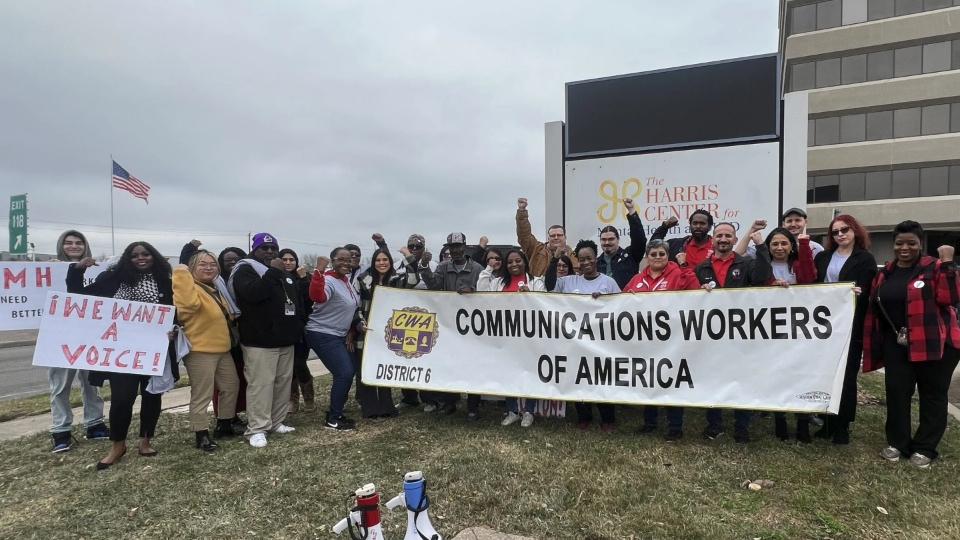
Image via United Workers of Harris Center-CWA Local 6154
HOUSTON—For the mental health workers at the Harris Center for Mental Health and Intellectual and Developmental Disabilities (IDD), the work is a calling. But for many, it’s also a financial struggle that forces them to hold two or even three jobs just to make ends meet.
In an interview with People’s World, Brian O’Reilly, a counselor at the Harris Center and member of United Workers of Harris Center-CWA Local 6154, described conditions on the front lines of Houston’s public mental health system as dire—and getting worse.
“Generally speaking, conditions are poor, and morale is low,” he said. “Many of our workers don’t make a living wage, so coming into work every day and not making enough money to support themselves can be exhausting, and it can make people disappointed to come in and do the job that they love.”
The Harris Center, a government agency in Houston, employs approximately 2,600 workers with a mission to assist those with behavioral health and developmental needs. But those workers are increasingly stretched to the breaking point.
Unsafe conditions, unrealistic caseloads
Brian said working conditions vary across the system, but some of the most harrowing stories come from inpatient psychiatric units.
“Our inpatient psychiatric technicians often have to provide their own PPE or they’re not provided with any PPE,” he said. “They work in unclean, unsanitary conditions. They don’t have backup because they’re so short-staffed, which sometimes leads to them being attacked or abused or assaulted.”
In outpatient clinics, the problem is different but no less crushing.
“The main problem that we hear from our members is constant unrealistic expectations,” he said. “Imagine yourself having a caseload of 150 people. It’s unlikely you’re gonna be able to take care of 150 people and manage that caseload effectively.”
Workers have reported caseloads ranging from 70 to 100 cases, with some service coordinators managing up to 53 clients per month across Harris County. The high turnover driven by low pay only adds to the strain on those who remain.
Union fights back
The United Workers of Harris Center is part of CWA Local 6154, which also represents mental health workers at Integral Care in Austin. The union won official recognition from the Harris Center Board of Trustees after two years of organizing.
Since public employees in Texas do not have collective bargaining rights, the union secured the strongest possible legal framework, including payroll deduction for dues, union representation in disciplinary hearings, and regular meetings with the CEO and board leadership.
Now the union is putting that framework to work. In July 2025, members held a week of actions—including a pay raise lemonade stand, a taco breakfast for shift workers, and a march on the board—demanding a $5,000 across-the-board pay raise and a $20 per hour minimum wage. The mobilization signed up 69 new members.
“We are trying very diligently to apply pressure to county commissioners’ court and state politicians,” Brian said. “The county commissioners court accounts for probably a quarter of our funding, and the state and the Fed account for the rest. The lion’s share of our grants come from the state government.”
The agency was forced to lay off roughly 180 workers in the fall of 2025. The mass layoffs were caused by the expiration of pandemic-era federal relief funds (ARPA) that had previously propped up local social services. Making matters worse, the Harris County Commissioners Court mandated a 10% budget cut for several county departments, including the Harris Center, while simultaneously increasing police funding.
This combination of expiring relief funds and local county tightening has left the remaining workforce stretched thin and is threatening to disrupt care and increase wait times for people in crisis.
Mental health care saves lives—and money
Brian stressed that mental health workers are essential not just for the people they serve, but for society as a whole.
“Not all wounds are seen from the outside,” he said. “A lot of people carry trauma and other mental health problems that we don’t always see from the outside.”
He also pointed to the economic argument: “We’re very important because we save the taxpayer billions of dollars every year by keeping people out of jails and out of prisons. I believe that mental health can do a lot to make this a safer and happier society.”
What to do
Brian urged the public to take two simple but powerful steps.
“The first thing that people can do to support mental health is to be open and honest about how they feel and about their own mental health,” he said.
Second, he called on people to use their political voice: “Write your elected Congress person and your local representatives and urge them to pay mental health workers with living wages.”
We hope you appreciated this article. At People’s World, we believe news and information should be free and accessible to all, but we need your help. Our journalism is free of corporate influence and paywalls because we are totally reader-supported. Only you, our readers and supporters, make this possible. If you enjoy reading People’s World and the stories we bring you, please support our work by donating or becoming a monthly sustainer today. Thank you!
CONTRIBUTOR