
Dan Wegmueller, a farmer from Monroe, Wisconsin, hit a low point in 2018. The family dairy operation, started by his grandfather in the 1930s, was struggling. To bring in extra income, he and his wife had decided to get into the Airbnb business. They planned to offer farm stays, complete with horseback riding, chores and fresh-from-the-farm produce and milk. People in the agricultural community — milk truck drivers, service providers — laughed at the idea.
“They didn’t think anyone would pay money for those things,” Wegmueller said. “At the time, we weren’t far enough into it to know if it would work. It was still an idea.”
Wegmueller reached out to someone he was close to, hoping for encouragement. The conversation did not go well.
“That person didn’t know how to talk to someone going through a personal crisis,” Wegmueller recalled. “As well-meaning as they were, they said everything wrong. It was horrible to be on the receiving end of that. It was a very dark time for me.”
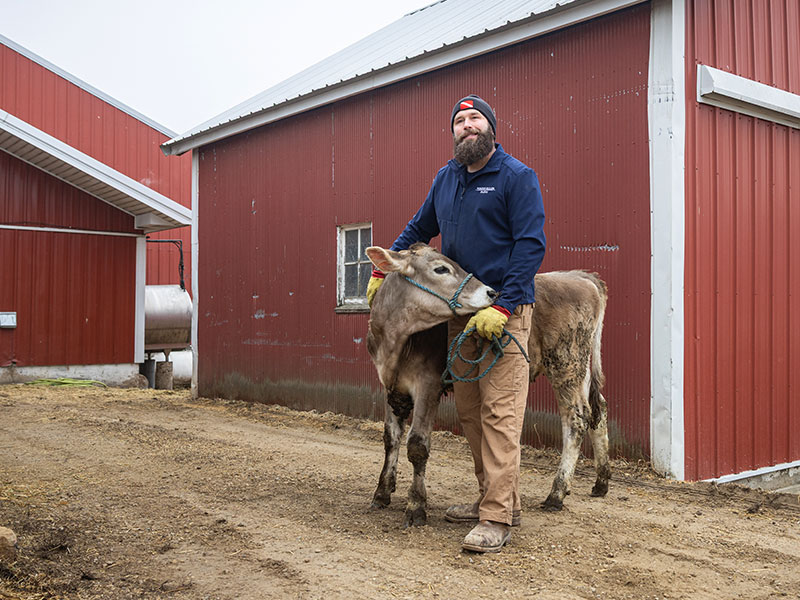 Dan Wegmueller
A wake-up call
A dark time can be a dangerous time. Over the last two decades, studies have shown that farmers are at least twice as likely to die by suicide as members of the general population. Between 2004 and 2018, there were 190 suicide deaths of Wisconsin farmers, according to a 2023 study led by Sara Kohlbeck, an assistant professor of psychiatry at the Medical College of Wisconsin. An additional 85 Wisconsin farmers died by suicide between 2019 and 2024, according to data compiled by Lindsay Emer, a public health researcher for the Wisconsin Department of Health Services.
In recent articles, The New York Times and the Green Bay Press Gazette cited financial instability and the possibility of foreclosure as key stressors for Wisconsin’s farmers. Accustomed to working hard and keeping silent about problems, many farmers don’t reach out for help. Those who do often don’t receive the support they need.
“Access to mental health resources across Wisconsin’s farming communities is in crisis,” said Amy Kind, associate dean for social health sciences and programs for the UW School of Medicine and Public Health, and executive director for WPP. “We recognized an opportunity to help.”
Commitment to rural health runs deep within the school, which offers rural health care training programs such as the Wisconsin Academy for Rural Medicine and is home to the Wisconsin Office of Rural Health.
Tackling the crisis Chris Frakes
In 2020, WPP awarded $1 million to the Southwestern Wisconsin Community Action Program (SWCAP) to address the growing crisis. These funds helped create Farm Well Wisconsin, an ecosystem of support to foster farmer resilience. Led by Chris Frakes, a senior director at SWCAP, the program set out to engage members of farming communities in southwest Wisconsin in mental health education and interventions to help prevent farmer suicide.
“We realized early on that the social connection piece is a protective factor,” Frakes explained. “We thought if we could bring farmers together in spots where they are already comfortable and sneak in some information about mental health, we could help them form protective connections.”
Frakes met Wegmueller at one of these outreach events. His crisis had passed, but the memory of it was vivid. He was drawn to Frakes’ efforts and approach.
“I could immediately see what Chris was working towards,” he said. “Formulating the right responses to people in crisis can literally save a life. That is the value of that kind of training.”
Wegmueller agreed to serve on a farmer wellness advisory coalition to discuss various interventions — what might work, what wouldn’t. That panel’s input helped Frakes to position Farm Well for further growth.
Rolling out suicide prevention efforts
Farm Well adopted a suicide awareness curriculum called safeTALK with a track record of success in rural communities. The model featured four-hour workshops attended by farm families and community members. From 2020 to 2025, Farm Well’s safeTALK sessions drew a total of 338 participants from across southwest Wisconsin.
Spouses, mothers, ministers, social workers, community leaders, and teachers signed up to learn how to ask the right questions and offer support to loved ones in crisis.
“SafeTALK requires some role play, which made people uncomfortable,” Frakes recalled. “You have to ask somebody, ‘Are you thinking of killing yourself?’ It is a hard question, but it is really important. We wanted to help people develop empathetic listening skills.”
As of December 2025, Farm Well’s safeTALK and other outreach programs had reached more than 1,200 participants from the five counties represented by SWCAP: Green, Grant, Lafayette, Iowa and Richland.