
SAN JOSE — Frustrated by the city’s still-heavy reliance on police officers to respond to mental health emergencies, the ACLU of Northern California and Silicon Valley De-Bug are pushing officials to resume talks to reach a resolution or risk being sued over the pace of progress.
The two civil-rights nonprofits say the leverage of potential litigation is the only option they have left after the city in December declined to move ahead with what is known as a Structured Negotiation Agreement; that pact is meant to bring the two sides, plus Santa Clara County, together to come up with plans and policies to have civilian responders take on more mental health emergencies.
In a letter sent to Mayor Matt Mahan earlier this month, Susan Mizner, director emeritus of the Disability Rights Program for the ACLU, urged the city to reconsider and pointed out that the county is participating in the pact. She also emphasized the urgency of the matter, citing city data showing that last year, nearly 2,500 emergency calls — where mental health issues were the primary driver — drew a police response.
That citation did not specify whether those calls had overlapping risks that might warrant a police presence, but Mizner noted that all of the parties are generally in consensus that more mental health calls can be dispatched to behavioral health resources and TRUST, the county- and community-backed team of civilian responders trained to de-escalate crises centered on emotional or psychiatric distress.
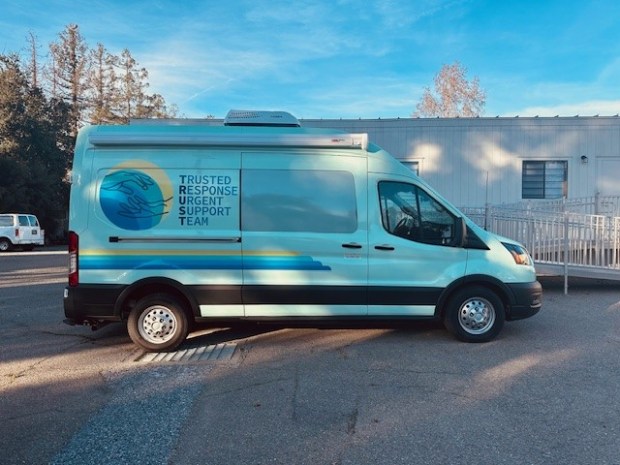 Pictured is a branded van used by the Trusted Response Urgent Support Team program in Santa Clara County. The program, which provides crisis response services without police intervention or partnering, has gotten a new direct phone line for residents in need of help with serious emotional distress and certain mental health emergencies. (Photo courtesy of Pacific Clinics)
“Some San Jose staff have suggested that the city would transfer more of these calls if the county’s crisis response teams had more capacity to respond,” Mizner wrote in the letter. “However, the city’s refusal to come to the table to discuss these issues is a real impediment to creating meaningful change.”
Mizner also cited a 2023 news investigation published by the Bay Area News Group, KQED and the California Reporting Project that examined a decade of use-of-force records from San Jose police and concluded that people who are mentally impaired — either by psychiatric illness or intoxication — accounted for nearly three-quarters of serious use of force incidents and 80% of police killings. The investigation helped spur efforts to create a direct phone line to the TRUST program for callers who explicitly wanted no police response to a qualifying emergency.
The city responded to an inquiry about the ACLU letter with a statement from City Attorney Susana Alcala Wood, who said “the city shares the goal of ensuring that individuals experiencing mental health crises receive appropriate, effective care, and we recognize the importance of continuing that work in partnership with our regional partners.”
Alcala Wood highlighted how the city has devoted resources to study and improve emergency call dispatching for “calls that may be better suited for non-police response,” as well as allocating funding to TRUST and similar county programs and publicizing the 988 crisis and triage line operated in the county.
She also reiterated the city’s position that the county is in the driver’s seat in terms of providing services like TRUST and the Psychiatric Emergency Response Team, a group of joint police-clinician teams assigned to mental health calls that pose serious safety risks.
“It is equally important to recognize that the county is the primary provider of health services including behavioral and mental health services for all residents in the city, and the availability and capacity of those services are critical to the city’s ability to do any expansion of non-police response,” Alcala Wood said.
She added: “We remain open to constructive dialogue that advances shared goals while also ensuring that any approach is legally sound, fiscally responsible, and operationally feasible. To that end, I have been in recent discussions with the attorney for ACLU to understand their request of the city and find a mutual path forward that doesn’t involve spending public resources on litigation rather than on connecting individuals to desperately needed services.”
That last remark drew a certain sense of irony from the ACLU and De-Bug, which is the client being represented in the letter. They argue that the whole intent of the pact sought by the groups — and to which the city declined — is expressly to create an non-court avenue to find relief.
“When the other side is essentially agreeing with you that there is a problem and they want it fixed, that’s a time when we have very productively used structured negotiation agreements,” Mizner said in an interview. “It involves getting people talking directly to each other who would otherwise only be talking through their lawyers. We found that can be much more productive in coming to solutions that are better for everyone.”
She also objected to the city’s position to defer to the county, noting that San Jose indeed has a hand on the wheel of the issue, by virtue of operating 911 dispatch and the police department in the county’s largest city. She contends the city can be sending many more mental health emergency calls to 988 and civilian response teams.
“As a basic barrier, it won’t matter how many mental health response teams the county has if the city’s 911 call center always sends police to mental health calls and doesn’t send the mental health response teams,” she said.
The ACLU letter concludes by giving the city an end-of-April deadline to re-engage in the proposed discussions with them and the county. De-Bug Co-founder Raj Jayadev said the necessity of the move is reflective of how well discussions on the issue are actually going.
“The fact that they kind of just ghosted us in the request for conversation, that is pretty consistent with the way the city has dealt with the basic question about, ‘Is there something else that we should be doing besides investing in policing that could serve our community?’,” he said. “There are irreversible consequences that have been happening in the background of the city not engaging urgently around really investing in and enabling a non-police crisis response. What that looks like is people who should be receiving treatment, and services and support, instead facing arrest, incarceration, and police violence. In some cases, those are lethal.”