
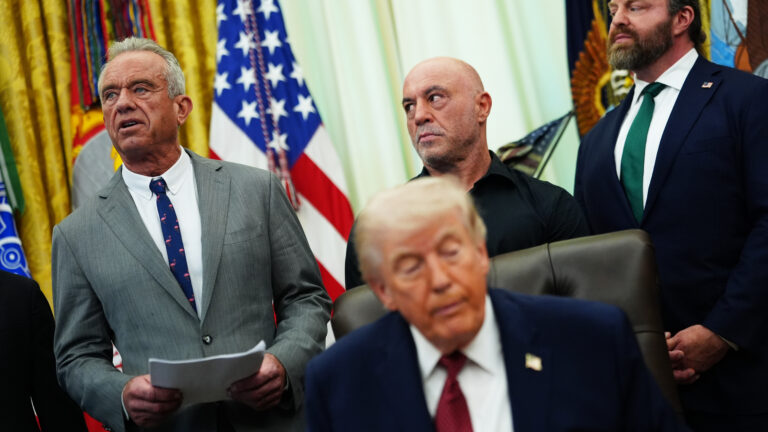
On Saturday, with podcaster and psychedelics fan Joe Rogan standing over his shoulder, President Trump signed an executive order intended to expand access to psychedelics for mental health treatment.
For some, it may come as a surprise to see a Republican president embrace psychedelics. But he’s only the most recent member of the GOP to hop on the psychedelics bandwagon.
In a June 2025 Washington Post op-ed, for instance, Rick Perry championed the psychedelic drug ibogaine — which Trump and Rogan have both specifically mentioned, too — as a revolutionary treatment for veterans and others suffering from trauma and addiction.
Soon after, a front-page New York Times article detailed Perry’s personal experience with ibogaine and recast him as a leader in America’s psychedelic revival. The former Texas governor and secretary of energy under the first Trump administration — who built his career on moral conservatism, budget-slashing austerity, and punitive drug policies — now urges lawmakers to embrace a “bold, bipartisan move” and funnel tens of millions into ibogaine research.
Across parts of the political right and the tech world alike, psychedelics are increasingly framed as transformative molecules capable of resetting trauma, interrupting addiction, or optimizing the brain. In some ways, Trump is a latecomer to this cause. Republican lawmakers including Dan Crenshaw and Morgan Luttrell of Texas, and Jack Bergman of Michigan have championed federal research into psychedelic therapies for veterans, introducing legislation that would direct the Department of Defense and the Department of Veteran’s Affairs to study compounds including ibogaine, MDMA, and psilocybin for PTSD, traumatic brain injury, and addiction. Texas itself has allocated tens of millions of dollars for psychedelic research initiatives focused on ibogaine.

STAT Plus: Trump order to advance psychedelic treatments generates excitement — and worries
On the surface, this unlikely conversion may seem like progress. For decades, the Republican Party sustained the war on drugs, supporting harsh sentencing and policies that treated addiction as a criminal problem rather than a health condition. Now some of those same circles speak enthusiastically about psychedelics as medicine.
But something essential is missing from this new enthusiasm.
We have both worked in addiction and psychiatric care for decades — one of us in long-term psychiatric services, the other in harm reduction and ibogaine treatment. We have seen psychedelics help people in profound ways. Ibogaine can interrupt opioid withdrawal. Psilocybin can loosen the grip of depression. MDMA can soften trauma. These compounds hold real promise and deserve careful research and thoughtful clinical use.
But psychedelics do not work in isolation. And the research on recovery tells a much less glamorous story than the headlines about breakthrough compounds.
The strongest predictor of sustained recovery from addiction is social support: stable relationships that provide belonging, accountability, and emotional care. People recover when they are held in networks of connection that reinforce a different way of living.
Closely following social support is what researchers call recovery capital. Recovery capital refers to the total resources a person has available to build and sustain a sober life: safe housing, employment opportunities, access to health care, supportive family relationships, and communities that make recovery possible rather than fragile. It includes not only social connections but also the material conditions that allow those connections to stabilize a life.
Recovery capital is the scaffolding to ending problematic use and behaviors. Without it, even the most promising treatment struggles to take root.
Research on recovery from serious mental illness, trauma, and PTSD points to many of the same factors. Psychiatric rehabilitation studies consistently show that social connection, stable roles such as work or meaningful activity, and community inclusion strongly influence whether people stabilize and rebuild their lives after psychiatric crises. The same social resources that support recovery from addiction — relationships, purpose, and access to material stability — also shape recovery from trauma, brain injury, and other behavioral health conditions.
This is where the current political embrace of psychedelics becomes deeply contradictory.
Trump, Perry, and many of the other figures now promoting psychedelic therapies have supported sweeping tax and spending legislation that strips away the very forms of recovery capital the research shows are essential. The Republican tax and budget framework known as the “One Big Beautiful Bill” will cut more than $1 trillion from federal programs including Medicaid and food assistance over the coming decade. These programs fund addiction treatment, mental health care, housing stability, and basic economic security for millions of Americans.
These policies do not merely trim abstract programs. They remove the material conditions that sustain recovery from addiction, and mental and physical health problems.
Strip these away and recovery becomes dramatically harder, regardless of what pharmacological tools exist.
The contradiction becomes especially stark in the way veterans are invoked in the psychedelic conversation. Lawmakers such as Crenshaw, Luttrell, and Bergman frequently frame psychedelic research as a lifeline for veterans suffering from PTSD or traumatic brain injury.
Yet the same political agenda supports budget priorities that weaken the broader safety net veterans rely on when they return home: health care services, housing support, food security programs, and community-based behavioral health systems.
I took part in a 2012 psilocybin trial. What I’m seeing now horrifies me
You cannot detox a veteran with ibogaine and then send him back into housing insecurity, understaffed mental health systems, and shrinking social support. That is not innovation. It is abandonment wrapped in the language of breakthrough medicine.
There is also a broader social context that cannot be ignored. Decades of research across sociology and public health show that exclusion — whether driven by economic inequality, social marginalization, or barriers tied to race, class, or gender — contributes to psychological distress and substance use. The same conditions that push people to the margins often make recovery harder, because they limit access to housing, employment, community belonging, and health care. Policies that deepen those forms of exclusion do not simply shape economic life; they shape who has a real chance to recover.
Decades of research also point to broader structural forces that shape who develops these struggles in the first place. Exposure to violence, incarceration, prolonged poverty, and social exclusion all increase rates of addiction, trauma-related disorders, and mental illness. The military itself reflects these patterns: Recruits are disproportionately drawn from minority communities, and from poor and working-class households, where the promise of stable employment, education benefits, and upward mobility makes service one of the few available paths forward.
Yet many return from war carrying the psychological consequences of combat — including PTSD, traumatic brain injury, and moral injury — often reentering the same communities that already lack adequate behavioral health resources. At the same time, decades of punitive drug policies and mass incarceration have destabilized families and neighborhoods across the country. These forces do not simply determine who needs treatment; they shape whether recovery is even possible.
Estimates suggest that between 25% and 40% of returning service members carry these less visible neurological or psychological injuries, while hundreds of thousands have been formally diagnosed with PTSD or traumatic brain injury in the years since the wars in Afghanistan and Iraq began. When lawmakers champion treatments for veterans while supporting budgets that prioritize military spending over the social infrastructure veterans and civilians alike depend on, the gap between rhetoric and recovery grows even wider.
Treating trauma while ignoring the social and political conditions that generate it risks turning medicine into a repair shop for problems our policies continue to produce.
Perry’s own story illustrates another dimension of the problem. His experience with ibogaine appears to have been meaningful, and it must have taken courage to discuss it publicly.
But Perry returned from that experience to a life already rich in recovery capital: financial security, access to health care, stable housing, and social influence. And he spent decades supporting policies that weakened the very systems that provide them. As governor of Texas, he rejected Medicaid expansion and oversaw cuts to mental health and social service systems.
His successor, Texas Gov. Greg Abbott (R), has continued many of the same priorities: declining Medicaid expansion, leaving Texas with the highest uninsured rate in the country, and overseeing a mental health system that ranks near the bottom nationally in access to care.
At the same time, Abbott has become one of the most prominent political backers of ibogaine. In 2025, he signed legislation committing $50 million in state funding to what is now the largest publicly funded psychedelic research initiative in the country, aimed at treating addiction, PTSD, and traumatic brain injury.
Politicians like Trump, Perry, Abbott, and other right-leaning advocates of psychedelics are not arriving at this view on their own. The idea that these substances can function as near stand-alone solutions has been shaped, in part, by the way psychedelics are often discussed within the field itself. Across the landscape, a narrative has taken hold — often advanced by some of the movement’s most visible leaders — that emphasizes compounds, protocols, and neurological mechanisms. Venture capital and pharmaceutical models follow naturally from this framing. Clinical trials focus on molecules. The story becomes one of breakthrough chemistry capable of resetting the brain, rather than of the relationships and social conditions that make change sustainable.

STAT Plus: Over-the-top psychedelic promos could undermine the field’s drug development efforts
Public figures have helped accelerate this narrative. Rogan, an outspoken proponent of ibogaine who was present at the signing, has repeatedly described it as capable of interrupting addiction in a single experience, particularly for veterans. Widely seen as having significant influence with Trump — and by some accounts as a key force in bringing ibogaine into the administration’s orbit — Rogan has helped elevate these claims into political conversation.
These ideas have circulated widely, often turning possibility into certainty in the public imagination. While early studies and clinical observations suggest ibogaine may reduce withdrawal symptoms and cravings, the research remains limited, with small sample sizes, little long-term follow-up, and significant medical risks still under study. The gap between what is currently supported by evidence and how these substances are often described reflects a broader tendency to treat them as near stand-alone solutions, rather than as tools whose effects depend on the conditions in which they are used.
This framing carries real consequences for the people most in need of care. Someone seeking relief from addiction may spend everything they have to access a treatment like ibogaine, often traveling far from home, drawn by the promise of a decisive break from use.
When that promise is not realized — or not sustained — they may return not only to the same conditions that shaped their struggle, but with fewer resources, diminished support, and a deepened sense of personal failure. Without preparation for the possibility of relapse or continued vulnerability, they are left more exposed, not less, to the risks of further use.
Anyone who has worked seriously with psychedelics knows that outcomes depend profoundly on the surrounding context — the therapeutic alliance, the environment in which the experience unfolds, and the relationships that hold a person afterward. Psychedelics amplify connection. They open memory and emotion. They heighten sensitivity to the people around us.
But they cannot replace the social conditions that make healing sustainable.
By allowing the public story of psychedelics to become a story primarily about molecules, the movement itself has become vulnerable to a political interpretation that fits neatly within an older ideology: technological solutions paired with social disinvestment. If the molecule is the hero, we do not need housing policy. If trauma can be reset chemically, we do not need to rebuild communities. If addiction can be interrupted pharmacologically, we do not need to invest in the slow, relational labor of care. Healing becomes something a compound does to an individual brain.
If psychedelics are to enter American medicine responsibly, they must arrive alongside something far less glamorous but far more important: reinvestment in the social foundations of recovery. Housing. Healthcare. Community mental health systems. Long-term therapeutic relationships. Economic stability. Restrained foreign policy.
Because the research is clear about one thing: Recovery is not primarily a pharmacological event. No psychedelic compound, no matter how powerful, can substitute for the human connections and material stability that recovery requires.
Ross Ellenhorn, Ph.D., is a sociologist, psychotherapist, and the founder and CEO of Ellenhorn, a psychiatric program with offices in Boston, New York, and Los Angeles. His most recent book is “Purple Crayons: The Art of Drawing a Life.” Dimitri Mugianis is a writer, harm reduction activist, and psychedelic practitioner with years of experience working with ibogaine, featured in the documentary “Dangerous with Love.” Together, they are the founders of Cardea.