
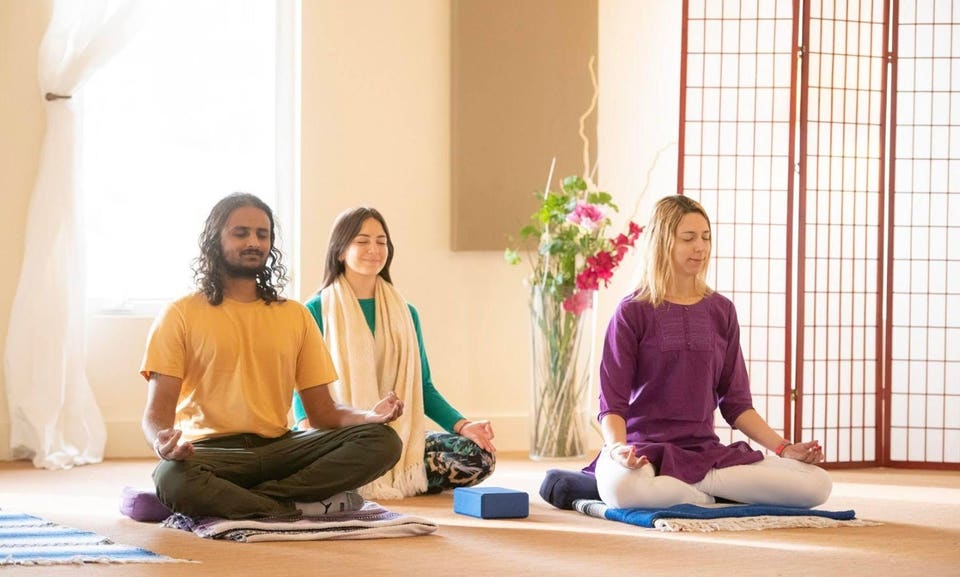
Art of Living is bringing SKY Breath to the workforce.
Courtesy of Art of Living
For decades, the modern American workplace has told us that if we perform better, work faster, think smarter, listen harder, collaborate better, that success and job security, even happiness, would follow. Workplaces are often riddled with anxiety and contribute to one’s overall mental health. Now, more of the workforce wants and expects a more balanced work environment that supports their overall wellbeing.
Long before burnout became a headline, the Art of Living Foundation has been dedicated to a singular global mission of creating a stress-free, violence-free society. As anxiety and burnout reshape American work, the organization is helping leaders and employees refocus on what it sees as the lever for managing modern stress and improving work performance through our own nervous system and breath.
Mental health is no longer episodic but persistent, cumulative, and deeply woven into how we live and work. The data confirms what many already feel. 35% U.S. workers say their job harms their mental health, and roughly 50% report feeling used up, emotionally drained, or burned out from work. Beyond work, nearly one in five U.S. adults lives with a mental health condition, according to the National Institutes of Health.
A Biological Lever for Stress: SKY Breath
The Art of Living’s premise is simple: stress isn’t just psychological, it’s biological. And biology can be shifted, often through something as simple as the breath. The Art of Living’s foundational breathwork program, SKY Breath, is redefining breathwork not as a wellness luxury but as a practical, science-backed tool for regulating the nervous system. “The challenges in today’s workplace are not merely external; they arise from a restless and overburdened mind,” says Gurudev Sri Sri Ravi Shankar, founder of the Art of Living. “Our goal in developing SKY Breath was to give people a direct experience of stillness through the breath and a practical tool to achieve their success and goals, whether it is work or personal,” he adds.
Sky Breath has been shown to improve mental health in the workplace.
Courtesy of Art of Living
The idea is simple: interrupt the chronic fight-or-flight state that so many people live in through SKY Breath’s structured, rhythmic breathing. By doing so, the body creates the physiological conditions for emotional regulation, clear thinking, and resilience. In simple terms: when the body feels safe, the mind can finally change. The Art of Living Foundation’s programs are now taught by more than 50,000 instructors across 182 countries, with its core SKY Breath practice increasingly embraced by corporate leaders, employees, and students across the U.S.
From Pressure to Agency
While the mental health strain of modern work and life affects everyone, women, especially those in leadership, consistently report higher stress, burnout, and more negative mental health impacts from their jobs. Gallup data shows that over half of working women feel stressed for much of the day, significantly more than men.
For women navigating the layered, compounded pressures of leadership, SKY Breath shifts the body out of chronic fight-or-flight, creating the conditions for agency under heightened expectations and scrutiny. That internal shift can change not just how women feel but how they lead.
Women in leadership tend to suffer from more stress in the workforce.
Courtesy of Art of Living
Rathi Murthy, former CTO of Gap Inc. and current CTO of Varo Bank, spoke at the Art of Living’s 2026 International Women’s Conference in Washington, D.C., held in recognition of International Women’s Day, “SKY Meditation has been a transformative force in my journey as a woman leader in the tech industry. In a space that often demands resilience, adaptability, and clear-headed decision-making, it has provided me with invaluable tools for stress management and self-reflection.”
In Art of Living’s leadership programs, women define empowerment not only in structural terms like pay equity, but as an internal state, confidence, authenticity, and the ability to speak up. “To be empowered is very much an internal state of being, having confidence, presence, clarity, being natural and grounded. The breath and meditation enable women to tap into this power easily,” says Jennifer Stevenson, Head of Training for Art of Living Corporate Programs.
The Results Behind the Breath
Across more than 189 studies compiled by the Art of Living and conducted by over 40 institutions, with the majority independently led, the findings point in a similar direction. In a study of corporate managers, participants reported stress fell 28% and anxiety 29% within a single week of practice. Among healthcare workers, participants reported reductions in work exhaustion of 34% and negative emotions of 23%.
Before entering the workplace, college students reported reduced perceived stress, while high school students showed lower cortisol levels and fewer poor mental health days after 10 months of practice in another study. Denitza Stantcheva, Senior Program Advisor at Harvard Business School Executive Education, notes that even in executive education settings, the impact is being seen: “At Harvard, individuals who practice SKY report greater resilience in responding to challenges, improved focus, and stronger relationships.” The same effects are seen beyond the workplace in other high-stress environments and underserved communities where the Art of Living Foundation has brought SKY Breath, from veterans’ programs to prison systems. In one trial, veterans with PTSD reported a 32% reduction in depression within six weeks.
From Margin to Mainstream
Breath and biology are now entering the global institutional psyche. Gallup has announced the first initiative to measure meditation practices around the world, in collaboration with the Art of Living Foundation, building the first representative dataset on the impact of meditation.
Sky Breath can bring the body out of flight or fight.
Courtesy of Art of Living
“We’ve been measuring the problem, but not the solution,” said Jon Clifton, CEO of Gallup, speaking at a World Meditation Day event hosted by the Art of Living Foundation. “We’ve been measuring the noise, but not the silence.” Ravi Shankar has long argued that inner stability and outer peace are inseparable, an idea now reaching institutional scale. “Inner peace,” Gurudev says, “is not separate from outer peace.”
In today’s work culture that tries to optimize everything, the next frontier may be far more personal, even biological, providing the ability to meet the pressures of modern work and life through breath.