
By Jessica Whiteside, Contributor
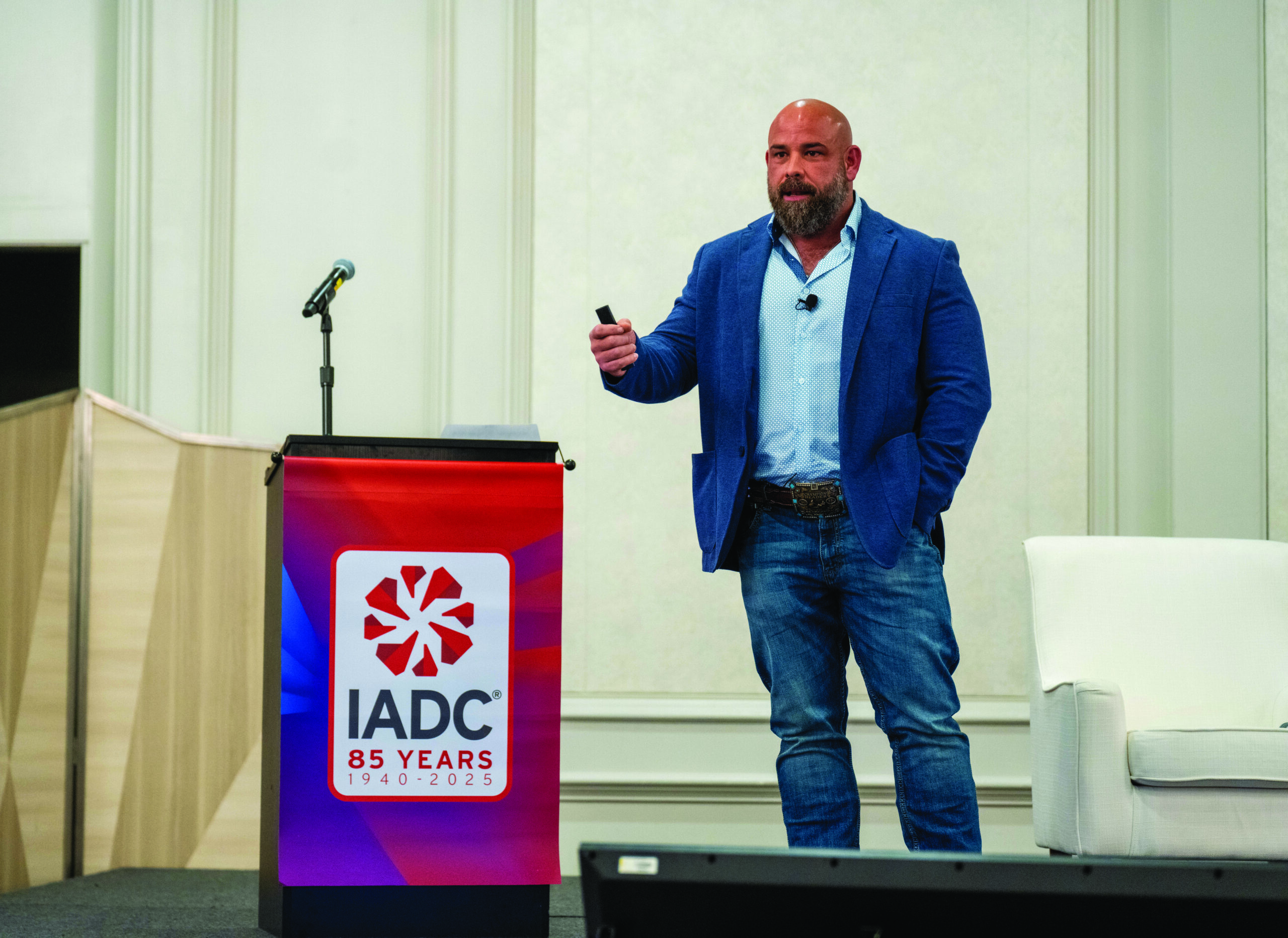 Keeley Bell, Senior Drilling & Well Control
Advisor with Noble, shared his personal
journey with physical discipline and
mental resilience during a presentation
last year at the IADC Annual General
Meeting, held in Naples, Florida.
It took three heart attacks to set Keeley Bell on a path to finding a healthier approach to work and life. Now, he’s on a mission to help rig crews and their employers make the connection between physical and mental health and safe, efficient operations.
“The toughest battles that we have in our industry are not fought with steel and machinery. The toughest battles we have are fought within the mind of our people, and we are not focusing on it,” he said during a presentation on building mental resilience through physical discipline at last year’s IADC Annual General Meeting in September.
Mr Bell is a Senior Drilling & Well Control Advisor with Noble Corp and a certified mental performance coach. During his more than 20 years in the drilling sector, he’s seen how failing to take care of your body – whether through insufficient exercise, an unhealthy diet or substance abuse – can exacerbate mental health issues and contribute to costly errors in the workplace. He sees physical discipline as one of the fastest ways to upgrade mental performance, giving your mind the stability it needs to handle the pressures of the job.
“We talk safety, we talk performance, we talk efficiency, but it means nothing if our people are broken,” he said.
Grasping the sector’s mental health problem
Long shifts, harsh conditions, isolation and the burden of responsibility take a toll on rig workers. Numerous studies have explored the extent of mental health concerns in the oil and gas industry. Research published in 2019 in the journal Occupational Medicine showed that almost 15% of employees surveyed at an offshore oil and gas company in the Middle East reported symptoms of anxiety and depression.
A global study commissioned by the International SOS Foundation and published in 2021 looked at mental health in industries reliant on offshore and onshore rotational workers, including oil and gas. More than half reported that their mood and mental health suffered while on rotation. Nearly one-third met the criteria for clinical depression, and 40% had experienced suicidal thoughts while on rotation.
The suicide rate for US oil and gas extraction workers reached 73.9 per 100,000 workers in 2021, more than double the national average for the civilian, non-institutionalized working population, according to the US Centers for Disease Control and Prevention.
Battling stigma
Workers in the oil and gas, drilling and wells, and marine and shipping sectors were more likely than workers in other sectors in the UK’s North Sea energy industry to agree that accessing mental health support could negatively impact their jobs, according to a report by Step Change in Safety published in 2025 in partnership with Mental Health in Energy and the Marine Safety Forum. In a sector with a largely male workforce and oftentimes a traditionally “macho” environment, it can be challenging for rig workers to seek help, as highlighted in a 2023 report on changing the industry’s approach to mental health issued by the IADC North Sea Chapter.
“I was one of those people for years,” Mr Bell said, calling mental health in the industry “a taboo topic” that nobody wants to talk about.
However, the return on investment from providing mental health support is “massive,” he said. Some research suggests employers earn a more than four-to-one return from investments in mental health initiatives through reduced costs and increased productivity. Other research has found retention goes up by as much as 79%.
“I’m challenging you as a leader or as a person at your company to move forward and take a different step,” Mr Bell said. “Our people are our greatest asset. It’s time to protect and strengthen them, not just think of them as replaceable equipment. And I hope that stings just a little bit.”
Investing in physical discipline: five fundamentals
Mr Bell views mental resiliency as a skill that can be trained. He recommends five fundamental steps for developing the physical discipline workers need for strong mental performance in a high-pressure environment: get enough sunlight, sleep, nutritious food, exercise and water. These steps don’t reinvent the wheel, he said, but they are simple ways to build health and get your mind where it needs to be, in part by reducing high cortisol levels associated with stress and impaired decision making, situational awareness, communication and memory.
Sunlight
“Sunlight is your body’s natural antidepressant. It releases serotonin, which gives you energy,” Mr Bell said. “It also regenerates your circadian rhythm, which is your natural body clock.”
Sunlight has the benefit of being free. One easy way for leaders to help offshore teams get more sunlight: When the heliport is not in use, make it available for outdoor exercise, he suggested.
Sleep
“Sleep is the most missed thing that we have in the offshore industry,” Mr Bell said, describing it as important for the body to heal and gain mental clarity.
Disrupted sleep is a particular problem for workers that monitor screens emitting blue light. This exposure can disrupt their circadian rhythms, especially for night-shift workers. Supplying blue light glasses to workers whose jobs require significant screen time is a strategy now employed by two of Noble’s rigs in Guyana, and their performance is picking up as rig crews get better sleep, Mr Bell said.
Nutrition
He recommends that companies provide their crews with healthier menu options because “nutrition feeds the mind.”
“It is hard on the rigs, I get it. And we can’t force them to do it,” he said. “What we can do is provide options. Here’s a clean section, here’s your pizza section – but give them the option.”
Exercise
People are built to sprint, walk, lift, hinge, push and press – even walking 10 or 30 minutes a day is beneficial, Mr Bell said, calling exercise a natural stress relief. He points to yoga as an exercise that both challenges the body and clears the mind.
The leaders on some of Noble’s rigs have begun setting up physical challenges for their crews – for example, a push-up challenge one month and a rig run the next – with a reward for the winners. The goal is to challenge crews to do something new every month, helping them build positive habits they can continue on their own, on and off the rig, Mr Bell said.
Water
Dehydration is a common concern in the industry, and healthy hydration helps workers gain the mental clarity they need to make split-second decisions, Mr Bell said.
He recommends preparing for the day by drinking water first thing – before your morning coffee. He also urges rig leaders to promote the consumption of water over more sugary beverages.
Giving hope with a personal story
During his own time offshore and sometimes at home, he was going to very dark places, Mr Bell said. He was 41 years old, on 13 medications and had already had three heart attacks. He began focusing on the five fundamentals and now celebrates a new set of numbers: He’s 45, is on zero medications and is four years sober.
He shares his personal journey when he speaks to rig leaders and crews about the importance of physical discipline in mental resilience. He feels that his message connects with crews because he’s lived in their shoes and experienced the same pressures. After one session, a worker pulled him aside and confessed, “I’m struggling, man.” He’s not alone.
“Our people are our No. 1 asset, and it is time to make them feel that way because they’re struggling emotionally, physically and mentally,” Mr Bell said. DC