
Whatcom County Council is gearing up to set a $225 million budget cap to design the new county jail and behavioral crisis center.
Council members are considering a split of $205 million for the jail and $20 million for the behavioral crisis center. Discussion on a resolution currently being drafted is expected during the council’s criminal justice committee meeting on Tuesday, April 28.
The cap is meant to give designers a dollar figure for what the jail and crisis center could look like, the services that can be provided within the facility, and general construction costs. It’s not meant to act as a formal finalized budget.
But running parallel to the budget cap discussion is a sense of tension for the county and its citizens over what the project can actually include inside its walls.
In 2023, Whatcom County voters approved the construction of a jail and behavioral crisis center through a 0.2% sales tax. The current Whatcom County Jail is an aging facility from the 1980s that quickly became overcrowded and has little, if any, mental health support for those in custody going through a behavioral health crisis. The new jail, described as “therapeutic,” would include more space for substance abuse disorder programming, possibly two courtrooms, and design choices that allow more natural light into the building.
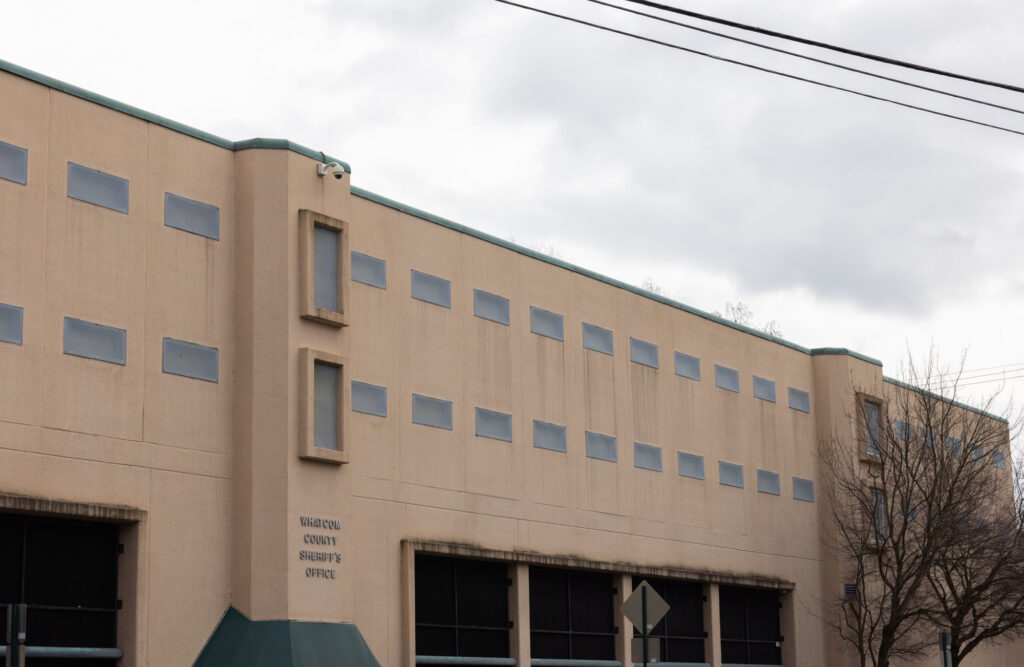 The Whatcom County Jail and the sheriff’s office in Bellingham, shown in January 2025. (Finn Wendt/Cascadia Daily News)
The behavioral care center will be a new model of inpatient mental health care. Community members and those in custody at the jail looking to be diverted from the criminal justice system would be able to use the facility.
As part of the tax ordinance, the county was directed to enter into negotiations with the seven cities in Whatcom County regarding bond repayment for the facilities and a portion of funds, ideally 50% at a minimum, to incarceration-prevention services.
That resulted in an interlocal agreement signed by the county and cities in April 2024 that put the cities on the hook for four to six years of debt payments before 50% of revenue switched to fund community services — something colloquially referred to as the 50-50 split.
But revenue projections from 2023 do not match the reality on the ground today. Rising construction costs, inflation and now, rising fuel costs and interest rates resulting from a U.S.-driven war in Iran, have slowed tax collections. Those factors also limit what the county can realistically accomplish after telling voters that portions of the funds would go toward a therapeutic jail setting and increasing incarceration reduction programs and other services.
“Either we can overly constrain this budget to a point where we’re not going to meet any of these goals that folks are setting or we can spend all the money on the jail and have none of the community services,” said Kayla Schott-Bresler, Whatcom County deputy executive, in an interview with Cascadia Daily News. “What we’re trying to accomplish is to land somewhere in the middle.”
But some community members and council members are hesitant to fully jettison the 50-50 goal.
During a council meeting on April 14, council member Jon Scanlon said that in any potential jail budget he looked at, he wanted to see as close to a 50-50 split as possible.
“We can have that conversation about what is possible at an amount that gets us closer to what I believe was an original commitment to voters and taxpayers of this county,” he said.
Meanwhile, council member Ben Elenbaas at the same meeting shared his concern of the split, saying it constrained the entire justice project.
“I think we have a good overall plan, and we’ve committed to doing the behavioral health and we are obliged by all of these laws to provide a jail,” he said. “I wish we could frame this conversation around ‘this is the plan that we have, these are the pieces of infrastructure that we feel we need to execute the plan.”
While the county recognizes its fiscal constraints and that the interlocal agreement needs to be renegotiated, Schott-Bresler said, it’s not backing down from the community service funds.
By 2058, should revenue projections pick up, 52% of the justice tax funds would be going toward community services, according to the county.
“It’s not about throwing the 50-50 out the window,” Schott-Bresler said. “I feel like I’m standing by the road with a neon sign saying you can’t have both of these things exactly, so where do you want to land in the middle to get to a reasonable decision?”
Annie Todd is CDN’s criminal justice/enterprise reporter; reach her at annietodd@cascadiadaily.com; 360-922-3090 ext. 130.