
When I line up for my first marathon tomorrow, I’ll be wearing the same trainers I wear every day: for the gym, for running, to and from work, and out on the weekends. In fact, I’ll have spent no money on fancy kit, training plans or tech — just a tenner on a bright orange vest in support of Calm (the Campaign Against Living Miserably), the suicide prevention charity.
Having been a spectator in previous years, I know how much standing out helps supporters to catch sight of you and belt out your name. And I want every penny to go to a charity whose services I’ve leant on before, and wish had been able to save friends who have taken their lives.
Two people close to me were lost to suicide in the past year — painful reminders that it remains the biggest killer of men under 50. I’ll be running the 26.2 miles across my home town of London in their memory, hopefully in under four hours and without the aid of any fancy footwear.
Part of me wonders if resisting a spending splurge and making the whole experience deliberately harder for myself is to make it feel like an even more impressive feat.
Having been diagnosed with depression at 13, I spent years in and out of therapy, and was signed off sick with anxiety and depression for three months just after I’d started my dream job ten years ago. So I’ve come to learn how much more punishing mental pain can feel than physical.
There have been many low moments. Some days a mixture of depression and anti-anxiety medication, designed to numb you so much you can’t do anything stupid, prohibited me from getting out of bed.
On one particularly bleak occasion in 2016 I collapsed on the pavement outside London Bridge train station and lay sobbing, unable to move or think straight, until a stranger picked me up, dusted me down and sent me on my way home.
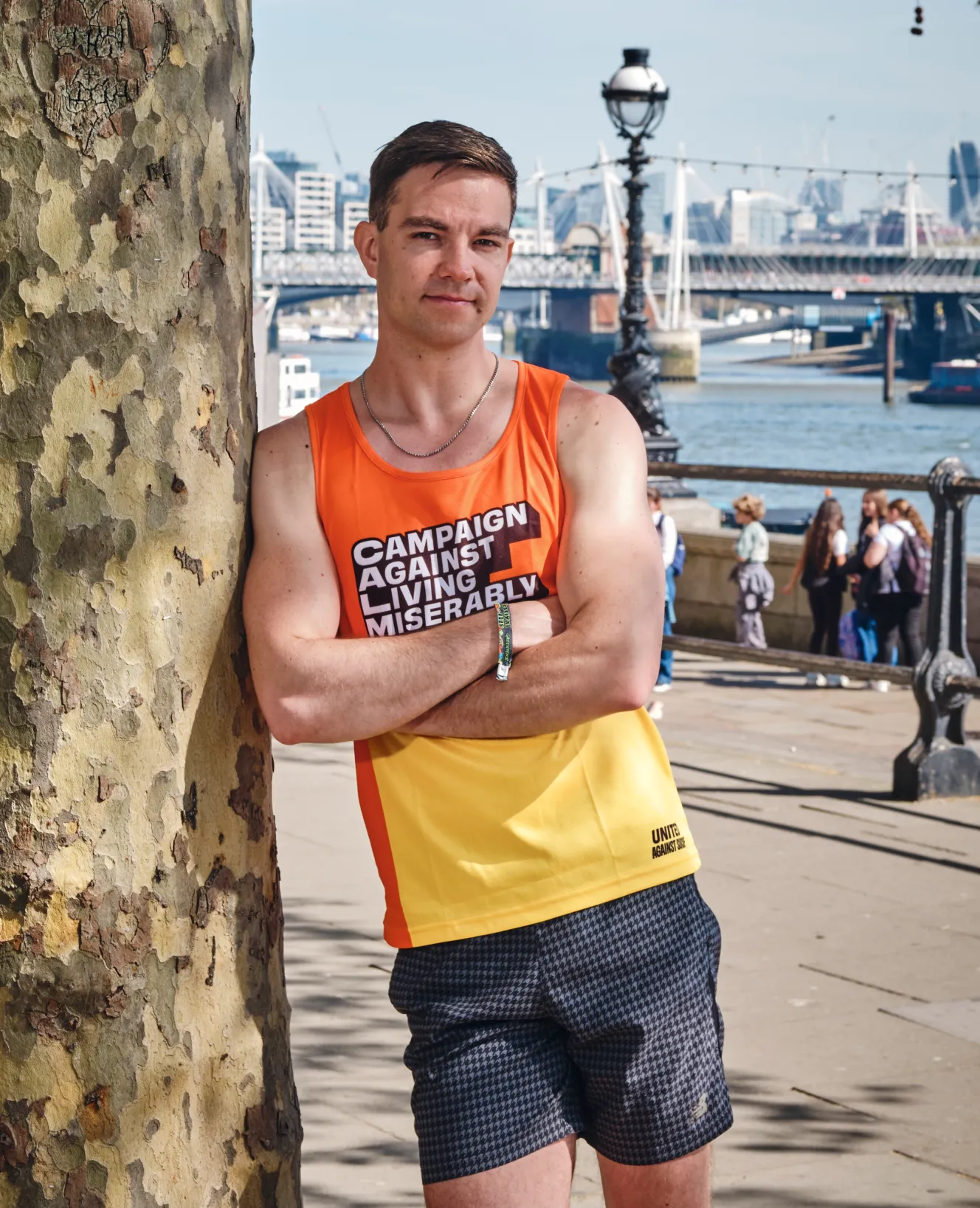 “Running is no replacement for medication or therapy, but it became an important crutch for me”CHRISTOPHER L PROCTOR FOR THE TIMES
Through a combination of support from Calm’s helpline, therapy and medication over the following two years, I found the self-belief and purpose to work every day to keep myself alive.
I only decided to run the marathon last autumn, when the familiar dark thoughts returned and my antenna alerted me to the warning signs that usually precede an episode of depression.
I was struggling to find the right time to process negative thoughts. Whether in the pub with friends or during quiet moments by myself, grappling with the reasons I felt hopeless often made me feel worse and just led to a spiral. Running was the only time I felt mentally equipped to let my brain loose on itself.
I’d done some running previously — including a couple of half-marathons — but they were both pre-Covid, and I never imagined I’d ever be capable of running a full one. Schlepping around St James’s Park next to my office on cold, dark January evenings gave me a sense of accomplishment and achievement.
I used my three training runs a week as my safest space to think — the only times I would deliberately let my thoughts stray, gently unpack reflections and turn them over in my head.
The self-confidence I gained from each session, whether 20 minutes or three hours, built up a mental resilience I came to rely on.
As this paper’s chief political correspondent, and someone often deeply engrossed in their phone, I struggle to retain the mental attention for mindfulness exercises. But running forces me to go screen-free.
I started using my runs to do “colour matching” — concentrating on noticing items or foliage of one particular shade — a common technique to calm a busy, uncontrollable mind.
Similarly, I would take mental notes of things I might have otherwise walked by that I could find small joys in: humorous T-shirt slogans on fellow runners, cute dogs.
Running is no replacement for medication or therapy, but it became an important crutch for me as life threatened to lose its meaning again. Completing the marathon felt like the only thing I really had to aim for. Doing so without spending any money only added to the challenge.
It was as a student that I first learnt how much more frugal I was than my peers. When the soles of my trainers wore thin, I didn’t buy another pair. I put a carrier bag over each sock to keep my feet from getting wet, then two, before eventually upgrading to a thicker “bag for life”.
I now see that I was possessed by a fear of financial insolvency. I refused to spend the roughly £50 it would have cost for a new pair of shoes, despite working a 30-hour week for above the minimum wage with a healthy maintenance grant and bursary.
When I signed up to run the London Marathon, friends suggested I fork out more than £100 on shoes with incomprehensible foam measurements that would apparently complement my gait — but my innate resistance to splurge won out.
Besides my old trainers (and even they were a present from my mum, still scarred from the “bags in shoes” days), my running shorts are borrowed and the odd energy gel has been gifted from runner friends.
While they subscribed to apps and purchased training plans, I’ve relied on the free version of Strava to monitor my pace and distances. Similarly, the free-to-use version of ChatGPT devised my 16-week schedule of interval, long and recovery runs.
After my relationship ended last year, the only thing I did need to buy were pairs of cheap white socks to replenish the shared wardrobe my partner and I had built up over nearly a decade.
My refusal to spend on the equipment and tech my friends tell me would make the ordeal easier has certainly made it harder. But I feel strangely ready — to run in memory of my dead mates and to raise money to help to stem the scourge of suicide.
I used to retort that the ancient Greeks didn’t need any of today’s gadgets, until one friend rebutted that the only other universally known thing about the original marathon is that, as legend has it, the man who ran it dropped dead at the finish line.
So now I just say I’m stubborn, and that long-distance running should not be about inoculating yourself from all physical pain but that can instead be part of the reason you’re doing it: to remind you of the power of mental strength.
And that, so far, it’s the hardest battles I’ve emerged most strengthened by.
To donate to Aubrey’s marathon fundraiser for Calm, visit 2026tcslondonmarathon.enthuse.com
‘I started running as an antidote to grief’
By Jamie Doward
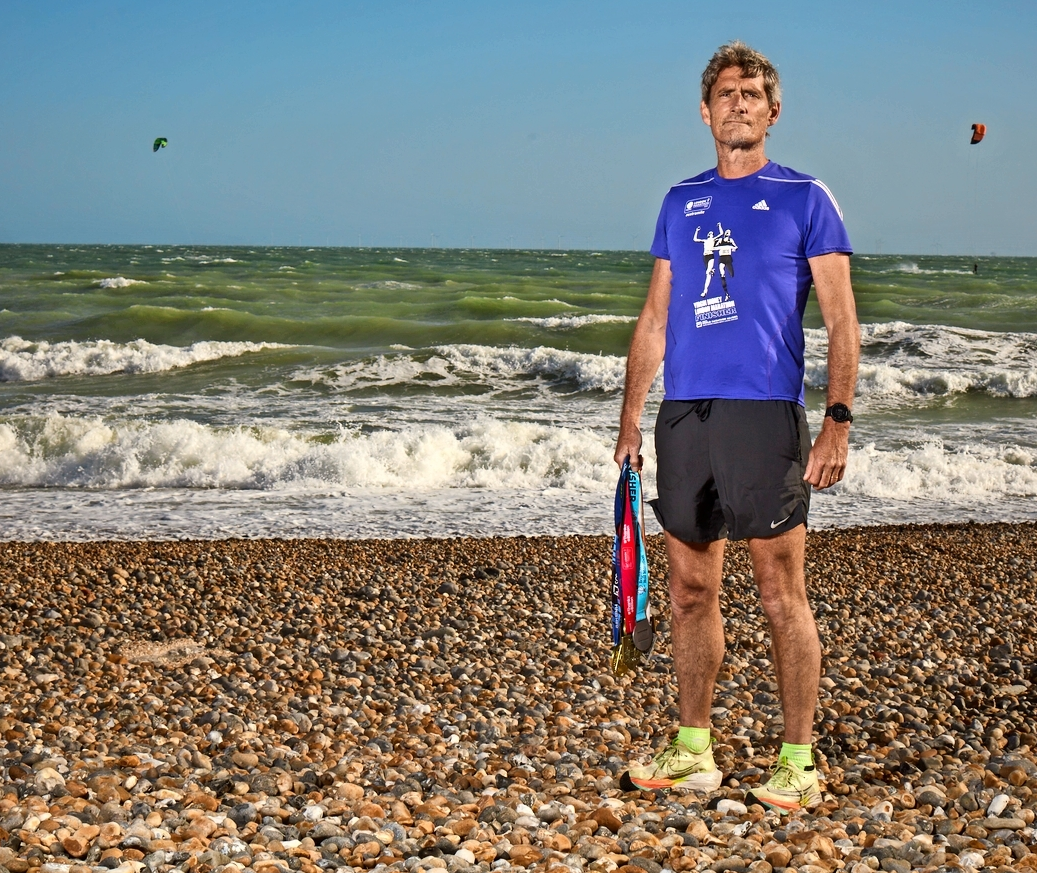 Jamie DowardJude Edginton for The Times Magazine
The definition of insanity according to a quote wrongly attributed to Albert Einstein is doing the same thing over and over again and expecting a different result.
Well, on Sunday, injury scare permitting, I’m running the London Marathon for the 12th time knowing full well the result of more than 20 weeks of effort: I will fail to bag a half-decent time and come up short — again.
It’s the same story every year. And yet each April I return to the scene of the crime like some old bank robber who promises to do one more job before calling it quits. I just can’t break the marathon’s spell.
At the age of 53, the London marathon has become a mirror on my life and a rapidly changing world. The first time I ran it, a younger me and a younger London basked in the glory and optimism of the 2012 Olympics; the next year was a subdued affair following the terrorist attack in Boston; in 2016 I ran it with the astronaut Tim Peake, who completed it virtually on the International Space Station. There was the awful one, the hottest on record (2018, when it was 24C), and the emancipatory one — the autumn London Marathon of 2022 when we emerged delirious from the pandemic, giddy from our newfound freedom.
Then there was the time I ran it “virtually” around the Eton boating lake when we were coming out of lockdown, and the time I tried to run it solo around Hampstead Heath running track in the small hours when it was cancelled because of the pandemic (I stopped after 26km, so far my only Did Not Finish). I know the course as intimately as my home — the places where I will find joy, pain and despair; the roar of the crowd on Tower Bridge; the chaos of Cutty Sark; the grinding, attritional miles along the Embankment before the sharp right turn as the welcome sight of Big Ben looms into view.
Despite writing a book about my relationship with it, I’m still not that clear why each April I feel the compulsion to turn out or why it was so important to me that I was one of the lucky ones out of the more than 1.1 million who applied to have bagged an entry place this year.
I could say it’s got something to do with trying to do a small, good thing in a troubled world, and there is something in this. I’m running for a brilliant research charity, Leukaemia UK, in memory of a family friend, and this is a strong incentive.
But my real drivers are more questionable, more selfish. For more than a decade the marathon has been the North Star in my calendar, guiding me through the chaos of a life that sometimes seemed determined to veer off-course. It was there before I got married, and before I became a father. It was there when I quit my career in journalism and when I fled London. It’s always been there as the world around me spun faster and faster, a centrifugal force holding everything together.
Looking back, I think I started running as an antidote to grief — or rather the profound feeling of guilt and self-recrimination that swamped me in the years that followed my mother’s death from cancer when she was 56, and I became acutely aware of my own failures during our time together. For a while the feeling of powerlessness had been medicated away with industrial amounts of alcohol and an artfully curated nihilism that coloured everything. But running redefined me, gave me a purpose, a way of fighting back. For the first time I felt I had agency.
This feeling was solidified in 2019 when the doctors told us our second child, so healthy in her mother’s womb, had a diaphragmatic hernia, which meant her vital organs would be crushed by her lungs when she was born. For a while the familiar rage at not being able to do something, anything, to protect her, swept in. But in time the running helped; it certainly wasn’t a cure for grief, but it was something.
Year after year I would train for it for months on end and then, when it was over, begin a new tranche of training and a possible second marathon before repeating the cycle all over again. There was a rhythm to it which was hypnotic, familiar, comforting. Years passed. Always the same result. Train, run, fail. Train, run, fail.
Then one day during lockdown when I was talking to a doctor over the phone about the possibility of being prescribed antidepressants (the running highs were no longer enough to keep away the mounting despair I felt as a parent of two children in a world whose manifold crises had become just too overwhelming for me), I realised I’d been using running like a drug, believing that if I got enough it would make everything better.
Out of this everyday epiphany my relationship with running changed. In the months then years that followed, I stopped using running as a crutch, a way of mitigating torment and grief and guilt. Instead it became a way of acknowledging the sheer joy of movement, a chance to experience the euphoria we feel as children when we take our first steps. This shift in focus brought dazzling new perspective. I saw running for what it couldn’t do — fix me — and saw it for what it could: make me grateful for being alive. In this way it shifted from being a predominantly physical activity to a mental one.
It helps that running is a brilliant listener and, crucially, non-judgmental; runners are governed by the laws of physics, chemistry and biology and you can’t argue with those. When so much of what is happening in the world right now can seem unfair, determined by hubristic social media posts or curated by unsparing machines, being subject solely to these immutable forces offers a connection with something bigger, more important than whatever is the latest event to disrupt our own short lives.
Two weeks ago I pulled my hamstring and thought — I hope wrongly — that the chances of making this year’s race were over. Once, this prospect would have been catastrophic. Denied my drug of choice, it would have been an opportunity to lament my deep misfortune and wallow in self-pity and anger.
Yes, as I write this, still uncertain whether I will recover in time, the thought that I will register my first Did Not Start is horrible (how I imagine people who love Glastonbury feel in a fallow year) but my relationship with the marathon, this brilliant, exhausting, exhilarating celebration of everything that is great about being alive, has changed.
It’s no longer about a fixed point— the North Star — in my calendar; it’s about what I’ve learnt about myself on the never-ending journey to it. In this sense running has become a form of open-ended therapy, a work that will never be finished. And it is all the more powerful because I now understand this.
This is why the 59,000 or so runners attempting the marathon tomorrow are victors even before they cross the start line. To reach that point they will have completed an epic voyage of self-discovery, one which will have determined their limits and what they are truly capable of through the simple, magnificent action of putting one foot in front of another.
To quote the dying words of Pheidippides, the original marathoner, after he completed his heroic run: “Rejoice, we have won.”
Jamie Doward is running the London Marathon for Leukaemia UK 2026tcslondonmarathon.enthuse.com
And So I Run by Jamie Doward (Vertebrate Books, £14.95). To order a copy go to timesbookshop.co.uk. Free UK standard P&P on orders over £25. Special discount available for Times+ members