
Students and community members gathered in McKinnon Hall for the first-ever Beyond the Athlete Conference. Leaders in sport spoke about the challenges that Black or African American and allied community members, identifying as women, face during and after their athletic career.
Elon senior Haleigh Cephus, decided to host this conference not only because her undergraduate research focuses on the mental health of student athletes of color, but also because of her past experiences as a student athlete on Elon’s campus.
“After I left the track team, I knew I needed to do something to leave my mark on Elon’s campus, and I wanted to do something that promoted my friends and also the people that helped me grow,” Cephus said.
The conference has a mission centered around empathy, collaboration, critical reflection, storytelling, advocacy and networking to strengthen mental health for African American and Black identifying individuals and ally community members. The event provided attendees with information on self identity, mental wellness and life beyond athletics. Cephus explained the lack of knowledge and research on Black student athletes and why the topic is incredibly significant to discuss.
“I felt like this was the perfect place to start the conversation,” Cephus said. “I knew that at some point someone needed to start it, and it may not have been my conference when everybody would show up, but eventually somebody would follow after me and say, ‘Let’s take the initiative and actually do something.’”
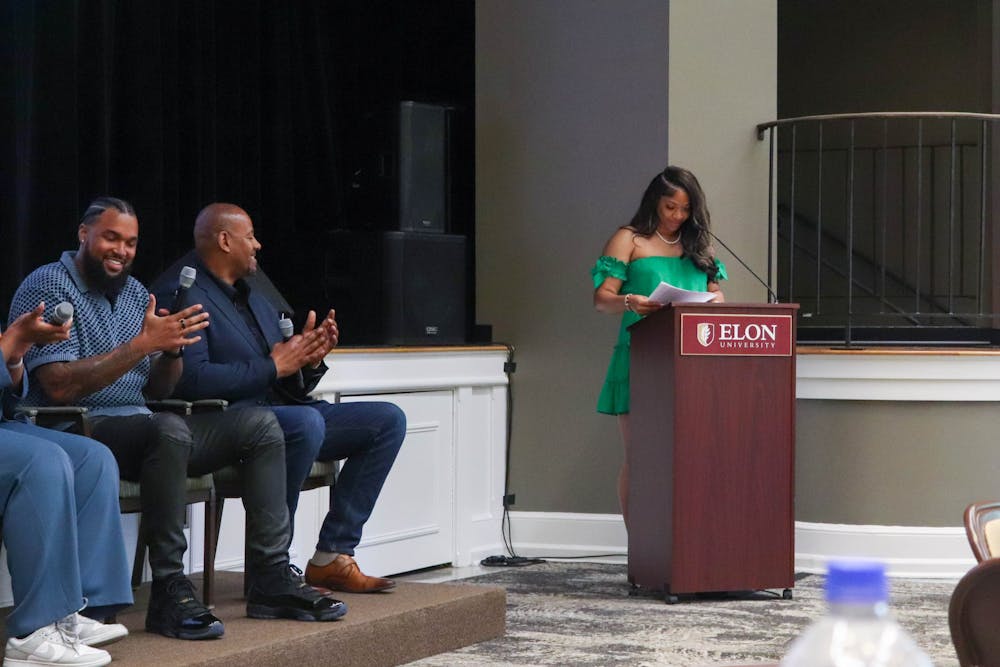
Kathan Gandhi | Elon News Network
Senior Haleigh Cephus coordinates a fireside chat with a panel of speakers at her Beyond the Athlete conference on April 25.
With a purpose to share why mental health matters and connecting participants to tools, relationships and resources that encourage student athletes’ success beyond their performances, a group of panelists spoke about ways individuals can make a personal and public impact during and after their sports career.
Leaders in the sports and the greater North Carolina community, Andriana Londono, Lorenza M. Wilkins, Amber Hill, Andrea Durham, Monique A.J. Smith and Marcus Smith II kicked off the conference with a fireside chat. The panelists each gave advice and suggestions on topics that included creating more accessible resources to student athletes in systems like education with restorative practices, increasing knowledge on counseling services and mentoring, prioritizing self-care and an increased mental health capacity and taking ownership of your own environment.
The panel ended with a call to action to create your own systems for yourself, improve the systems and structures in place that are currently not supporting student athletes and valuing the individual beyond their sport.
“Encouraging the culture of being something more than your sport is something that’s really huge,” Cephus said.
Junior Lizzie MacKenzie said she enjoyed listening to the panel, and even with no background in sport, she communicated the weight the event held. She learned about the conference after seeing a flyer on the wall on the way to class.
“I just think it’s a really great cause,” MacKenzie said. “I am really glad a student at Elon is talking about this topic. I don’t think there is enough focus on the actual whole person of an athlete.”
A current mental health advocate, Circle of M CEO and former NFL player, Marcus Smith II, served as the conference’s keynote speaker. He spoke to the importance of active listening, empathy, confidentiality, self-care and how non-directive approaches are what athletes need to fully express their thoughts and emotions with related mental health problems.
“The more you speak, the more you free yourself,” Smith said during the keynote.
Women leaders in sports facilitated four different breakout sessions: emotional intelligence and communications; healing and coping practices; NIL and pressures and performance; and empowering young women, where intimate conversations were had related to their specific topic.
Cephus believes Elon Athletics will be greatly impacted if they start providing resources for athletes that can transform them holistically. Her ideas include a mentorship program for current Elon athletes to connect with former athletes, hiring a campus counselor who works after hours or during the hours athletes are free, increased representation in academic advisory and a boost of community well-being.
“This conference is a stepping block,” Cephus said. “I don’t even want you to remember my name after this, I want you to remember yourself. Your well-being is the priority and telling your story is always something you should do because you never know how you are going to empower someone in the next room.”
Cephus said she has hopes to host the event again with Elon, while also bringing together different campus communities.
More information on Cephus’ work can be found on Beyond the Athlete’s website.