
In a recent column on The Players Tribune, Cadillac driver Valtteri Bottas has opened up on his rocky road to F1, but it’s his struggles while he was already at the pinnacle that are much more revealing.
Unless your parents are billionaires, making it to F1 requires a ridiculously rare mixture of talent, luck and true grit, and Bottas’ story trying to get on the radar from Finland is no exception. With only 20-odd seats available, children who set such lofty ambitions are often laughed out of the kart track or encouraged by teachers to aim for a ‘real job’.
But while Bottas’ origin story is an interesting read, what happened once he finally made it is the real story. In his column the Finn opened up on the eating disorder he developed during his early years with Williams, saying he “started starving myself” after the team predicted its 2014 launch car would be overweight, suggesting its driver could lose five kilos to compensate.
“If you put a clear goal like that in front of me, I am going to obsess over it,” Bottas wrote. “When you tell me five kilos in two months, my brain thinks, “Five? Why not 10? We can make the car even quicker. The game became completely consuming.
“It got so bad that I actually started having heart palpitations when I was working out, and my coach knew something was wrong. But I was just in denial for so long. I kept telling everybody that I was OK.”
Bottas said he hit rock bottom in the aftermath of Jules Bianchi’s – eventually fatal – accident at the 2014 Japanese Grand Prix. “The turning point didn’t come until a very, very dark day, when my old team-mate Jules Bianchi crashed at Suzuka.
“I remember flying back home from Japan, and we all knew that the situation was really bad, and that Jules was in a coma. I was sitting on the plane, and it just felt like nothing mattered to me anymore. I remember my ex-girlfriend texting me wishing me a safe flight, and I just thought, If the plane goes down, who cares? I will disappear and it will be over. I didn’t find joy in anything anymore.”
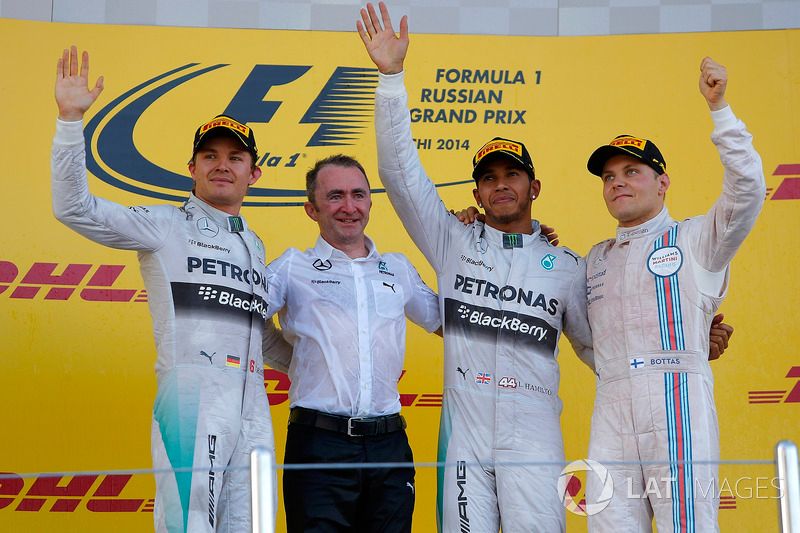
Valtteri Bottas on the podium at the 2014 Russian Grand Prix alongside his future Mercedes team-mate Lewis Hamilton. Behind the scenes, the Finn was starving himself to help his car get below the weight limit
Photo by: Sutton Images
Bottas found help through a psychologist, but kept his struggles hidden from the outside world. “I kept everything from my team and even my team-mates. Even my family didn’t know. In the paddock, you can’t show any weakness. Only my coach and my doctor knew what was going on. It took me almost two years to feel like myself again.”
Bottas’ mental and physical turnaround coincided with his one in a lifetime opportunity to replace Nico Rosberg at Mercedes, and thankfully the story has a happy ending as the Finn became a multiple grand prix winner, but not before suffering a burnout over the 2018 season. It’s worth reading his full account of how a long trek into the Finnish woods led to a change in mindset as he started 2019 on the front foot with a dominant season opening win in Australia.
It’s also worth pointing out F1 changed its rules ahead of the 2019 season by no longer including the driver weight in the overall minimum weight limit, a key move to help curb heavier drivers aggressively cutting down on weight to benefit car performance. Until then, Bottas was not alone in being compelled to go to an uncomfortably low weight.
“Over the course of a season, team members face continuous travel, disrupted sleep cycles and sustained cognitive and physical demands” Vineet Arora
But his story shows F1 has also come on leaps and bounds in how it deals with mental health, now treating mental and physical well-being as one ‘holistic’ package. In motor racing the mental component to human performance has always been much bigger than the physical one, and over the past decade it has moved front and centre rather than being treated as an afterthought.
Bottas is the latest F1 figure to speak out about his experiences, following the likes of Lando Norris, Lewis Hamilton and Toto Wolff, which has gradually shifted the debate around mental health. With the exit of Red Bull’s notoriously hard-nosed Helmut Marko, perhaps one of the last champions of the old-school thinking, and young drivers coming into the sport can now see that the heroes they idolised have sought help too. If it’s okay for them, it’s surely okay for you.
The ‘human engine’ of F1 teams
Drivers and teams have started utilising the available resources to varying degrees, and that goes well beyond the performance of the drivers alone. While athletes are under enormous pressure to perform, that also applies to staff. Especially the track personnel that travels the world in economy class and then puts in long and gruelling shifts, thankfully under a welcome paddock curfew that prevents overnight garage work.
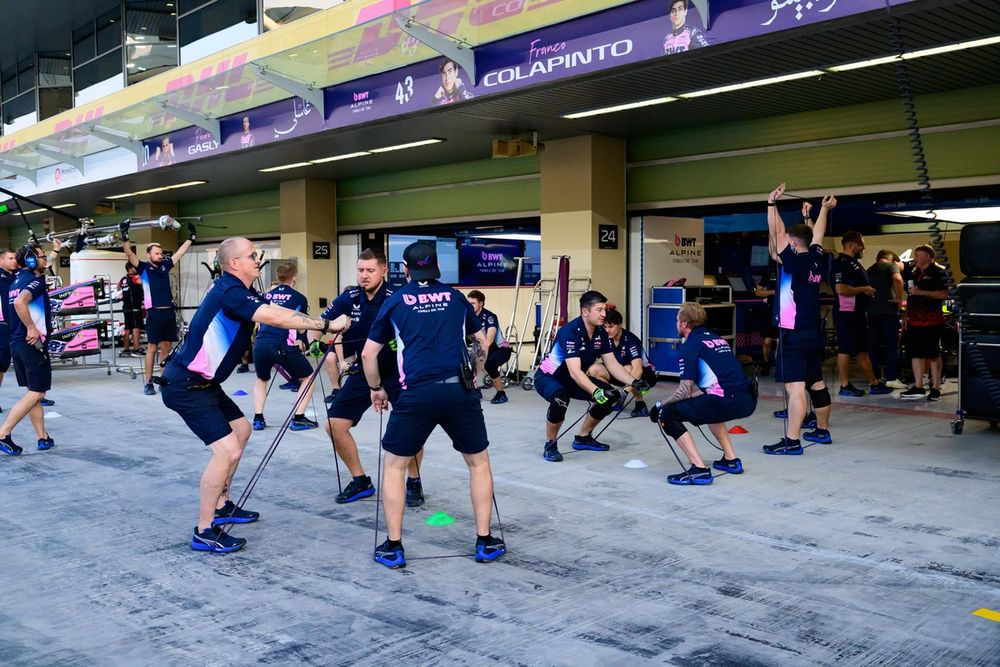
Alpine mechanics go through a warm-up routine before the race.
Photo by: Erik Junius
The result is that pretty much every team has a fleshed out human performance department now. Ferrari is partnering with wearables tech company Whoop to monitor the health of its staff, while Haas recently announced a partnership with the University of Chicago. The so-called Human Engine project tracks the team’s personnel for a long-term study into the mental and physical demands of working in F1, which also includes the use of wearables.
“Over the course of a season, team members face continuous travel, disrupted sleep cycles and sustained cognitive and physical demands,” said Vineet Arora, the dean for medical education at the UChicago Pritzker School of Medicine, who is also the study’s principal investigator. “Our goal is to understand how these factors interact over time and to develop targeted interventions that support performance, recovery and well-being. What we learn here has the potential to shape how we support teams in other environments.”
Finding a purpose outside racing
Another interesting takeaway from Bottas’ Players Tribune piece was his psychologist’s remark – back in 2014 – that he didn’t appear to have any interests outside of racing. In that regard Bottas may well have been more of a rule rather than an exception. From a pre-teen age aspiring F1 racers have left no stone unturned to defy the aforementioned naysayers and make it to that elusive club. And in that laser focused approach there is often no room for a normal childhood to develop the usual hobbies and interests.
And once you have made it to F1 and finally realised that life-long dream, the biggest fear is to let that moonshot chance slip by doing or saying the wrong thing. Looking back on it now, Bottas acknowledges he was “the most boring F1 driver” at the time, having nothing else to say that wasn’t related to braking into Turn 1 or a snap of oversteer out of Turn 7.
How Bottas has changed, then, having become an accomplished triathlete, a gin and coffee entrepreneur and one of F1’s more colourful personalities who has stopped caring about what people might think as he dons budgy smugglers on an Australian beach, his bleached mullet waving in the breeze.
It may sound like common sense to find something to take your mind off racing and keep you grounded, but the most high-profile drivers are often criticised when they do so. Hamilton tends to receive barrages of criticism for having the temerity to show up at New York fashion events in between races. Yet somehow Hamilton has bounced back from a tough Ferrari debut season at the age of 41, so he must surely be doing something right to still have the desire and be in the right headspace to compete at the sharp end after 20 years.
His former Mercedes team-mate has now also appeared to have found a new lease on life, and is soaking in what it really means to compete in F1 on his return with Cadillac. “Look, I’m still crazy. I still obsess over all of this. I still think I’m the best driver on the grid. But now I have a little bit of perspective to go with it. I can appreciate it all more,” Bottas concluded.
No, Valtteri, you’re not crazy. You happen to be human like the rest of us.
Read Also:
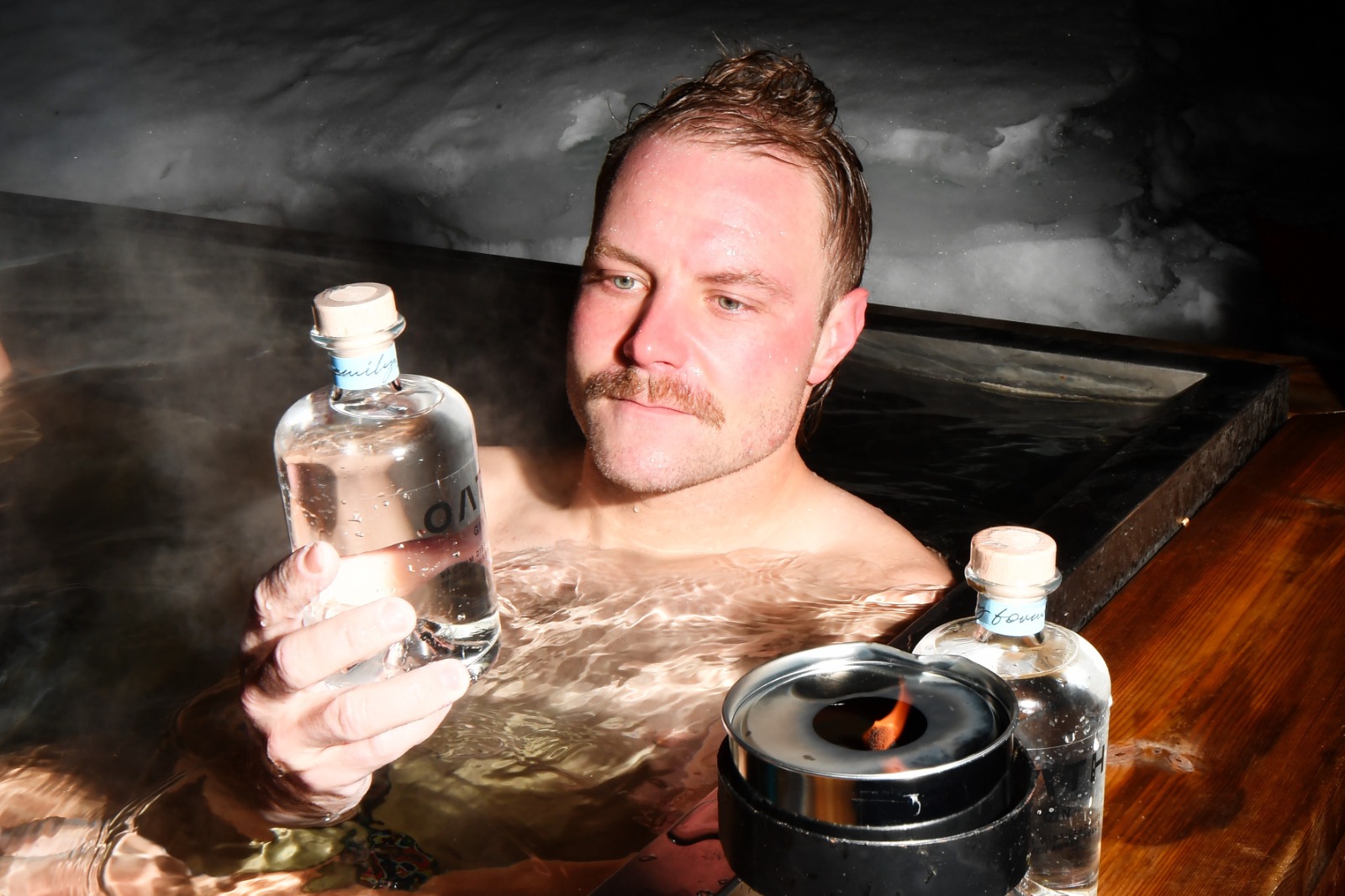
Bottas poses with a bottle of Oath Gin, the company he co-founded with partner Tiffany Cromwell
Photo by: Jerry Andre/LAT Images via Getty Images
We want to hear from you!
Let us know what you would like to see from us in the future.
– The Autosport.com Team