
By JULIE CARLE
BG Independent News
At a recent Wood County Alcohol, Drug Addiction and Mental Health Services Board meeting, representatives from the Wood County Educational Service Center (ESC) delivered a comprehensive presentation highlighting the growing impact—and mounting pressures—of their youth prevention and diversion programs.
Positioned as the largest of only five Educational Service Centers in Ohio offering formal prevention programming, Prevention Director Alana Stanbery-Sigg reported the Wood County ESC has emerged as a statewide leader. Its school-based model places prevention specialists directly within districts, reducing barriers such as transportation, cost, and stigma while increasing access to critical mental health and behavioral supports.
“Not every county has this,” she told the board. “It helps support not only the youth, but also their families and our communities across Wood County.”
A cornerstone of the ESC’s approach is its large-scale youth survey, which gathered input from nearly 9,000 students across Wood County in grades 5–12.
Stanbery-Sigg emphasized that the data collected goes beyond statistics and represents the lived experiences of local youth.
“This is not just numbers. These are students’ voices. They are telling us what they think, what they feel, what they experience,” she said.
Thanks to the extensive amount of information collected, the center can target interventions around mental health, substance use and Adverse Childhood Experiences (ACEs), which then allows the school districts to tailor services to specific needs of their students.
“We serve all 10 districts in some way or another,” said Angela Patchen, manager of prevention specialists. “Primarily, we have staff in eight of the districts, and then we include the other districts when we do other programs like ‘Hooked on Fishing, Not on Drugs.’”
From August, when the school year started, to the end of March, WCESC served 4,557 students—1,300 received substance use prevention, 1,200 received suicide prevention, and over 2,700 received sexual abuse prevention, dating violence prevention that’s now required by the state, Patchen reported.
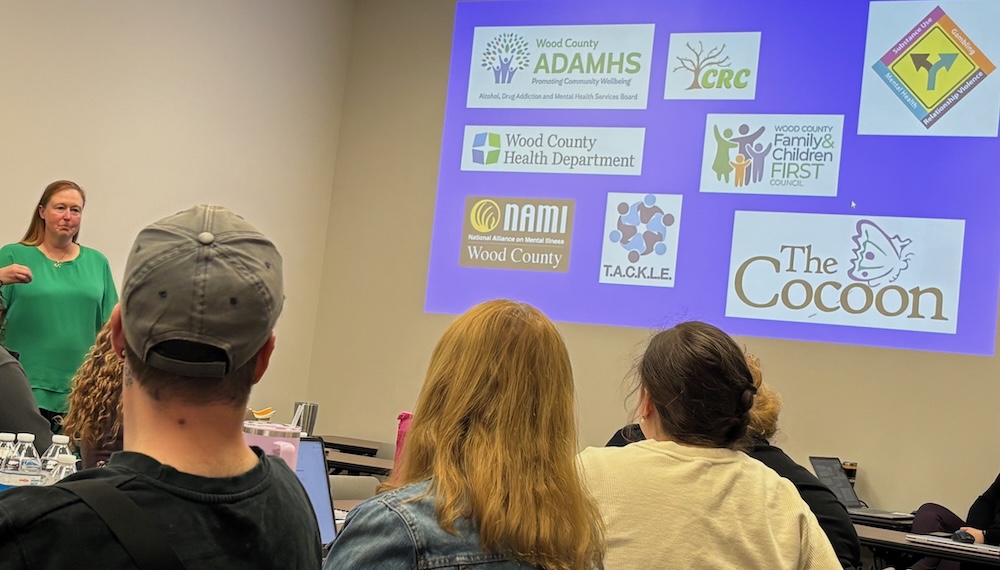 Angela Patchen, manager of prevention specialists, talks about some of the programs’ partners.
One of the most notable successes shared was the Diversion Program, a partnership with the juvenile court designed to keep youth out of the justice system.
“Our approach has led to a 91% success rate. That number comes directly from the juvenile court,” said Suzanne Eames, Diversion Assistant. The court keeps track of every case. Twelve months after the case is closed and the child has not become court-involved, the case is considered successful.
“I’ve come to understand that the diversion program is so much more than just keeping kids out of court,” she said. The court was not having much success initially, “because nobody wants to go to a courthouse.” The solution was to create the community-based diversion program.
“It’s successful, because it gets kids support, it gives parents guidance, and schools get support, guidance and relief,” she said.
However, success has driven demand: caseloads have nearly doubled in one year, increasing from 285 to over 530 cases, and creating strain on staff capacity.
“We’ve had to get pretty creative to handle that huge caseload,” Eames said. “We triaged cases and worked with another county that had an online truancy course that we got permission to take and modify for our county.”
Collaborative partnerships are one of the strengths of Wood County’s system, Stanbery-Sigg said. Those partnerships include schools, courts and community agencies that help expand the service reach and generate significant financial and in-kind support, she explained. “Their support has enabled us to help families gain access to a wide range of services, from prevention education to basic needs support,” Stanbery-Sigg said.
Future priorities will focus on managing the growing caseloads, continuing to use data to guide services, and providing additional support and supervision.
“The one thing we do so, so well in Wood County is collaborate and partner and really just work with each other. It’s really amazing to see. And when you talk to people in other counties, they just can’t believe how well we play in the sandbox together in this county to really just make sure that our family’s needs are met.”
Despite these achievements, challenges remain. Rapidly increasing caseloads, evolving youth needs, and limited funding are placing pressure on the system. She identified key priorities moving forward, including managing growth, continuing to use data-driven decision-making, and expanding staff support to prevent burnout.
The presentation concluded with a clear message: while Wood County has built a strong, collaborative model for youth prevention, sustaining and scaling that success will require continued investment, innovation, and community partnership, Stanbery-Sigg said.
Also during the meeting, the board approved a resolution for an adult mobile crisis pilot program and reviewed a draft of the System of Care Support, which included funding for transportation, harm reduction for the ongoing support of the Narcan vending machines, and adult days and adult care facilities, because there are higher needs for housing and housing initiatives since hospitalizations have stabilized.
 Posted by: Julie Carle on May 7, 2026.