
image:
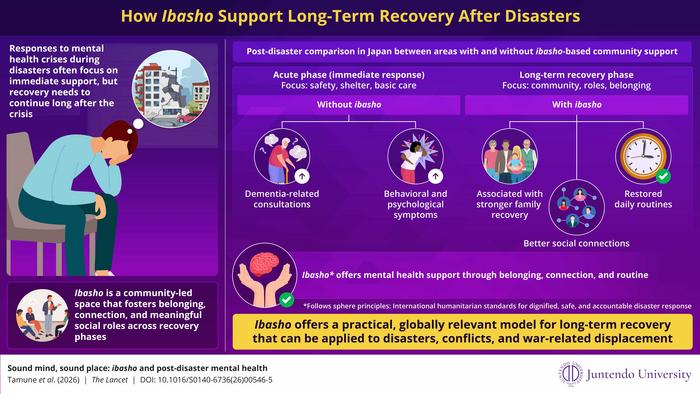
Belonging, purpose, and community ties through ibasho may be just as vital as clinical care in post-disaster recovery.
Credit: Dr. Hidetaka Tamune from Juntendo University Graduate School of Medicine, Japan
As disasters increasingly disrupt lives through displacement, conflict, and climate-related emergencies, addressing long-term mental health recovery remains a major challenge. A correspondence from Juntendo University discusses that, while acute symptom assessment remains important, disaster psychiatry may benefit from a community-led approach to care. The authors discuss the importance of ibasho (community spaces of belonging and social purpose) and suggest that rebuilding routines, roles, and neighborhood connections may support long-term recovery and resilience.
Natural disasters drastically affect human lives—destroying homes, separating families, leading to disruption of daily routines, which affects their stability. While emergency mental health responses are crucial in the beginning of the crisis, new correspondence discusses that psychological recovery may rely on a more meaningful approach to help restore a sense of place and belonging.
Ibasho: A Community-led Place for Belonging and Meaning
In this context, authors from Juntendo University, Japan, led by Associate Professor Hidetaka Tamune from the Department of Psychiatry and Behavioral Science, along with Dr. Yutaka Igarashi from Nippon Medical School, Japan, and Dr. Yuzuru Kawashima from the Disaster Psychiatric Assistance Team, Japan, discussed the approach of ibasho (a community-building concept in Japan) for people affected by disasters. The details were made available online on April 3, 2026, and published in Volume 407, Issue 10537 of The Lancet journal on April 11, 2026.
Dr. Tamune says, “Disaster recovery is not only about reducing acute psychiatric symptoms. It is also about restoring the social environments that give people stability, dignity, and a sense of purpose. In Japanese, the places that make this possible are called ibasho.”
Ibasho means a place of belonging where people are engaged in social networks, routines, and meaningful roles. The authors suggested that restoring this sense of connection among people affected by disasters may be just as important as detecting early symptoms, as it plays a vital role in supporting community recovery. Supporting this, the correspondence places ibasho within the internationally recognized Sphere humanitarian framework, which focuses on survival with dignity, continuity with care, and coordinated support systems during crises. It also suggests that ibasho aligns closely with those principles by offering social infrastructure for displaced and affected communities.
Ibasho in Japan: Community-Led Recovery in Practice
Compared to conventional interventions, ibasho refers to safe, community-led spaces where individuals can reconnect with others and resume daily routines. This may include neighborhood gathering spaces, shared community programs, and locally led recovery hubs. To support this perspective, the authors cited the evidence from disaster-affected regions in Japan. These include examples from the 2011 Great East Japan Earthquake and the Fukushima nuclear accident. Notably, there was an increase in the dementia consultations and behavioral and psychological symptoms of dementia (BPSD) among older adults near the evacuation zones of the affected areas. In contrast, the communities where older residents were helped by leading ibasho-style programs reported stronger recovery and more stable routines with improved social and family relationships. This suggests that recovery improved when people were able to regain meaningful roles in community life. The older adults not only receive support but are also actively contributing to the recovery efforts and rebuilding community life.
“What appears to be most important is not simply access to services, but whether people can reclaim their place within the community and continue to feel valued, useful, and connected. In Japan, a disaster-prone and super-aged society, we have both the experience and the responsibility to share what we have learned about caring for older adults with dementia, especially those who develop BPSD and delirium,” explains Dr. Tamune.
Redefining Recovery Through Connection, Culture, and Dignity
Although particularly relevant to natural disasters, the correspondence suggests that preparedness and recovery both depend not only on services but also on whether people can remain connected to local networks, routines, and meaningful social roles. The authors further note that trauma-informed support should remain culturally congruent; in some communities, restoring routines, roles, and communal life through ibasho may be the most acceptable first step.
Overall, the correspondence highlights the importance of ibasho in post-disaster mental health. It suggests that, although acute symptom detection matters, recovery also depends on whether people can continue to live safely, sustain relationships, and regain meaningful roles after displacement. In this sense, ibasho may function as a culturally congruent local social infrastructure through which dignity, continuity, and safety are restored in everyday life.
***
Reference
Title of original paper: Sound mind, sound place: ibasho and post-disaster mental health
Journal: The Lancet
DOI: 10.1016/S0140-6736(26)00546-5
Author(s) name: Hidetaka Tamune1, Yutaka Igarashi2, Yuzuru Kawashima3,4
Author(s) Affiliation:
1Department of Psychiatry and Behavioral Science, Juntendo University Graduate School of Medicine, Japan
2Department of Emergency and Critical Care Medicine, Nippon Medical School, Japan
3Disaster Psychiatric Assistance Team, Japan
4Hanzomon Nobisuko Children’s Clinic, Japan
About Associate Professor Hidetaka Tamune from Juntendo University
Dr. Hidetaka Tamune, MD, PhD, is an Associate Professor at the Department of Psychiatry and Behavioral Science, Juntendo University Graduate School of Medicine, Tokyo, Japan. He holds a Doctor of Philosophy (PhD) in Cellular Neurobiology and has an interdisciplinary academic background spanning psychiatry, neuroscience, and primary care. Till date, he has published over 47 peer-reviewed articles, with research focusing on neuropsychiatry, consultation-liaison psychiatry, delirium, disaster mental health, and medical education.
Article Title
Sound mind, sound place: ibasho and post-disaster mental health
Article Publication Date
11-Apr-2026