
Aldo wouldn’t be the same without the therapy he started receiving when he was 12 years old. He struggled with smoking and drugs at the time.
Now 18 years old, he credits his growth to his therapist Brittne Canizales, who he has seen on and off for the last six years.
“She helped me understand that it’s not bad to tell people your problems,” he said. “I felt like she actually really listened to me.”
Aldo, who is being identified by his first name only, is one of Canizales’ clients at The Elevate Project. It’s a new organization aiming to break the cycle of juvenile incarceration for people like Aldo — Latino youth between 15 and 24.
“I feel like they really need community and connection and belonging and acceptance and a place to come and be,” said Canizales, the organization’s founder and executive director.
She launched The Elevate Project after receiving an opioid abatement grant of $160,000 from Tulsa County last year — one of several Tulsa-area organizations tapping millions in funds from legal settlements to address addiction.
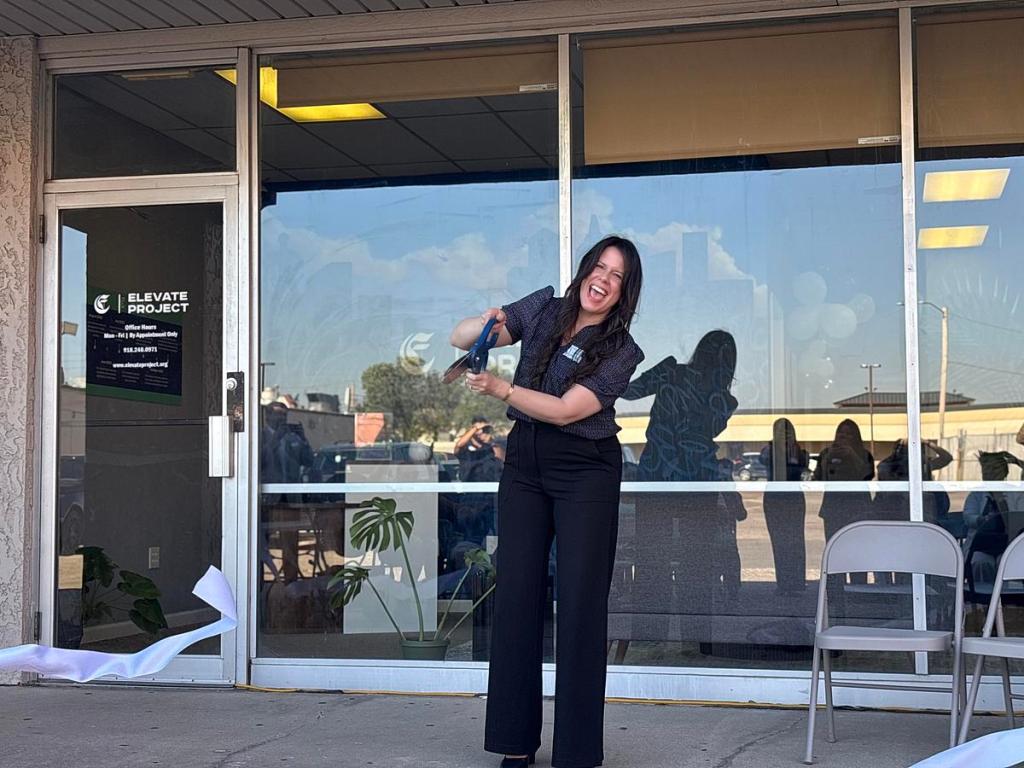 Brittne Canizales, founder and executive director, cuts a ribbon on March 26, 2026, to signal the grand opening for The Elevate Project. The organization aims to help youth on the eastside by providing bilingual therapy, group counseling, activities and more. Credit: Angelica Perez / Tulsa Flyer
The organization currently focuses on providing one-on-one bilingual therapy and group counseling. Canizales plans to expand services this summer with mentorships, life skill courses, field trips, community service projects and more.
“I was really passionate about trying to start something that had a relational lens to the work that provided a safe place and an alternative to the streets and sometimes home,” she said.
Throughout her professional experience, Canizales often felt like there were holes when serving Latino and Hispanic youth. She wanted to create a different kind of space than the places where people typically go to receive care.
East Tulsa is often referred to as a “desert” when it comes to behavioral health services and programs, according to The Elevate Project’s website. She’s trying to fill that gap.
“I always like to say more than a place to come and leave, but a place to come and be,” she said.
The organization held its grand opening at 10915 E. 31st St. Ste. 7 in late March.
She often sees Hispanic youth have a desire to work rather than continuing their education. She tries to remind them that they can do both.
Within their households, Hispanic youth are often seen as a source to bring in more income or become a caretaker for younger siblings. It’s not a bad thing — it’s a cultural thing, she said.
“If you look at the negative effect, it can create stress or it can create pressure for kids,” she said, citing a need for young people to make quick money. “The way they make good money is to sell drugs, so they can go pay the bills at home.”
As a therapist, she knows it’s hard to simply tell the youth to stop doing something, such as being out on the streets, without providing them with an alternative.
Her organization wants to find new ways to connect while bringing healing and decreasing crime and violence in the community, she said.
“They deserve someone not to give up on them and they deserve this, and I just have to keep working to create it,” she said.
This article was produced as part of a partnership between the Tulsa Flyer and La Semana, a Tulsa-based bilingual Spanish-English newspaper serving Latino communities in Oklahoma.
News decisions at the Tulsa Flyer are made independently of our board members and financial supporters. Read more about our editorial independence policy here.
Related
Related Articles