
The Bergmann Center, a day program for dozens of adults with intellectual and developmental disabilities in Charlevoix, is scheduled to close Saturday
Program leaders say reimbursement rates for their services have become unsustainable.
Other providers warn the closure signals a potential collapse within the state’s mental health system
Madison Priest found her voice at the Bergmann Center.
The Charlevoix-based day program has operated for more than a half-century and serves about 70 adults with intellectual and developmental disabilities. For Priest, a 24-year-old wheelchair user from East Jordan, the impact has been clear to her and her family.
“I’m verbal, but struggle with being social,” she told Bridge Michigan. “I’m talking a lot more confidently than I was when I first started.”
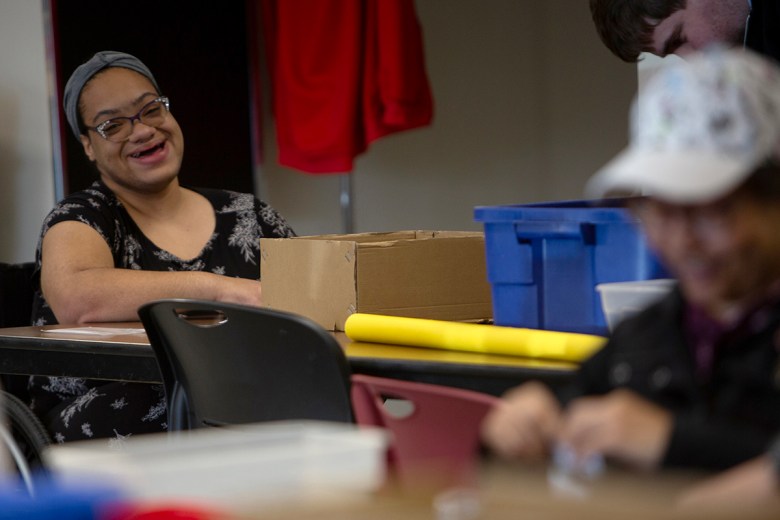 Madison Priest of East Jordan laughs as she talks with friends at Bergmann Center. Madison was working in the workshop, one of the employment opportunities the center provides to adults with physical and developmental disabilities. The Charlevoix-based nonprofit subcontracts with local industry partners to provide employment opportunities for the individuals it serves. (Kathy Kieliszewski/Bridge Michigan)
The Bergmann Center has given Priest a strong sense of community and structure. The facility gives her a place to work, packaging parts for a local magnetics company. She lunches with her friends around town and does art projects. She even attended a special prom night party put on by the program.
But those opportunities are soon expected to end — the Bergmann Center is slated to close on Saturday. “I’m really sad,” Priest said. “It’s hard to lose that.”
The center’s closure reflects a deepening rift running through Michigan’s $4.9 billion Medicaid-supported behavioral health system.
Community Mental Health agencies — the public bodies responsible for funding service providers like the Bergmann Center — have increasingly “shifted from being a system manager” to competing for the same resources they allocate towards network providers, according to Heather Rae, president and CEO of Common Ground.
Related:
The Oakland County mental health nonprofit that has experienced its own issues vying for services in its community after ceasing operations at its clinic in Pontiac earlier this year amid a contract dispute. Oakland Community Health Network (OCHN), the Community Mental Health agency for the area tasked with managing care for about 30,000 county residents, said it would take over crisis services previously provided by Common Ground.
“When a funder becomes a competitor, bad behavior and bad public policy are inevitable, potentially corrupting the entire system because the roles are enmeshed and public accountability is broken,” Rae told state lawmakers in April.
OCHN has said its goal is to provide “a more coordinated, compassionate, and accessible crisis care system” for the county. But months after the transition, OCHN says it’s still awaiting for state licenses needed to offer crisis stabilization and residential programs in-house while it asks law enforcement to temporarily divert psychiatric patients to local emergency departments.
Out of funds, out of time
At the heart of the Bergmann Center’s closure is a dispute over direct care worker wages and whether they include a Medicaid-funded bonus provided by the state to reimburse certain frontline public health workers.
Bergmann says the wages are not being properly refunded. But North Country CMH, the agency that maintains the Bergmann’s payments, says those dollars have been appropriately dispersed and assumes the center’s closure stems from the center’s own operational decisions.
“When I look at the (reimbursement) rates, they’re quite sufficient,” North Country CMH CEO Brian Babbitt told Bridge. “I do believe that they are … likely paying their staff well above what we are funding at.”
The Michigan Department of Health and Human Services confirmed North Country CMH is meeting its wage standard in its contract with the Bergmann Center. The current required direct care worker wage floor is $17.13 per hour — a $13.73 minimum hourly wage with a $3.40 an hour “pass-through” add-on.
The agency defers to CMHs and their overseeing regional Prepaid Inpatient Health Plans, or PIHPs, to negotiate and maintain provider rates and terms.
“MDHHS does not intervene in individual contract negotiations or rate disputes,” state health department spokesperson Lynn Sutfin said in an email, adding the agency is “continuing to monitor and receive regular updates on the transition process to ensure all individuals are afforded their protections under the Mental Health Code.”
Northern Michigan Regional Entity, the PIHP that oversees North Country CMH, did not respond to Bridge’s repeated requests for comment on this story.
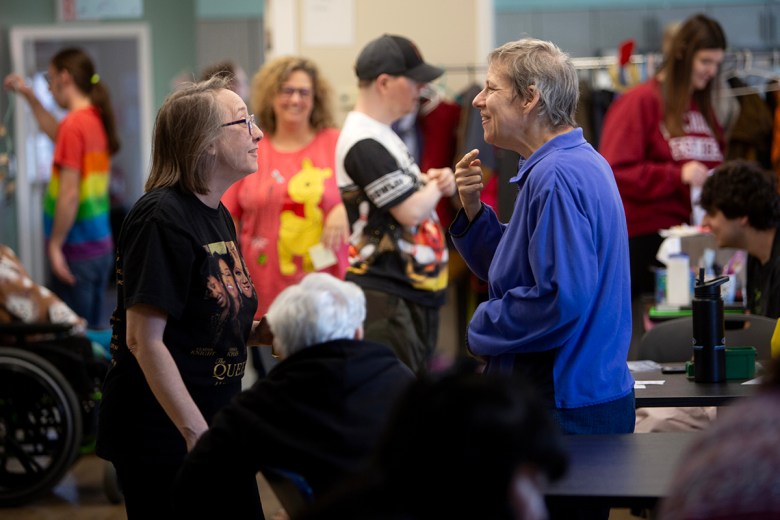 Bergmann Center staff member Penny Hawkins, left, talks with Julie, a client at the center, during an afternoon of socializing, puzzles and arts and crafts. (Kathy Kieliszewski/Bridge Michigan)
Keri Laporte-Montero, Bergmann Center’s CEO, said North Country CMH has offered shifting guidance on wage “pass-through” rates for years, resulting in reimbursements that fail to meet established state standards, requiring her organization to step in to fill the financial gap. Her allegations of system failures have resulted in a cease and desist letter from North Country CMH, which describes her remarks as “defamatory.”
Unsustainable pay
The acrimonious relationship between the groups has exacerbated the financial issues that come with serving a rural community, Laporte-Montero said. She said there’s an inability to attract and retain employees at the state’s baseline minimum wage for direct care workers.
“Rates are not sustainable regardless,” said Laporte-Montero. “Nobody in Northern Michigan can work for $13.73 an hour.”
Organization leaders say under the current framework, the center generally covers transportation for clients, which includes wheelchair-accessible vehicles and fuel costs for long distances.
There’s been a significant drawdown of the center’s rainy day savings — repairs from last year’s ice storm have been costly. The Bergmann Center has new expenses to address the influx of clients following the closure of a different day program maintained by North Country CMH.
The center forecasts a $388,000 deficit by the end of the year, according to board chair Mike Hurchick, even with the support of philanthropy and its imminent closure.
“Nonprofits run lean,” Hurchick said. “We just don’t have it. Our bank account is going to be empty, period.”
Cracks in the system
The concerns come as the state works to restructure how mental health care is delivered in Michigan. While a lawsuit brought on by several of the state’s CMHs successfully blocked the redesign as previously outlined from proceeding, the state has signaled its intent to continue the effort.
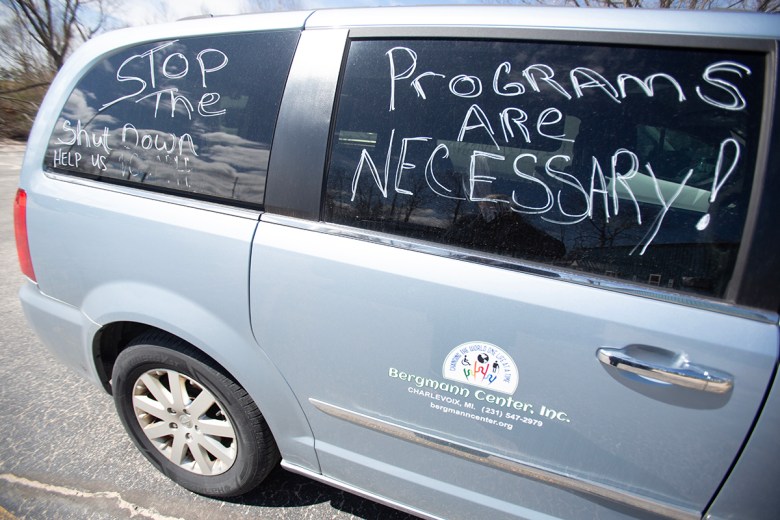 The windows of one of the Bergmann Center’s vans are covered with messages protesting the closure of the facility, which serves adults with physical and developmental disabilities, primarily in Charlevoix and Emmet counties. (Kathy Kieliszewski/Bridge Michigan)
Aside from limiting their influence in the regions they operate in, some CMH executives like Babbitt say they oppose the state’s proposed redesign because it would put their organizations in direct competition with external service providers like the Bergmann Center.
Some say the cracks in that relationship are already forming.
“The provider network outside of the CMH itself is beginning to fail,” said Cindy Evans, the executive director of Grand Traverse Industries. The nonprofit similarly provides day services for adults with disabilities in northern Michigan and is facing its own program challenges.
“And when it begins to fail, it will be a domino effect.”
Many point to an inherent conflict of interest in how the public bodies are structured. CMHs operate as “judge, jury and executioner” to their oversight, according to state Rep. Luke Meerman, R-Coopersville.
“I think when all of that power rests in one place and there’s no one to go to … this is what’s going to happen,” he said.
‘Scrambling’ for services
Ahead of the center’s closure, families are left with few options for their children.
Brian Greene of Petoskey said his son Dawson, who is on the autism spectrum and has cerebral palsy, was a “rockstar” when he arrived at the Bergmann Center.
As his family searches for a new place in the area for Dawson to have dependable social interaction and planned activities, Greene was frank — “there are none.”
Greene worries his son’s needed day-to-day routine and support system is at risk of being upended. “To have a group of people like that take care of your loved one, and then for them to get shit upon … it’s devastating.”
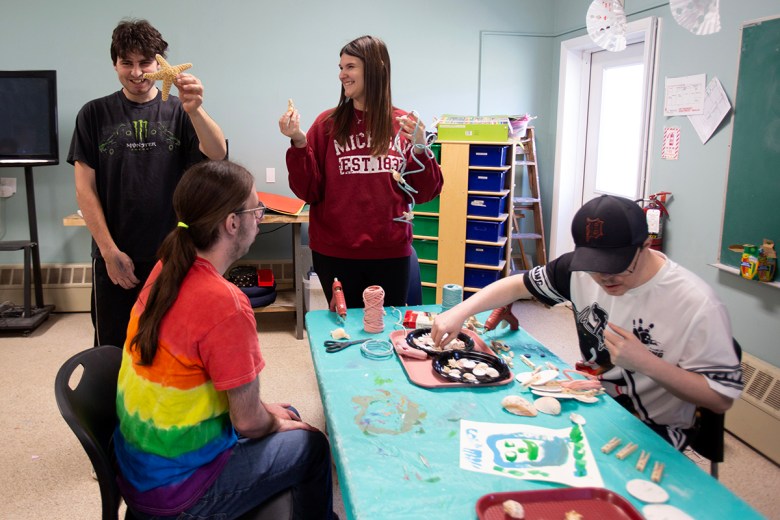 Dawson Strojny, far left, of Petoskey shows off his starfish as part of a craft project he did with Bergmann Center staff member Alayna Smith. (Kathy Kieliszewski/Bridge Michigan)
 Anya, a client of the Bergmann Center, sorts nuts and bolts on Wed., May 6, 2026, as part of an employment program the center provides to adults with physical and developmental disabilities. The Charlevoix-based nonprofit subcontracts with local industry partners to provide work opportunities for the individuals it serves. (Kathy Kieliszewski/Bridge Michigan)
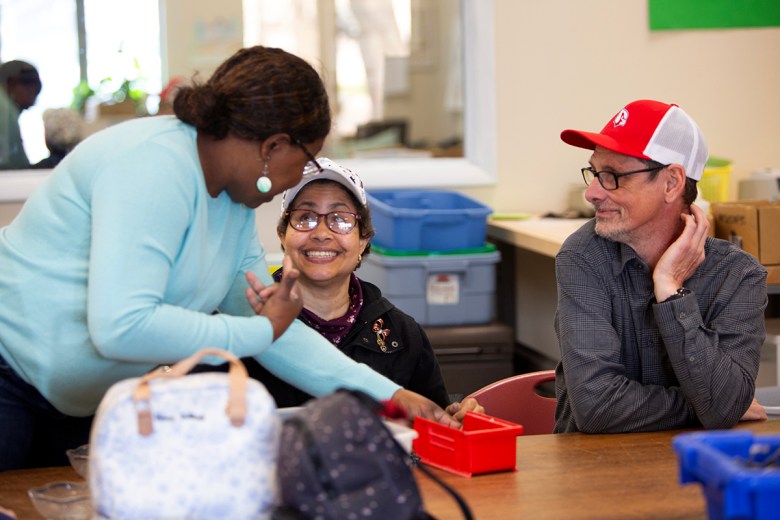 Bergmann Center staff member Andrea Miller, left, talks with Anya and Jason while the two work in the workshop, part of an employment program the center provides to adults with physical and developmental disabilities. (Kathy Kieliszewski/Bridge Michigan)
 Signs expressing love for the Bergmann Center, created by the center’s clients, line the walls of the Charlevoix nonprofit. (Kathy Kieliszewski/Bridge Michigan)
Industrial Magnetics, Inc. in Boyne City has partnered with Bergmann Center on supported employment, allowing clients at the facility to gain work experience and get paid doing so. The relationship was “the best thing ever,” according to employee Scott Calvert.
The company is now “in a world of hurt” without the center’s labor, Calvert said, saying the group supported hours of production. “That’s something that we will not be able to sustain without hiring two or three more people in our facility.”
Babbitt, the North Country CMH CEO, said while the closure of a day program was not what he wanted, a future model may offer more customization for community integration — he envisions smaller cohorts arranging trips to the movies and public libraries utilizing Community Living Support (CLS) services.
“A provider who does not have a facility can still … try to keep these social circles in place,” he said.
Phyllis Priest, Madison’s mother, is skeptical.
“We’ve looked for seven or eight years and have not been able to find a CLS provider,” she said. “Unfortunately, a lot of them look like what you would hire a home health aide to do — not what we need.”
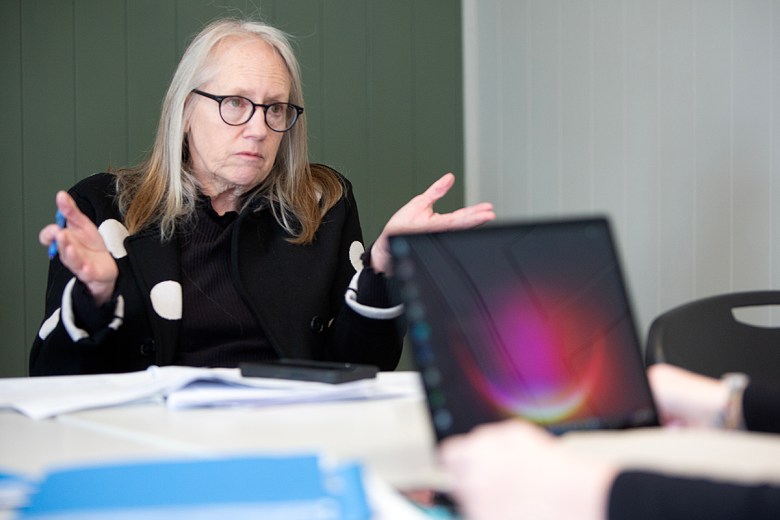 Phyllis Priest of East Jordan talks with case workers from North Country Community Mental Health about the closing of the Bergmann Center in Charlevoix and its impact on her five children who rely on the center for the services it provides to adults with physical and developmental disabilities. (Kathy Kieliszewski/Bridge Michigan)
She said the alternatives outlined by her daughter’s caseworkers have been unacceptable and inadequate in addressing accessible transportation and facilities. “That doesn’t really give me a whole lot of confidence that they actually have a plan that’s workable.”
A residential nurse and mother of several medically fragile children, five of whom currently attend Bergmann Center, Priest said she’s “scrambling” for options to replace the facility. “There is nothing else like that,” she said.
Madison agrees. “We’re just so happy there.”
Related
Thank you to our Michigan Health Watch Sponsors
Bridge Michigan Health Watch is made possible by generous financial support from our sponsors. Sponsorship supports our independent journalism mission but does not constitute sponsor endorsement of individual articles or editorial content. Bridge Michigan journalism remains fact- and data-driven and independent at all times.
Please visit the About page for more information and to subscribe to Health Watch. Interested in becoming a sponsor? Contact Emma Carr.
Republish This Story
