
The Tacoma-Pierce County Health Department reported in April that there were 19 suicides among youth under age 25 from 2015-2024 in the Key Peninsula/Gig Harbor area. The highest number occurred in 2022, followed by a decline.
The report also found that the rates of emergency room visits for youth with suicidal ideation have been consistently higher in the Key Peninsula/Gig Harbor area than the rest of the county. Both areas saw an increase in suicidal ideation-related ER visit rates in 2025.
That jarring wake-up call came amid a Youth Mental Health town hall May 7 at the Key Peninsula Civic Center. A panel of regional experts shared advice and resources with concerned parents, teachers and caregivers.
“These numbers are not shared to create fear,” said moderator Lisa Reaugh of Peninsula School District. “They are shared because they represent the young people in our community who need connection, support, trusted adults and systems that work together.”
Second town hall Monday
Kids’ Mental Health Pierce County and other organizations presented the town hall in partnership with the city of Gig Harbor and Key Peninsula Civic Center.
If you missed it, don’t worry. A second town hall is set for 6 to 8 p.m. Monday, May 18, at Gig Harbor Civic Center, 3510 Grandview St.
Mental health resources
If you or someone you care about is thinking about suicide, call 911 if there’s a chance of imminent harm.
Call or text 988 to reach the National Suicide & Crisis Lifeline. Click here to chat online.
For help and referrals to regional services, reach the Pierce County Crisis Line at (800) 576-7764.
Harsh stats and hope
Reaugh, the school district’s executive director of student services, said many students report feelings of sadness, hopelessness, isolation and uncertainty about where to turn for support.
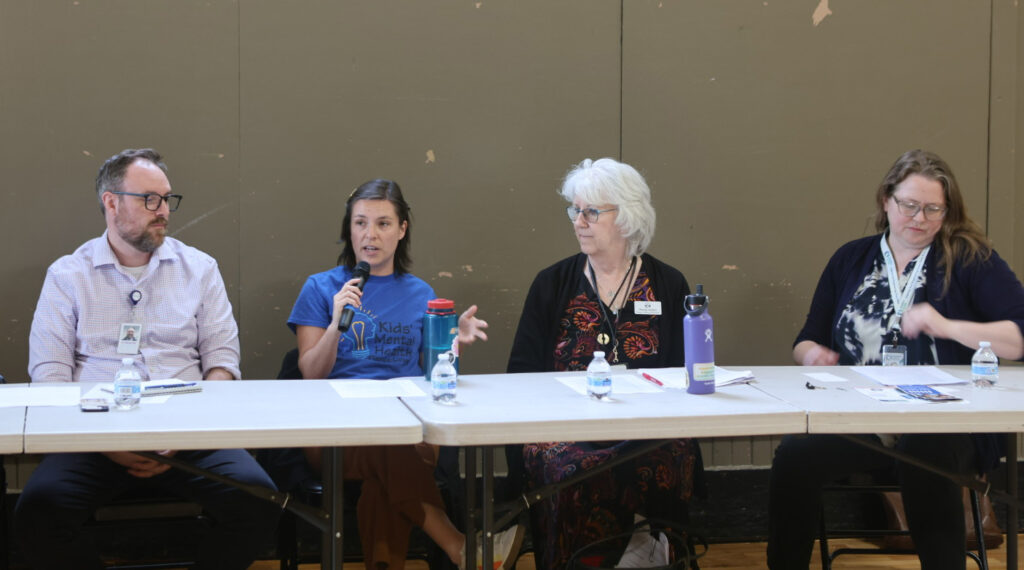
Maddy Greeley of Kids’ Mental Health Pierce County answers a question at a Youth Mental Health Town Hall on May 7 at the Key Peninsula Civic Center. From left, Dr. Lucas McIntyre, MultiCare Adolescent Intensive Outpatient Program director; Greeley; Wendy Malich, Peninsula School District director of activities and athletics; and Becky Maffei, Peninsula School District lead counselor. Photo by Christina T. Henry
But the most recent Healthy Youth Survey, a statewide student mental health survey administered every two years, provides encouraging news. Rates of depressive feelings declined among Washington students who took the survey. Thoughts of suicide, after years of rising, reached a two-decade low, according to data from 2023.
“These trends indicate that something that we’re doing is working well,” Reaugh said. “Mental health can be heavy, and it can be emotional and sometimes overwhelming, but choosing to come together as a community is an important step towards connection, awareness and action. Tonight’s not about having all the answers or having a solution to our challenges. It’s about learning together and recognizing the important role our community plays.”
Warning signs of crisis
Dan Whitmarsh, a pastor and licensed mental health counselor, talked about warning signs that a young person may be escalating to a crisis. Parents and guardians may see a marked change in behavior patterns.
Red flags would be, “if somebody’s very involved in sports and music and activities, and all of a sudden pulls back, they’re very isolated, if they aren’t spending time with friends,” Whitmarsh said.
Often, he said, it’s hard to sift normal adolescent behavior from an imminent mental health crisis. He talked about “ruptures” that happen between young people and their parents. The kid slams the door and stomps out of the house. Typically, the storm passes; there’s a conversation, maybe brief, and a rebound to normalcy, Whitmarsh said.
But if ruptures become a spiraling pattern, that’s a cause for concern. “I certainly encourage parents to listen to their gut,” he said. “Parents know their children better than anyone else, and that’s not ever to blame a parent when they miss the signs.”
Overcoming barriers
Maddy Greeley of Kids’ Mental Health Pierce County cited multiple barriers that make it hard for youth and families to find and access appropriate care. She works with a coalition of organizations that seek to fill gaps and help families navigate systems.
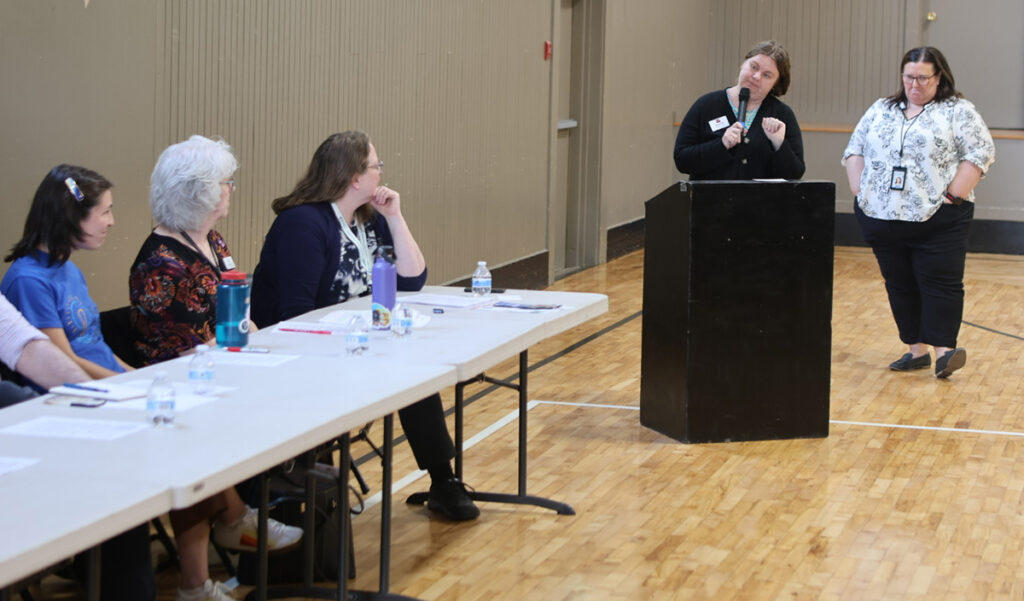
An audience member asks a question to the panel of mental health experts at a Youth Mental Health Town Hall on May 7 at the Key Peninsula Civic Center. Photo by Christina T. Henry
Insurance can be a barrier to getting care. Where you live can impact access to resources, especially for rural families, Greeley said. Parents or kids may be resistant to support, often because of the shame and stigma society places on mental illness.
“Kids don’t want to be a burden,” Greeley said. “They don’t want things in their life to change. They don’t want to be that kid with mental health issues. So, they, especially boys, I think, will say, ‘I don’t need the help.’ ”
Kids’ Mental Health Pierce County’s website lists focused resources for a range of needs, such as substance abuse, LGBTQ+ concerns, and support for parents and guardians.
Dr. Lucas McIntyre, MultiCare Adolescent Intensive Outpatient Program director, said our region faces a shortage of trained mental health clinicians, compounding the challenge. Parents’ work schedules, clinician hours and other logistical hurdles present barriers to care. His program offers a bridge between inpatient treatment and outpatient care, including after-hours support.
Mental health in schools
Becky Maffei, Peninsula School District lead counselor, said mental health in schools means supporting students who are struggling and networking with community providers to direct families to care. On another level, it means educating all students, at all grade levels, about emotional resilience, problem solving, belonging and other aspects of mental wellness.
“It’s not an all or nothing kind of a thing,” Maffei said. “We all live somewhere on a continuum all the time with our mental health, just like with your physical health.”
Crisis response teams
If schools are one end of the spectrum of care, the other is crisis response. In Pierce County, MultiCare operates a Mobile Outreach Crisis Team that responds to adults in crisis anywhere in Pierce County. Catholic Community Services provides the same outreach for people 17 and under.
According to Rona Toomey, CCS clinical crisis supervisor, a crisis may involve not only suicidal thoughts or self-harm, but aggressive behavior, property destruction, or severe anxiety or depression.
“I think it takes courage and bravery for our youth and families to be able to say they need help,” Toomey said.
Know that whether you call 911, 988 or the Pierce County Crisis Line, (800) 576-7764, someone will be there to support and guide you to the next step.
Suicide, let’s talk
McIntyre reported that 35 youth ages 11 to 18 died by suicide in Pierce County between 2021 and 2025, according to the Pierce County Medical Examiner. Of those, 25 were male.
“We need to look at male mental health. This is a male crisis,” he said. “Females are facing other issues. They may not die by suicide at the same rates, but they are also suffering quite a bit. They are engaging in self-harm at very high rates (and) they are making suicide attempts at a much higher rate than males.”
He said the current mental health system is not tailored to males, who are less likely to seek out help.
Suicides among young transgender males — with three documented in the medical examiner’s report —are disproportionately higher than their percentage of the population, McIntyre added, saying we need to be aware of trends to address them correctly.
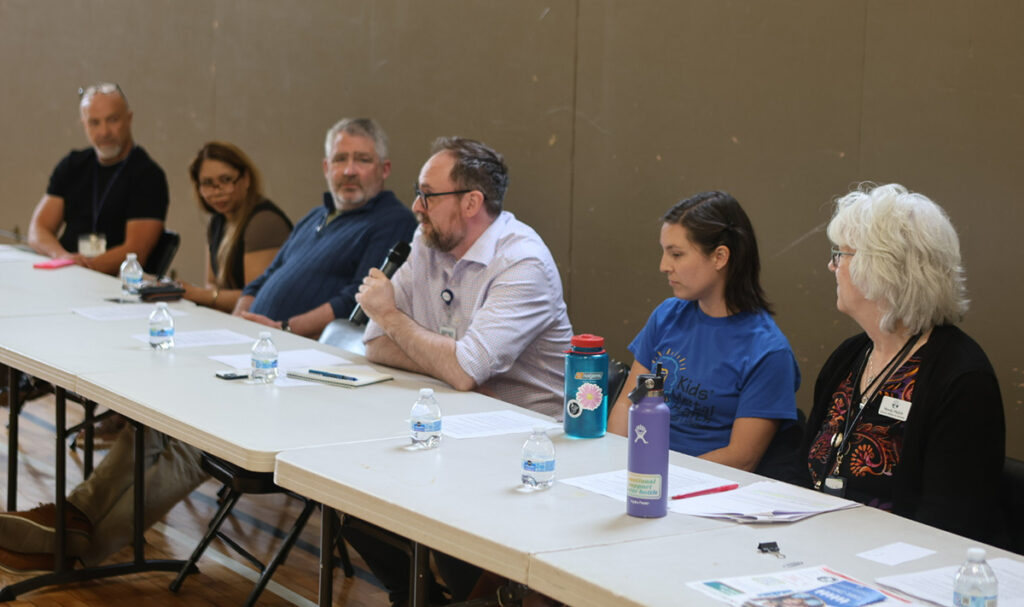
Dr. Lucas McIntyre, MultiCare Adolescent Intensive Outpatient Program director, answers a question at a Youth Mental Health Town Hall on May 7 at the Key Peninsula Civic Center. Photo by Christina T. Henry
“We are always dispelling this myth, talking about suicide does not lead to people being suicidal,” McIntyre said.
He encourages parents to ask directly if their child is thinking about suicide. “Because the more that they see that you’re comfortable saying the words, having the conversation, that makes them more likely to open up. That’s really important.”
Mental Health First Aid
Reaugh said protective factors that promote youth mental well-being include connections within the community and relationships with trusted adults. She urged everyone at the forum to think about their role in the “safety net” that keeps young people healthy, safe and feeling well.
Peninsula School District will present a Youth Mental Health First Aid Training, open to the public with registration, from 5 to 8:30 p.m. July 21 and 23, at the Red Barn Youth Center, 15921 84th St. NW in Lakebay. Learn to identify, understand and respond to signs of mental illness and substance use disorders in youth.
The materials fee is $40, or free for PSD employees. Dinner and scholarships available through Boys and Girls Clubs of South Puget Sound.
A Teen Mental Health First Aid Training (participants are teens) is planned for Aug. 10, 12 and 14 at the Red Barn.
For information and to register, email [email protected].