

Happy Friday and welcome back to The Microdose, an independent journalism newsletter brought to you by the U.C. Berkeley Center for the Science of Psychedelics.
What might the FDA Commissioner’s resignation mean for psychedelics?
FDA Commissioner Martin Makary resigned on May 12 after speculation that President Trump planned to fire him. During his tenure, Makary clashed with lawmakers on several drug regulation decisions, and he was also accused by conservative lawmakers of stalling the safety review of mifepristone, a mail-order abortion medication. He reportedly left over concerns about the agency’s decision to approve fruit-flavored e-cigarettes despite their appeal to young people according to the New York Times and other news outlets.
In his resignation letter — sent via a text message that President Trump then shared on Truth Social — Makary highlighted his accomplishments during the thirteen months he served as FDA Commissioner. “I’m extremely proud that we reduced drug review times from a year to 1-2 months,” wrote Makary. The second thing he listed as a point of pride was having written “new guidance to advance psychedelics.”
Both of these actions were part of President Trump’s executive order, signed last month, to help accelerate psychedelic treatments. One week after the signing, the FDA issued national priority vouchers to three companies studying psilocybin for treatment-resistant depression and major depressive disorder, and methylone, a drug similar to MDMA, for post-traumatic stress disorder. The goal of the voucher program is to get drugs to market faster. Those drugs are chosen to align with national priorities, including addressing urgent health threats and unmet medical needs. After receiving a voucher, when the clinical trial sponsor completes its studies and submits its final New Drug Application, the sponsor could anticipate a review period of 1-2 months. Without a voucher, this review could take up to one year.
The FDA has had significant turnover during the past year. Health and Human Services Secretary Robert F. Kennedy Jr. fired around 3,500 FDA employees, and many others resigned their positions. Losing a fifth of its workforce means the FDA has lost institutional knowledge and subject matter expertise. The next commissioner will take over the helm during a tumultuous time for the agency; his or her opinions about psychedelics could play a significant role in determining how Trump’s executive order is implemented. “The new commissioner will have to walk a tight rope between what the administration wants — Trump and R.F.K. Jr. — and what federal law commands of F.D.A.,” Nathan Cortez, a Southern Methodist University law professor who studies the F.D.A., told the New York Times. “Historically, the expectation is someone with an M.D. or PhD and real scientific chops. It’s a lot of pressure.”
For now, Kyle Diamantas, who currently oversees FDA nutrition and food safety protocols, will take over as the new acting FDA Commissioner. Diamantas is a lawyer who does not have a medical or science background. Prior to joining the FDA, he worked as a corporate attorney, and he once defended a top formula maker against claims that its product harmed premature babies. The Microdose did not find any evidence online of Diamantas making any public statements related to psychedelics.
Ketamine infusions rapidly reduce suicidal and depressive symptoms during major depressive episodes
In a systematic review and meta-analysis published in JAMA Psychiatry on May 6, researchers from Canada, Germany, Korea, and the United States analyzed results from 26 randomized clinical trials with 1166 patients with a major depressive episode. Overall, the evidence suggests that intravenous ketamine effectively and rapidly reduced suicidal and depressive symptoms.
Patients receiving a single ketamine infusion, compared with control patients, had significantly lower suicidal symptoms 24 hours later, and after one month. Repeated ketamine infusions resulted in a similar reduction in magnitude of suicidal symptoms at the end of the treatment. Patients had significant reductions in their depressive symptoms at four hours through one week after a single ketamine infusion, and at the end of the treatment after repeated infusions.
Approximately 280 million people globally are affected by major depressive disorder. Treatment options, including talk therapy, antidepressants, and neurostimulation can take weeks to help people feel better, and there is a population for whom these treatments do not work. According to the authors of the meta-analysis, there is a need for rapid-acting treatments to reduce suicide risk and depressive symptoms, and intravenous ketamine may be effective at meeting those needs in the acute phase of depression. However, longer term outcomes on safety and efficacy are still uncertain.

Could psychedelic-assisted therapy help improve adolescents’ mental health?
According to a review published in British Journal of Clinical Pharmacology on May 8, most participants in psychedelics trials to date were aged 25 to 65 years. The mental health conditions for which psychedelic-assisted therapy appears to be beneficial are highly prevalent in younger people. In fact, the authors write that “mental illnesses have a peak age of onset of 15 years, with 63%–75% of onset occurring by age 25 years, the opposite pattern to physical illnesses.”
The review analyzed all psychedelics research focusing on children and young people, dating back to the 1950s, as well as more modern observational research on traditional and Western non-medical use. Currently, there are no rigorous clinical studies testing psychedelic-assisted therapy for youth, but there is a growing interest, especially considering that suicide is the third leading cause of death for people aged 15 to 29.
The authors found limited existing research on young people. Despite that, the authors write, “psychedelics appear to be safe overall and may have the potential to improve mental wellbeing in young people.” They added that lifetime psilocybin use was associated with lowered rates of suicide risk, whereas LSD was associated with increased odds for suicidal thinking, planning and attempts. Adolescents who consumed ayahuasca for religious purposes reported lower levels of anxiety, body shape concerns, and attention problems, compared to adolescents from the same Brazilian school community who never used ayahuasca.
Some negative effects were reported, including that young people may be at greater risk for experiencing psychedelics-related anxiety, more likely to develop symptoms of Hallucinogen Persisting Perception Disorder (HPPD) symptoms, and tend to have difficult experiences of ego dissolution. “As the sense of self is still under development in adolescence, perhaps a disintegration or complete loss of ego might be more frightening and destabilizing for a young person relative to an adult,” the authors write. According to the study, these age-related ego dissolution challenges may indicate that researchers should consider focusing first on MDMA, which does not tend to produce feelings of ego loss.
National polling suggests a “rising tide of cautious support” for psychedelics
Researchers at UC Berkeley released the results of a second national public opinion poll on psychedelics that found that 74% of U.S. voters said they’d heard about psychedelics over the past 12 months and 57% had either tried a psychedelic themselves, or someone close to them had during the same period.
The survey was conducted by the UC Berkeley Center for the Science of Psychedelics, which publishes The Microdose but does not dictate its editorial decisions. The surveys were conducted in 2023 and again in 2025, and each polled approximately 1,500 U.S. voters from all 50 states and Washington, D.C. In the most recent poll, support for scientific research and regulated access to psychedelics seems to be increasing, with 63% of voters indicating support, up from 49% in 2023.
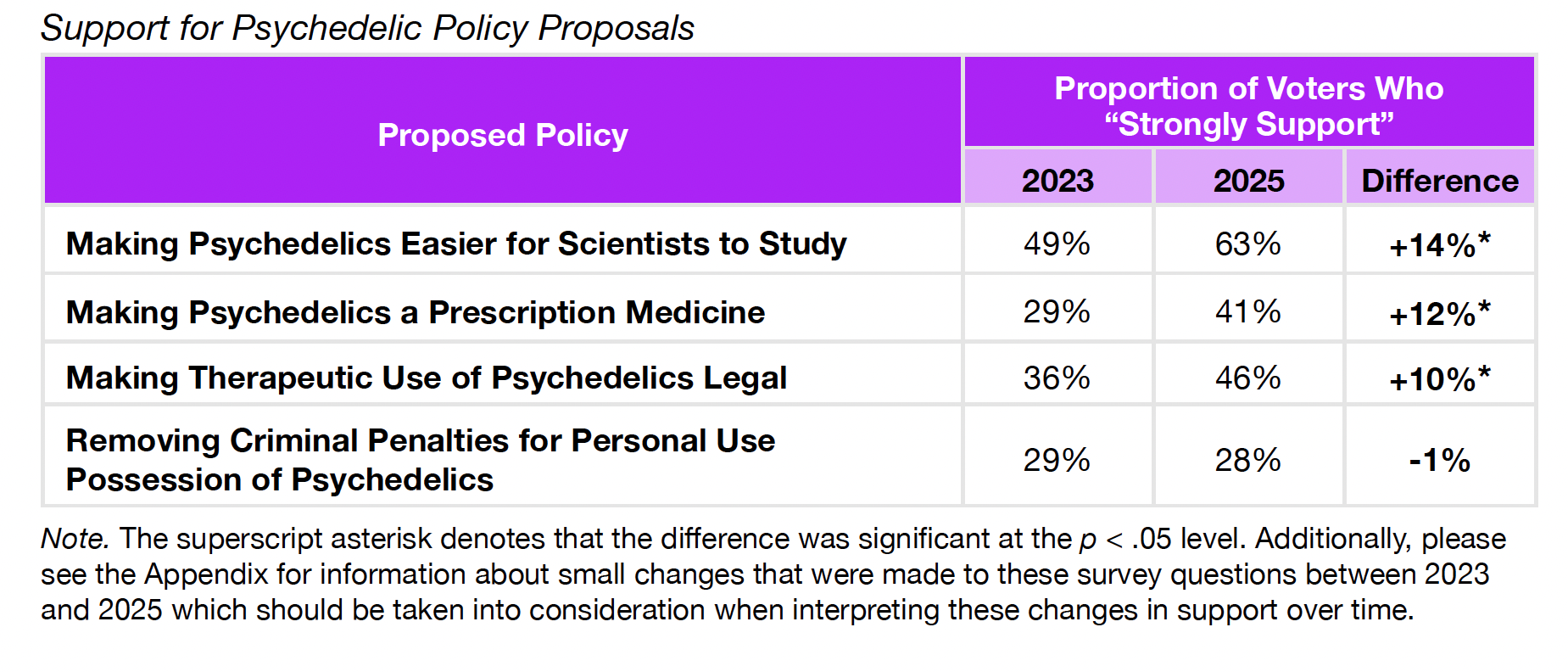
Those polled seemed most supportive of regulated access to psychedelics for people with depression, military veterans and people with addiction.
More news from this week:
In an opinion piece for STAT, Peter S. Hendricks, a professor of psychiatry and behavioral neurobiology at The University of Alabama at Birmingham, praised President Trump’s psychedelic executive order, but questioned whether the field is ready. Hendricks expressed the need to build a robust psychedelic health care workforce, follow rigorous clinical trial standards, create equitable access, and advance all psychedelics, not just ibogaine, which has been spotlighted recently. This article was published the same week as Hendricks’ 10-year clinical trial in JAMA Network Open, that studied psilocybin as a treatment for cocaine addiction. In an interview with Psychedelic Alpha, Hendricks explains the study findings and how his team recruited predominantly Black and socioeconomically disadvantaged participants from southern states which contrasts with other psychedelic studies that typically recruit more affluent and white participants.
The Illinois Senate passed SB 2772, which would establish the Illinois Psilocybin Advisory Board. It’s the first step of a larger bill, the CURE Act (SB 2184), which would establish a framework for the legal manufacture, delivery, use and possession of psilocybin. State Senator Rachel Ventura (D) is leading the legislation, originally introduced in 2024. During a two-year period, the Board would advise on health and safety recommendations to agencies that would implement provisions of the CURE Act, if passed.
The Louisiana House passed SB43 to create a psychedelic-assisted therapy program to fund ibogaine and psilocybin clinical studies for opioid and substance use disorders, and treatment-resistant mental health conditions. If signed by the governor, the bill would authorize the state’s Department of Health to seek funding from the federal government, opioid settlement funds, and other grants and gifts. []
You’re all caught up! We’ll be back in your inbox on Monday with a new issue of 5 Questions.
If you know anyone who might like the latest on psychedelics in their inbox, feel free to forward this to them, or click below.
Got tips? Email us at themicrodose@berkeley.edu.