
QuickTake:
Springfield City Council held a public hearing Monday, May 18, on a request from Lane County and PeaceHealth to annex property into the city for a crisis stabilization center and behavioral health hospital. Two nearby business representatives spoke in opposition, saying the property is not zoned for such uses. The City Council continued the public hearing until June 1 to allow more time to review the proposal.
When a Bethel School District student needed psychiatric care earlier this year, she was taken to the emergency room before being transferred to Portland for treatment because there are no youth inpatient psychiatric beds in Lane County.
“The family didn’t have the means to transport themselves up to be able to support her, so we rallied and got them gas cards,” Superintendent Kraig Sproles told the Springfield City Council on Monday, May 18.
Sproles was among 15 people who spoke during a public hearing supporting a proposed behavioral health campus in northwest Springfield that would include a crisis stabilization center and behavioral health hospital. Project planners say the center and hospital will allow youth to receive care more quickly and stay in the community for treatment. The facilities would also treat adults and expand the number of adult inpatient beds in the community.
“What we’re missing most is the tip-of-the-spear supports,” Sproles said. “The schools have done a lot to be able to start identifying, but when you identify a student that’s truly in need, the schools can no longer meet that need. The behavioral health center that you’re hearing about is one piece of a system of care that is essential. Without it, all the rest of it kind of falls apart.”
Lane County purchased property off International Way, about a mile from PeaceHealth Sacred Heart Medical Center at RiverBend, for the stabilization center. PeaceHealth, which has purchased an adjoining lot, would run the 96-bed facility, called Timber Springs Behavioral Health Hospital. The public hearing was for a request from both parties to annex the vacant properties into Springfield, which are currently in unincorporated Lane County but within the city’s urban growth boundary.
City staff asked the council to continue the public hearing until June 1 to allow them time to review testimony and new materials submitted ahead of the hearing. It also provides more time to negotiate an annexation agreement, which would outline the timing and fiscal responsibilities for extending public streets and utilities to the property.
Assistant City Attorney Kristina Kraaz said the council could continue the hearing past June 1 or make a decision that day. Annexations are adopted by ordinance, which require two readings and a council vote. Monday was the first reading.
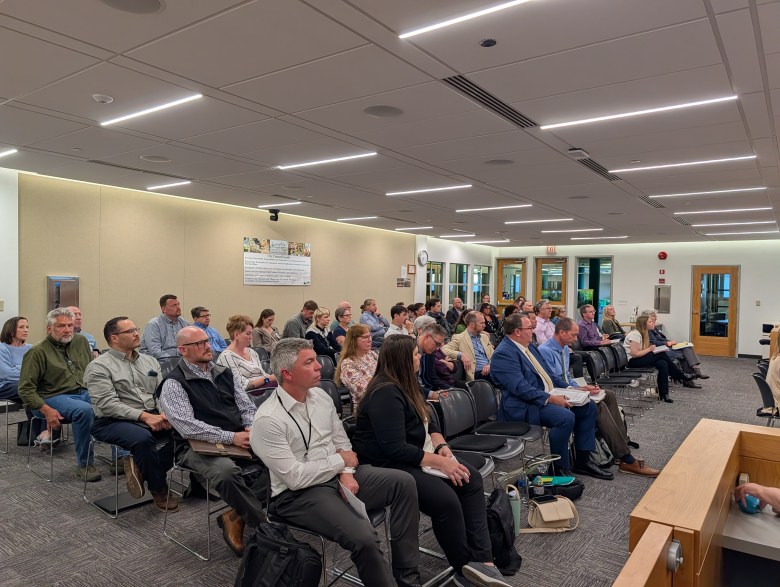 Community members attend a May 18, 2026, public hearing of the Springfield City Council on an annexation application for a behavioral health campus. Credit: Lillian Schrock-Clevenger / Lookout Eugene-Springfield
Super-siting and annexation
Mayor Sean VanGordon and council member Michelle Webber said they spoke with county officials about their lack of communication around a state law passed last year that, among other provisions, allows stabilization centers like Lane County’s to bypass city-required special use permits and plan amendments if they’re built alongside behavioral health hospitals.
“I have had several conversations with every member of the county commission expressing my deep dissatisfaction with the super-siting bill and their level of communication to this community,” VanGordon said.
Mike Reeder, attorney for PeaceHealth, said property owners have the right to seek annexation regardless of the intended use as long as there are sufficient urban facilities and services.
“And the resounding answer to that question is yes,” Reeder said. “This is a fully developed area.”
Michael Gelardi, legal counsel for Richardson Sports, who also spoke on behalf of G Group, said House Bill 2005 doesn’t apply to annexation, “and the city’s normal annexation rules require the city to evaluate the planned use, whether it’s permitted in the zone, and if so, then whether there are adequate public facilities and services to serve that use.”
Richardson Sports and G Group are among the plaintiffs in a lawsuit, filed against the city and county, challenging the constitutionality of the state law.
“Both Richardson Sports and I personally agree these buildings and services are needed in our community, but we feel this is the wrong site and not consistent with the approved zoning,” said Ardel Wicks, the chief financial officer for Richardson Sports.
VanGordon asked Kraaz to provide a legal analysis of how House Bill 2005 affects annexation at the June 1 meeting, as well as how prior transportation agreements apply and what the impacts would be at the intersection of Beltline Highway and Gateway Street.
Wicks and Gelardi questioned why the project is not being planned for undeveloped land by PeaceHealth RiverBend, which is planned and zoned to accommodate such uses. Reeder said the land close to the hospital is being reserved for uses that require ambulatory services and a nearby trauma center.
The stabilization center would be the first in Lane County. Currently, the only option for an individual experiencing a mental health crisis is to go to the emergency room, where they might face a long wait before transferring to a psychiatric facility. The center would act as an emergency room for behavioral health crises.
It would relieve pressure on all Lane County emergency departments, reducing patient wait times, said Alicia Beymer, chief administrative officer at RiverBend.
Currently, PeaceHealth’s 35-bed psychiatric unit in the university district cares only for adults. The behavioral health hospital will have 24 beds for adolescent psychiatric care and 72 for adult care.