
From the weather to sports to the performance of the stock market, predictions are a regular feature of our lives. Most of these sectors rely on past data and models that can give us a decent sense of what to expect in the future.
And as complex as meteorology and economics are, one researcher wants to bring a possibly more complicated topic into the world of predictions: human emotions. Specifically, Joshua Curtiss, a Northeastern assistant professor of applied psychology and mental health researcher, is investigating how a person’s emotions can be predicted using machine-learning models.
Being able to predict someone’s emotions in this way could provide insight into how they experience mental health disorders such as anxiety and depression, according to Curtiss. With that insight, providers could offer proactive and tailored mental health support.
Two models had the lowest error in predicting the four emotions, Curtiss reported. For contentedness and cheerfulness, it was a model that forecasts based on past performance that seemed to be most accurate. For sadness and anxiousness, it was the ensemble model that produced a sort of composite of the individual models’ results to make a prediction, according to Curtiss.
Oftentimes, the treatment or intervention for these disorders, which can include therapy or medication, are a one-size-fits-all approach, said Curtiss, who leads the Computational Clinical Psychology Lab. He argues that what works for one person may not be effective for another because humans are so diverse.
“Maybe there are better ways we could help personalize mental health and better understand the individual,” he said.
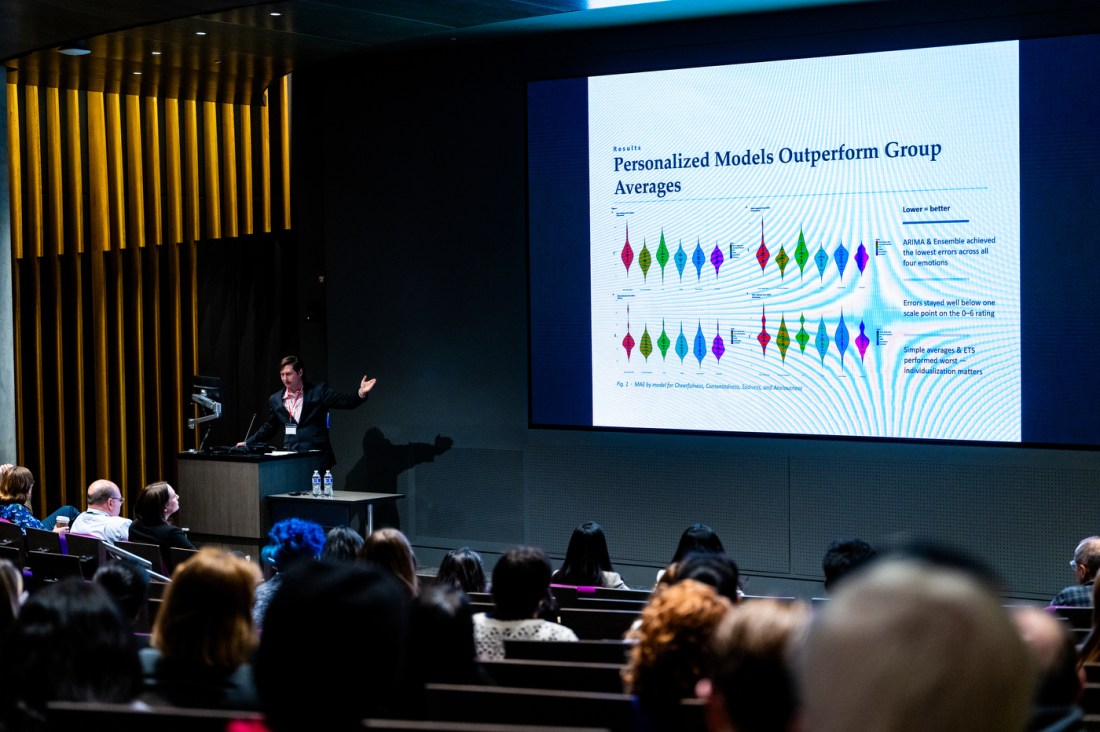 05/12/26 – BOSTON, MA. – Northeastern professors Stephanie Noble, Laurel Gabard-Durnam, Hyunju Kim, and Joshua Curtiss give flash talks on emerging technology during the 2026 CBH Institute Day in ISEC on Tuesday, May 12, 2026. Photo by Alyssa Stone/Northeastern University
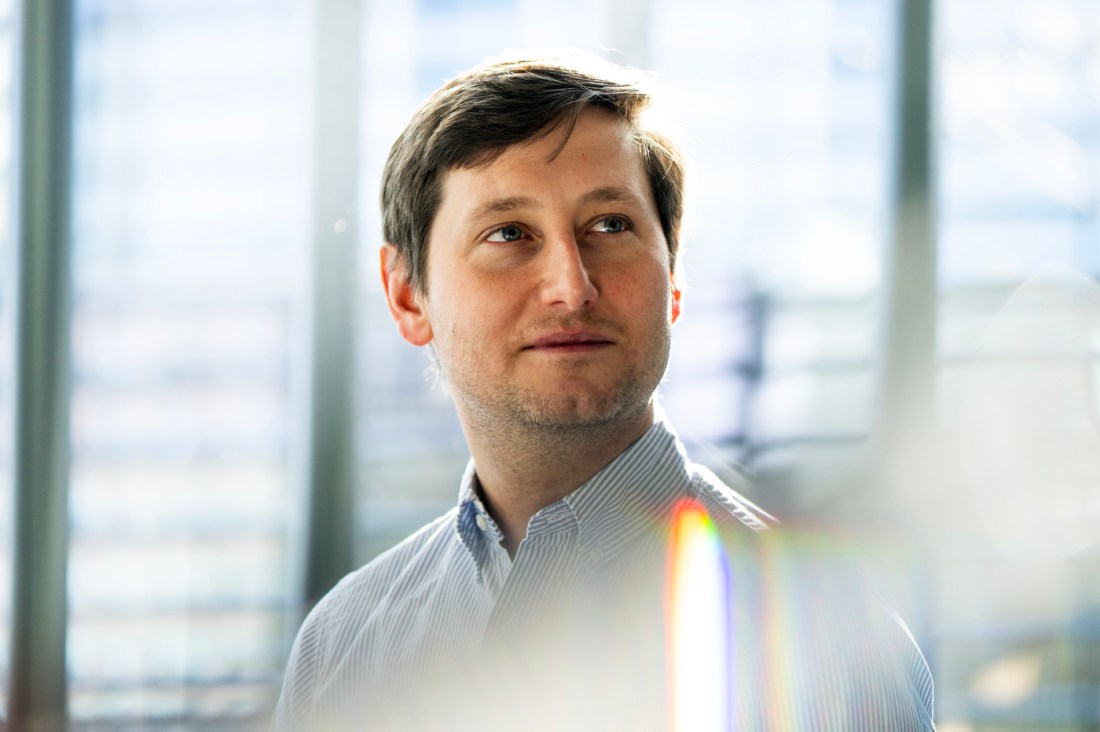 02/20/24 – BOSTON, MA. – Joshua Curtiss, Assistant Professor at Northeastern University in the Applied Psychology Department, with an appointment in the Center for Cognitive and Brain Health and an affiliation in the Psychology Department, poses for a portrait in ISEC on Tuesday, Feb. 21, 2024. Photo by Alyssa Stone/Northeastern University
Northeastern assistant professor and mental health researcher Joshua Curtiss is studying how machine learning models could predict emotions, which could have implications for tailored mental health response. Photos by Alyssa Stone/Northeastern University
The pilot study, which Curtiss gave a brief overview of during the Institute for Cognitive and Brain Health’s Institute Day, focused on 34 people who had an official emotional disorder diagnosis. These participants were asked to report on a seven-point scale their emotion in that moment: contentedness, cheerfulness, sadness and anxiousness. The questions were posed five times a day over a two-week period.
The responses were then fed into a half dozen individual machine-learning models to see if the model could identify patterns and predict the participant’s future emotion. The individual models ranged from using the average score of a person’s reported emotion and correlating that to an emotion on the seven-point scale to using a neural network, which mimics the brain in how it processes data, to find other patterns. These models were compared to a baseline of the average response across all study participants.
Northeastern Global News, in your inbox.
Sign up for NGN’s daily newsletter for news, discovery and analysis from around the world.

The accuracy of these models was tested by comparing the predicted value of a person’s emotions to the actual recorded value. Preliminarily, Curtiss found that the individual models were more accurate than the group-level benchmark in predicting a person’s emotions about one day in the future.
Moreover, the research suggests that while one type of prediction model may work for one person, emotional disorder or emotion, but could be inaccurate for another – which drives home the need for individualization.
While this research is still in the early, “proof of concept” stages before it can be regularly implemented in the world, Curtiss said that with more validation, forecasting machine learning could have implications for more personalized interventions.
It could be as simple as offering someone a head’s up to prepare how they might feel at a point in the future. It could also mean empowering someone with the knowledge to begin to engage in a certain habit or dissuade another, based on their emotions, “to give some bandwidth and wiggle room to preempt or offset some of the things we think could be happening in your future,” Curtiss said.
“Better prediction really means better care,” said Don Robinaugh, an assistant professor who is also in Northeastern’s Applied Psychology department but was not involved in the study.
“People are just enormously complex, and the challenges that people face, while they can seem very similar on the outside, things like depression and anxiety often have very unique and person-specific factors that are driving those areas of distress,” Robinaugh said.
Curtiss’ work “really embraces that complex reality” in a way “that appreciates how unique we are and how there may be different factors driving any given individual’s distress, and then we need models that are really tailored to the individual if we’re going to better predict where their mental health is going and how we can potentially best support them.”
The lab is now working on expanding the research to more people, different populations and for longer time periods. They’re also looking at what value, if any, data from smartphones or wearable technology — determining if someone is active or sitting at home, for example — can add to someone’s subjective emotional report.
The research is not without its challenges, however. One is how far in the future these predictions can be made because of both internal – one’s personality, thoughts, feelings and preferences – and external factors that can affect a person’s mental health.
“I have no way of predicting whether someone will receive health news from a doctor two months from now. I have no way of knowing whether someone will experience frustrating news about their job or their career three weeks from now, for instance,” he said.
“The main thing is trying to find a good balance. It might be too much to say, ‘Let’s develop a perfect model that predicts how you’re going to feel on a Tuesday a year from now,’” he said. But more realistically, Curtiss said being able to make these predictions just one or two weeks out could be helpful.
It’s why Curtiss equates this to the weather. These predictions are a best guess, but may not be 100% accurate.
“Even if I did have perfect information, it’s really challenging to predict these things because, almost like the butterfly effect, little individual differences in a person’s mood or affect one day can lead to more chaotic, unpredictable behavior later on,” Curtiss said.
He added: “No matter how good of a job we think we’re doing, we can still get things wrong. So, we need to make sure that we’re being very responsible about this.”
Robinaugh also noted the challenges with predicting emotions, but was hopeful by the research, calling the potential “enormous” and “game-changing.”
“There’s a long way to go, but this is, I think, a really exciting and promising direction, and I think the more that we can help people understand that these ideas are out there, the more we can try to help continue to build this work,” he said.
Hannah Morse is a news reporter at Northeastern Global News.