

Greetings, MindSite News readers.
In today’s Daily, a horrifying school disciplinary practice took place in New York State’s Salmon River Central School District, sending reverberations of collective pain throughout the Akwesasne Mohawk community. Federal funding cuts to mental health are threatening California’s burgeoning mobile crisis response system. And one psychiatrist’s argument that kindness can heal the brain.
But first, arts educator Freddie Hendricks, founder of the Youth Ensemble of Atlanta, has won the 2026 Excellence in Theatre Education Award, a special Tony Award that honors educators. Nominated by one of his former students, Hendricks told the Associated Press that he develops youth performances from the ideas and topics that are important to his students.
“A lot of kids these days, they don’t love themselves,” Hendricks said. “They don’t know who they are, for one thing. And I just kind of start with that and then go with loving themselves for who they are and letting them know up front, ‘In here, this is a safe space. You’re loved in here. You’re accepted in here. This is your home.”
California has been building a mobile crisis response system. Federal cuts – and a state budget decision – could dismantle it.
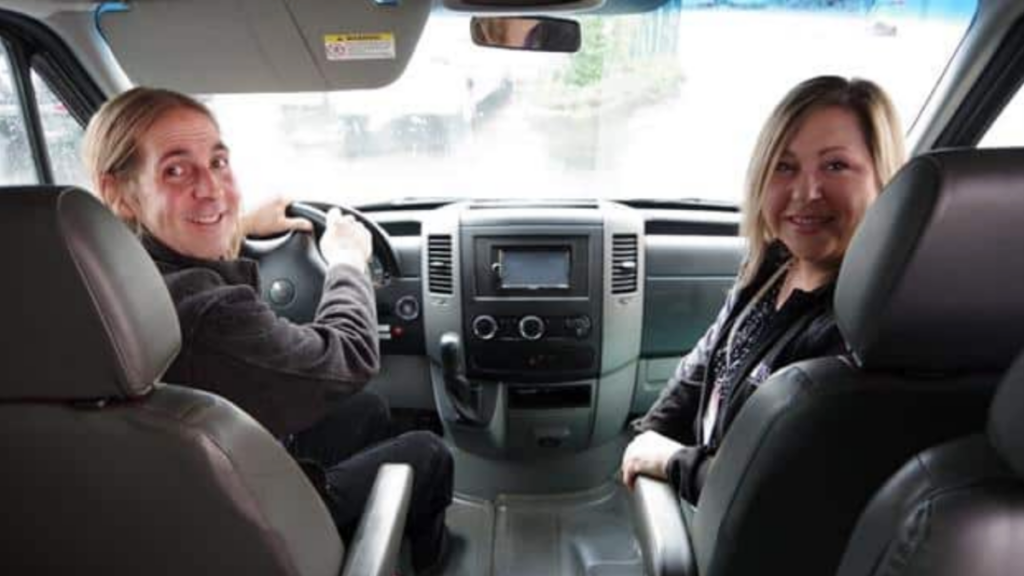 Mobile crisis unit of Shasta County, California, 2022. (Photo: Thomas Patterson)
California’s mobile crisis response system — the network of trained behavioral health teams dispatched when someone calls 988 in light of a mental health emergency — is facing a serious funding threat.
Beginning in April of 2027, the enhanced federal Medicaid matching rate that helped states build and scale these services is set to expire.
In anticipation of the change, Gov. Gavin Newsom has proposed a 2026-27 budget that would shift mobile crisis response from a required Medicaid benefit to an optional one, transferring costs previously covered by the federal government directly onto California’s counties.
For rural and under-resourced communities, the change could mean that these services simply disappear. California’s citizens can’t afford the risk, according to the Steinberg Institute, a mental health advocacy, education and research organization.
The institute argues that the state must allocate disappearing federal dollars to local counties and ensure the continuity of mobile crisis services statewide.
Not doing so would catapult communities back into a well-documented failure loop. When mobile crisis services aren’t available, police and hospital emergency rooms become a person’s first state of crisis support — often resulting in incarceration rather than care.
Moreover, the institute argues, low- or no-cost administrative changes, including a formal structure between state entities that use 988 crisis funds and a formal process to draw down those funds, could support keeping services in place by ensuring that they’re applied effectively.
A New York school district locked Akwesasne Mohawk children with disabilities in boxes. No one has been fired.
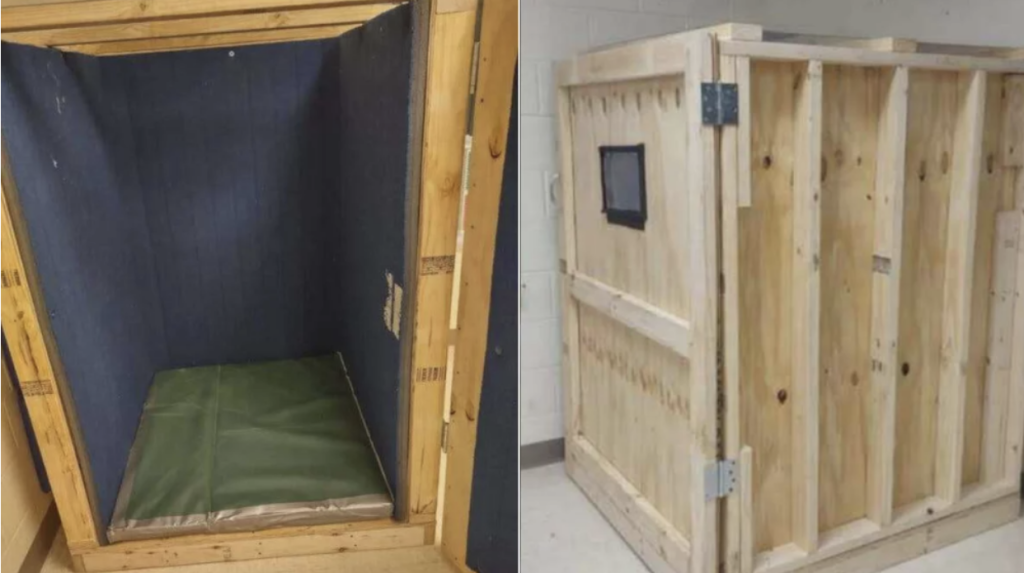 Photo: National Public Radio/Photo provided to NPR by Chrissy Onientatahse Jacobs
Over a century and a half, at least 3,100 Native American children died as the U.S. government forced them into boarding schools where their languages and traditions were violently repressed, according to the Washington Post.
Today, the collective memory of that horror feels fresh as residents of a small network of upstate New York communities, which includes parts of the St. Regis Mohawk Reservation, tell NPR of a disturbing disciplinary practice inflicting similar institutional harm against Native children, who were confined in wooden boxes called “calming stations.”
The Salmon River Central School District, where roughly two-thirds of students are Mohawk, confirmed that special education staff constructed and used wooden boxes to confine disabled elementary students during November and December of 2025.
“It was so unfathomable that our children were seeing these boxes and hearing children screaming in these boxes,” said Sarah Konwahahawi Herne, a parent and member of the tribal community.
Children were placed inside the boxes, with the door held shut, for a “timeout.” The scandal broke following a post on social media, since school officials did not notify parents — further violating state regulations against corporal punishment and isolation.
“None of us could believe initially that was true,” St. Regis Mohawk Tribal Chief Michael Conners said. “It was verified that it was and it was defended as legal. Nobody could believe it was legal to have that in our schools, with the intent of using that box on our children.”
New York’s state education department has since issued a compliance order requiring sweeping reforms in the district. Its investigation confirmed that at least five elementary-age students with disabilities had been confined to the boxes.
The May 8 order, obtained by NPR, prohibited school staff from using “corporal punishment, aversive interventions, and seclusion.”
Full details of the compliance order have not been made public, though it did not require the dismissal of staff involved in creating or carrying out the practice. The state education department says that personnel decisions remain a matter of local control.
Further compounding the community’s pain, several employees involved in the illegal aversive action are members of the Akwesasne Mohawk community — as are a majority of the local school board members.
“The fact that these were our own people working in these schools, hurting our children, allowing this to happen, it was so frustrating, so angering,” said Chrystalynn Jock, a parent and tribal member whose child attends the St. Regis Mohawk School.
Since news became public, the district has made several major staffing changes: Two interim superintendents quickly departed before a third, Ben Barkley, was appointed in March.
A teacher who had been placed on administrative leave was arrested by state police in May on charges of endangering the welfare of a student, though it’s unclear whether that case is directly connected to the confinement boxes. A permanent head of special education was hired to implement reforms mandated by both the local and state investigations.
“Nothing like this will happen in Salmon River again,” Barkley said. “We will be in full compliance with the state education department.”
But parents and tribal members like Herne feel less than optimistic, saying that the announced reforms don’t go far enough. The district has refused to issue a formal apology.
“I’m not trying to be on a witch hunt,” she said. “I’m just trying to hold people accountable and make a safer place. If they have to stand up and admit they were wrong, that’s what they need to do. That helps us all heal.”
The neuroscience of being kind
Roughly 20% of American adults struggle with their mental health every year, dealing with mood disorders like depression and anxiety.
While some require professional treatment to achieve relief, psychiatrist and author Dr. Daniel Amen says that kindness is a readily accessible, free tool that can help heal our brains. There’s even science to back him up, he writes in USA Today.
So much of our distress is driven by a focus on our pain, worries or frustrations, keeping the default mode network of our brains — which drives rumination and overthinking — overactive. This can push us into a mental loop that exacerbates suffering.
But acts of kindness are a powerful disrupter. When we shift our attention outward toward supporting or helping someone else, we not only reduce activity in the default mode network of our brains but also trigger the release of “happy” neurotransmitters like dopamine, serotonin, endorphins and oxytocin.
These brain chemicals help boost moods, lower stress and strengthen interpersonal connections.
In other words, “kindness is not just a moral virtue,” Amen writes. “It is a biological intervention that changes the way the brain functions.”
Reducing our digital connectedness in favor of in-person engagement is also an imperative for overall mental health for youth and adults alike. More than half of Americans report feeling lonely, and over a third of young people say loneliness disrupts their daily lives. Excessive screen time drives isolation, weakens meaningful relationships and ultimately keeps people unhappy.
But finding ways to connect outside of screens through volunteering or otherwise helping others can help reconnect neural pathways associated with connection, resilience and purpose.
In fact, emerging research on older adults in Baltimore found that those who volunteered regularly showed improvements in areas of the brain linked to memory and cognitive function.
Amen is careful to note that kindness is not a substitute for professional treatment. If you’re struggling with depression, anxiety, or other mental health challenges, seeking clinical care remains essential.
But for most of us, the research suggests one of the most effective tools for our mental health has been available all along — and it doesn’t cost a thing.