
 image: ©Frazao Studio Latino | iStock
Claire Jackson, Authorising Engineer (Water) at HC Legionella Ltd, outlines the challenges of managing Legionella control in mental health settings, emphasising the need for comprehensive risk assessments
HTM 04-01 sets out the requirement to manage and mitigate risks associated with Legionella and other waterborne pathogens. This requirement has been strengthened by the issuance of the 2024/3 NETB Guidance. This need applies to all healthcare settings, but task completion is increasingly complex in mental health settings. Specifically, these challenges include access, ligature risk, patient vulnerability, and the need to balance infection control with patient and system safety. At HC Legionella, we have decades of experience with such sites, which gives us unique insight into how to navigate these challenges.
The importance of Legionella risk assessments in mental health settings
The control of Legionella and other pathogens will always start with a risk assessment. In mental health settings, the need to assess more than just the pathogen risk is critical. We need to ensure that the outlets are safe and restrict the opportunity for an asset to become a ligature or for other self-harm risks. These designs can lead to flow restriction or complex internal structures that increase stagnation or make cleaning and maintenance more difficult.
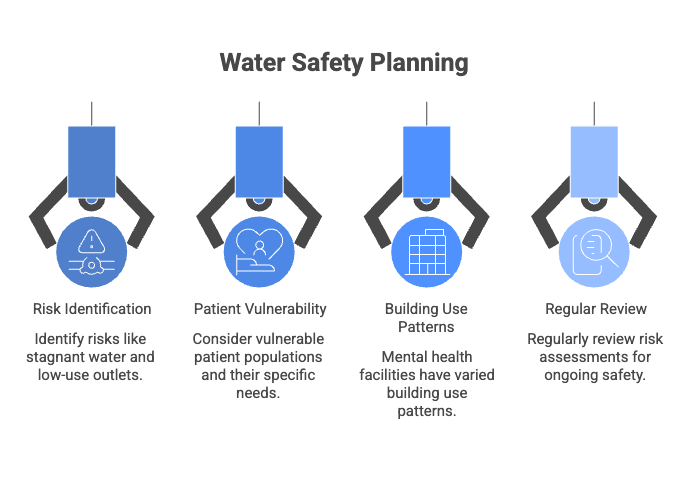 Image: ©HC Legionella Ltd
A second factor, especially prevalent in patient areas such as seclusion or rarely occupied wards, is the irregular use of water and systems. Some outlets in such areas may remain unused for extended periods. This creates ideal conditions for bacterial growth, so flushing regimes must be stricter and more closely monitored than in typical healthcare settings. HC Legionella understands what drives these conditions and accounts for these factors in our risk assessments in mental health settings.
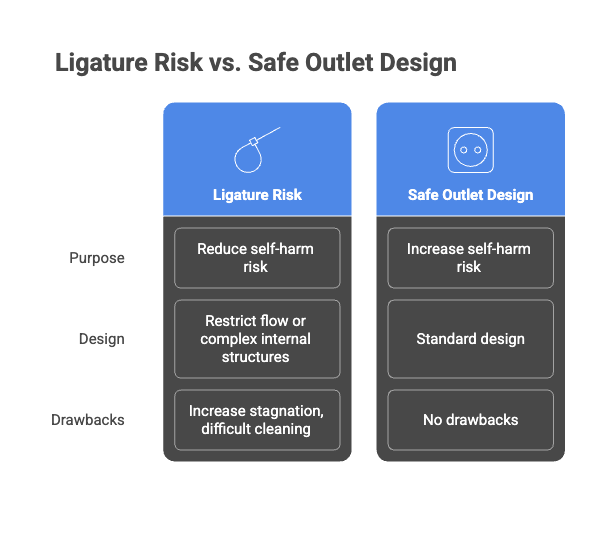 image: ©HC Legionella Ltd
Approaches to infection control
Once the system has been risk- assessed, we will know the levels of risk present on site and our ALARP (the target level of risk we aim to work towards). The target risk is not zero; it is the level of risk we are prepared to tolerate. This may be lower in healthcare settings due to increased susceptibility. By working with your estates and Infection Control team, HC Legionella will develop a water management strategy tailored to your site, taking into account your site- specific challenges, whether system-, patient-, or asset-led.
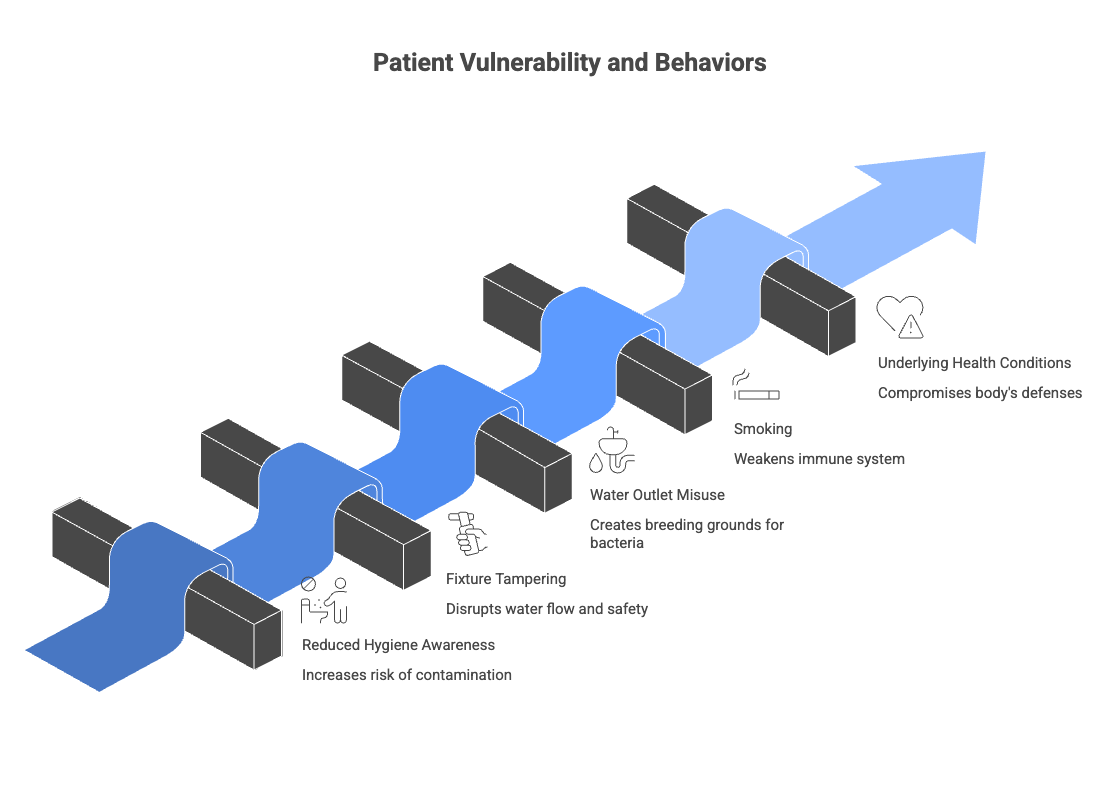 Image: ©HC Legionella Ltd
Now that we have our risk assessment and understand our risk levels, we will likely need to develop a Written Scheme of Control to manage the identified risks. This process balances infection control with safety control. For instance, limiting temperatures with Thermostatic Mixing Valves (TMVs) will significantly reduce the risk of scalding. However, these requirements require management and maintenance. We may need to take monthly temperature readings to ensure that the outlet is operating correctly. We need to ensure the unit’s fail-safes are in place and perform an annual service on the TMV. All of these tasks will require access to the ward and disrupt patients’ routines. These are the practical considerations.
At HC Legionella, we know that by working with estates and nurses, we can limit the impact of these services by coordinating with patient care teams to schedule planned maintenance around patient schedules. Additional concerns remain, though. We know that anti-pick sealants are required and must be set before we leave the area. We know that all tools must be accounted for and all doors secured before starting work or leaving an area.
TMVs present operational challenges, as does providing water services without a ligature risk. The common challenge here is showers. In line with HSG 274 Part 2 Table 2.1 and HTM04-01 Part B Table 1, shower heads should be cleaned and descaled quarterly (or as noted by the risk assessment). Shower cleanliness is an important factor in Legionella control. We have an outlet that is used infrequently (often only once daily), with temperatures in the prime growth zone (between 38 and 43°C via a TMV) and high aerosolisation, creating a clear infection pathway for any Legionella present to reach the patient directly from the system.
Addressing water hygiene challenges in mental health facilities
Outlets in mental health settings pose a wider challenge, and it’s not just showers. Due to the complex mental health challenges some patients may have, the risk may extend beyond Legionella. It is common for drains to be blocked, taps to be interfered with, or human waste to come into contact with parts of the water system that are not designed for that purpose, such as faeces on taps or urine down drains. These challenges mean that our monitoring and testing regime may need to be broader than for common hot and cold-water systems. Awareness of these circumstances comes with experience; it is not taught in regular risk assessment, monitoring or inspection training. Having an active dialogue with Care and Estates teams is a key part of this model. Clear communication pathways between your teams and your contractors are critical. If a situation occurs, or circumstances change, ensure it is documented, shared and escalated to the right people. It’s the cornerstone of good system management, an effective communication pathway.
The final part of the puzzle, once we have a risk assessment, a scheme of control and monitoring records, is to ensure that all staff, whether internal or external, are trained and competent to manage and monitor the system. We stated earlier that complex sites present scenarios that are not commonly covered in routine training. It is vital that the staff and subcontractors working on your system are aware of the situational challenges associated with water hygiene control in mental health settings. They need experience of these settings to look beyond routine checks and to anticipate the challenges that may need to be overcome. With decades of experience, HC Legionella has seen many of these sites and has the skills and competence to help you manage and mitigate these risks, even when some are not obvious to the untrained eye.