
By Cleo Whitney
“We don’t necessarily support the youth, we support the parents,” says Felica Harris, a peer support specialist with the Dane County Behavioral Health Resource Center.
This approach reflects a broader trend in youth mental health: a community-based strategy that supports the child by first supporting the parents. For organizations like the BHRC, the future of mental health for Madison’s youth relies on creating an even stronger foundation for long-term healing.
Reframing behavior as communication
All too often, children acting out are seen as ill-behaved, disruptive or simply annoying. But this dysregulation can be a telltale sign that needs are not being met. For young children, this isn’t intentional; it’s just the tools they have for expression. But it is then the job of the adults in their lives to help interpret the signs.
Young children — typically defined as below eight years old — communicate strong emotions through behavior, not words. This conflicts with health systems and clinical work that are built around verbal expression. By understanding behavior as communication, adults can then themselves model vulnerability and curiosity to support the youth around them.
According to Brown University Health, disruptive behavior signals one of three things: a child wants something, wants to avoid something or needs sensory stimulation. In young children, this can look like trouble regulating, attachment issues, big reactions, certain behavioral patterns or the lack of patterns altogether.
Robyn Wallin is a therapeutic services team supervisor at RISE Wisconsin, an organization dedicated to supporting children’s mental health in Dane County. She talks about reading the extremes of child behavior with levels ranging from “shut down” to ‘activated.’
“So a kiddo is expressing themselves through physical aggression or getting loud, their body getting loud,” says Wallin. “That is still communication.”
For young children, talk-based therapy may not be a reliable form of communication. This makes cognitive behavioral therapy, one of the most common forms of therapy for adults, often ineffective for children.
And so the question remains: how do we support children when they are unable to communicate their emotions to adults?
Parents: Get curious, not controlling
Rhetoric about mental health for adults often touches on the principle of self-autonomy: the individual must want to change in order to receive and benefit from help. Harris says this is true for children, too, an idea that may feel surprising to some parents. Rather than correcting them, she explains, the goal is to guide children towards using the tools they already have.
“When you continue to ask the ‘why,’ you’re no longer accepting the surface level answer,” Harris says. “You’re having them dig deep: ‘What’s showing up for you? Why?’” And you have to follow the question “why” with “what,” she added.
Model emotional expression
Development psychology research has shown that children learn emotional regulation and emotional literacy through observation and modeling the actions of the adults around them, according to a 2009 study. For most children, the adults they are closest to are their parents.
Wallin says there are some questions adults should be asking themselves: How are we modeling being brave? Being vulnerable and expressing ourselves? she says, and adds: “I think youth are looking to us as what they’re going to become as adults, right?”
This kind of modeling is beyond the “big moments,” the meltdowns, power struggles, times when emotions just spill over. It goes beyond even the moments that adults feel they are parents: how they handle stress at the end of the day or say ‘thank you’ to a cashier. If behavior is communication, then adults must recognize that their everyday actions are in constant conversation with the children around them.
Community caregiving
Simply understanding the behavior is just the first step. But sometimes, parents may find themselves out of their depth and need outside help. That is where these organizations come in.
During COVID, mental health partners like RISE turned to traditionally unconventional methods to connect with kids. Activities ranged from virtual at-home scavenger hunts (“find something in your house that brings you joy”) to socially distanced outdoor conversations while walking or playing kickball.
Sure, these activities were fun, but they filled the gap where community connection had been dispersed. Settings could be more familiar and comfortable.
“It’s okay if you just feel how you’re feeling, even if you don’t know what that is or how to express that,” Wallin says. At the same time, there was an even greater push to involve families so they could offer similar support outside of therapy. Another method is parent peer support.
According to the Wisconsin Department of Health Services, peer support has been a part of the Division of Care and Treatment Services since 2010. Peers have experiences with mental health — whether it be their own or a family members — and become paired with an individual to build a relationship. This non-clinical option is person-centered and dedicated to mutual support.
As part of her work at BHRC, an organization for free community assistance with behavioral health and substance abuse in Dane County, Harris offers support, trust, and resources to anyone seeking assistance.
“We as peers had to get very, very, very creative. And we looked at ourselves like we were urgent care workers, because we were,” says Harris.
While waitlists for comprehensive community services (CCS) grow and patients struggle to comprehend the complexities of health care systems and health insurance coverage, organizations like RISE and BHRC hope to expand access. These organizations and others like them act as what Harris refers to as a “transition space” for families and work to fill the gaps in need.
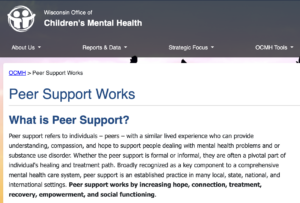 Screenshot of a Wisconsin Office of Children’s Mental Health study on peer support groups.
The Wisconsin Office of Children’s Mental Health identified a 2024 research review showing that peer support services were considered significantly effective in improving mental health among youth in 81% of studies. In particular, the programs improved outcomes and limited health-related expenditures. The BHRC provides resources for more than a dozen organizations in the Madison area, all focused on children and youth mental health, including RISE, which alone serves 3,300 children each year.
Yet they must strive to keep up with their own waitlists. As recently as 2021, waitlists for mental health care facilities in Madison could be months long.
But for some parents, programs like RISE and BHRC became a lifeline.
The value of such programs is in teaching parents how to talk to and relate to their children. According to Adrianne Farrow, the mother of an eight-year-old daughter, accessing these support services has taught her “how to talk to my child.”
“Without these programs,” she said, “I would not have known these things.”