
By KATE RUDER
After Lauren Brand’s husband died, it was a challenge to get back to her social and professional life in her mountain community of Frisco.
“It was also difficult to find a therapist to talk to in person in Summit County,” Brand said, “and it ended up being prohibitively expensive and unhelpful.”
Brand’s husband, John Kane, died about a year and a half ago. He was 47.
After seeing a Facebook listing for a free local bereavement support group last winter, Brand signed up for four sessions. But the setting was different from typical meetings in churches, hospitals or online. It was at the Summit County Coroner’s Office and led by the coroners themselves, who also shared stories of losing people they loved.
Deputy Coroner Britt Lea started Colorado’s first bereavement support group that coroners fund and operate. All six of last year’s sessions were at capacity–no more than eight participants and two facilitators per four-week session, as “the small group dynamic is extremely powerful and important,” Lea said. There is still availability for sessions later this year.
“They found a need and addressed it,” said Shane Sheets, president of the International Association of Coroners and Medical Examiners, noting that it’s the first time he’s heard of coroners performing these services on site at their offices.
Fostering mental health in communities may not come to mind when thinking of coroners. However, in several Colorado counties, coroners have implemented unique programs to reach people without easy access to counseling or therapy outside the Front Range. Forty percent of Coloradans live in areas with a shortage of behavioral health care workers, including in Summit County.
Brand said the sessions helped her release feelings of abandonment, anger, loneliness and grief, and instead invoked feelings of honor in helping her husband’s journey to death and gratitude for the life they shared.
“I don’t think people know how to grieve and deal with death,” but the coroners in Summit County are uniquely focused on supporting the family, friends and community of loved ones who’ve died, Brand said.
The coroners are not counselors but facilitators who have been trained through a program called Facing the Mourning, developed at the Heart Light Center in Denver.
“It was an odd, yet natural fit to offer grief support,” Lea said.
Making it free is important in Summit County, where residents’ high living costs can put paying for grief support out of reach, said Summit County Coroner Amber Flenniken. About 30,000 permanent residents live in Summit County.
Flenniken also has three survivor-support workers on call to help families when she or other coroners arrive on the scene. Park County Coroner David E. Kintz, Jr. uses a similar model in his rural community.
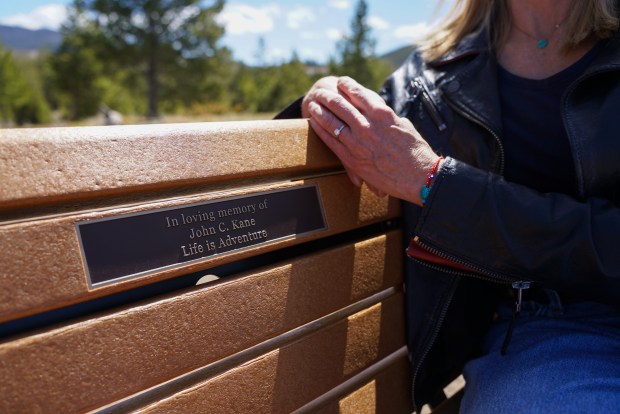 Lauren Brand sits on a memorial bench commemorating her late husband, John Kane, on Tuesday, April 21, 2026, in Frisco. The plaque is a dedication to her husband’s adventurous spirit and a playful way of honoring the way he spoke, she said. (Photo by Armando Geneyro/Special to The Colorado Trust)
Larger than the state of Delaware and covering 2,211 square miles, Park County is a vast area with only 18,000 permanent residents. Fourteen trained survivor-support volunteers with the coroner’s office are located across the county and respond to deaths in nearby communities at any hour of the day or night, 365 days a year. In 2025, there were 96 deaths in Park County and 101 in 2024.
“They provide whatever support services are needed for the family. That could be just sitting and saying nothing or being a shoulder to cry on,” Kintz said.
Volunteers call back to check in on families in the weeks and months after a death, Kintz said, adding that the number of hours his volunteers dedicate is incredible and “really from the heart.” He estimates they spend, on the low end, 1,250 hours each year volunteering for the coroner’s office.
Suicide prevention is another area, other than grief support, where coroners are stepping up. They provide behind-the-scenes data to state or local partners to inform analysis of broader trends or populations at risk.
Park County had the highest county-level suicide death rate in the state from 2019 to 2023, with 47 deaths per 100,000 people per year. For the first time this year, the county received a grant from Colorado’s Office of Suicide Prevention to encourage more data collection on suicides. Information such as prior attempts, substance use, sexual orientation and other details is collected from family and friends about their loved ones’ lives and circumstances leading up to suicides as part of Colorado’s suicide death investigation form, which was developed in 2016 and updated in 2022.
Summit County–which had six suicide deaths in 2023, and five each in 2024 and 2025—has also received grants from the state Office of Suicide Prevention for its coroners to use the death investigation form. Data from this form and the coroner’s office helped Nadia Borovich develop suicide prevention programs to reduce stigma about mental health for young men in Summit County. Borovich is the community wellness coordinator for Building Hope Summit County, a nonprofit working to improve mental health and prevent suicides.
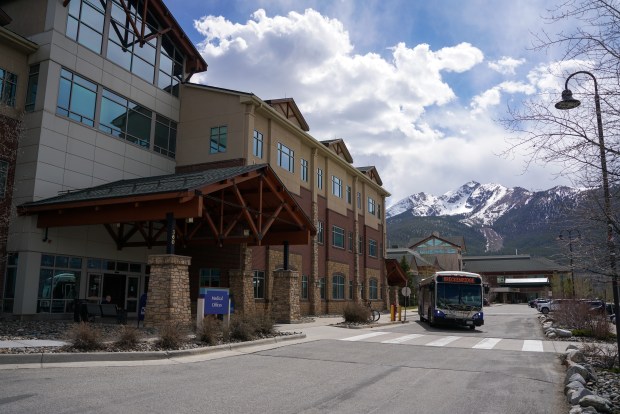 A bus drives away from the medical building where the Summit County Coroner’s Office is located on Tuesday, April 21, 2026, in Frisco. The building is next to the CommonSpirit St. Anthony Summit Hospital. (Photo by Armando Geneyro/Special to The Colorado Trust)
All five suicide deaths that occurred in Summit County in 2025 were by young men who worked in service industries. After finding this out, Borovich decided to visit ski areas like Arapahoe Basin, restaurants and other organizations to talk about suicide and mental health.
Beyond providing data, the Summit County coroners take time to develop relationships, Borovich said. “Even with the heavy work that they do every single day, they still show up in a beautifully supportive way.”
In western Colorado, the Mesa County Coroner’s Office has also built support for families into its role. Mesa County had 50 suicide deaths and roughly 700 total deaths in its population of nearly 160,000 in 2024. It also had a high county-level suicide death rate of 30 deaths per 100,000 people each per year from 2019 to 2023.
“We try to meet families where they are in their grief,” said Kasandra Salvati, support coordinator for the Mesa County Coroner’s Office. That could mean a card, text or care package, and can occur weeks after a death when things are less chaotic but still emotionally raw.
Salvati is both a death investigator and support coordinator, a dual role that helps her and others in the coroner’s office connect with families, she said.
Survivors sometimes wonder whether they missed signs that a person was suicidal or whether they could have done something differently, Salvati said. “You can feel like you’re on an island a little bit when you’re going through it,” said Salvati, who lost her husband to suicide six years ago.
“When you have someone who says, ‘I’ve been through a similar experience,’ it opens up the floodgates for having a more open conversation about thoughts and feelings.”
On a Monday morning in November, Lea picked up the phone immediately to talk to a father who had just lost his son to suicide. Lea and the three other coroners in Summit County, all women, stay in touch with grieving families for weeks, months and sometimes years after a death.
“The empathy piece is huge,” Britt said in talking about how women are well suited to be coroners, though it’s a career historically dominated by men. “Not all coroners’ offices are like ours,” she said.
“If we’ve made someone feel a modicum better on what could be the worst day of their lives, then we’ve done our jobs,” Lea said.
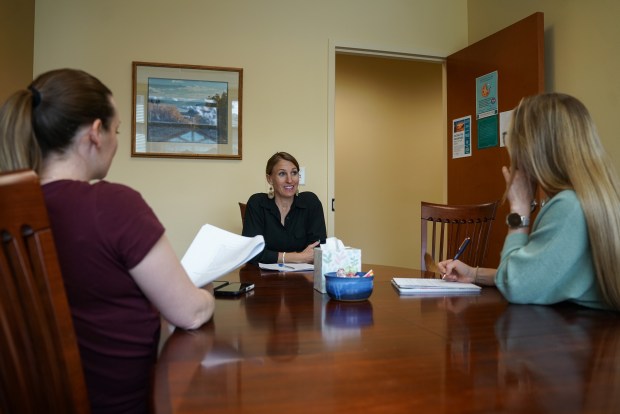 Summit County Deputy Coroner Britt Lea, center, meets with other coroner’s office staff members, Annie McPeters, left, and Deborah Senecal, right, ahead of a grief support group meeting at their office on Tuesday, April 21, 2026, in Frisco. The group is free to Summit County residents. (Photo by Armando Geneyro/Special to The Colorado Trust)
“Coroners sometimes get a reputation for just picking up dead bodies, but we do this job because we love it and are passionate about it. We do it for the people who die and those they leave behind.”
Cultivating a safe space to grieve is one way that coroners and their staff, including volunteers, give back to families across the state.
Brand said Facing the Mourning provided tools, homework and support to initiate healing from the most challenging situation. “It also helped me feel connected to and supported by my community,” she said.
If you or someone you know is struggling with their mental health or suicidal ideations, call or text 988 for help.
Freelance journalist Kate Ruder wrote this story for Collective Colorado, a publication of The Colorado Trust. It first appeared at collective.coloradotrust.org on May 4, 2026, and it can be read in Spanish at collective.coloradotrust.org/es. The Colorado Trust is a philanthropic foundation that works on health equity issues statewide.
Get more Colorado news by signing up for our daily Your Morning Dozen email newsletter.