
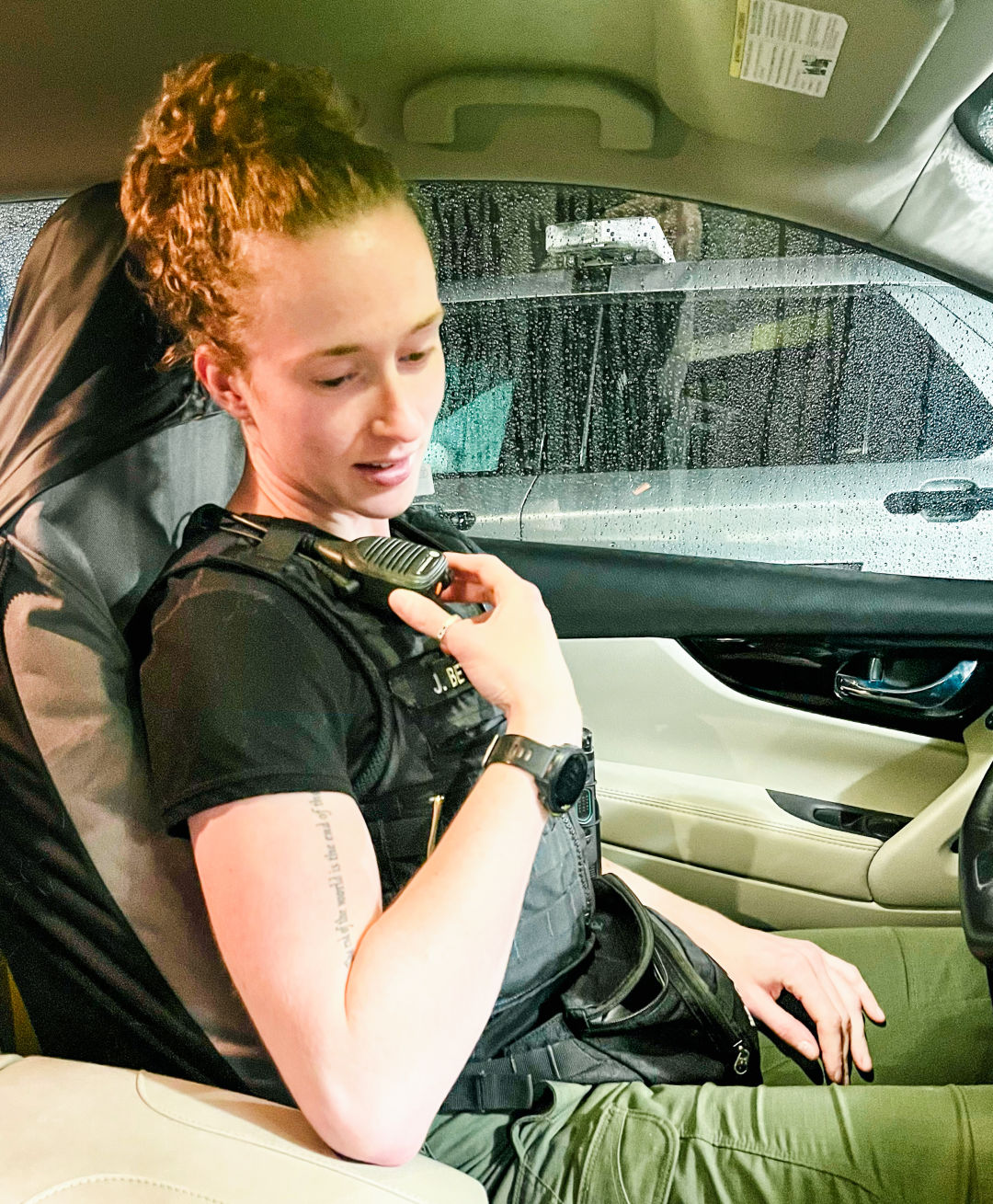
Jessi Beyer listens for calls that require her behavioral health expertise.
When Jessi Beyer was in high school, her boyfriend at the time attempted suicide. She was the one to call 911, and law enforcement showed up—with a social worker in tow. They interacted for only a few minutes, but the social worker handed Beyer her business card and told her to call anytime.
“I put her business card in the top drawer of my bathroom, and I never looked at it again,” she says. “But what that moment really did…it just kind of painted this one bright spot in an otherwise very dark night for me.”
Beyer ended up studying psychology as an undergraduate, then getting a master’s degree in critical psychology and human services, and a second in military psychology. She kept finding herself drawn to crisis intervention, but she wasn’t sure exactly how she wanted to put her skills to use—until she received a call one day from an organization looking for a clinician for an in-field crisis response program. “I just remembered that business card from that social worker sitting in the top drawer of my childhood home bathroom, and it was this very cool full-circle moment for me to be able to be that bright spot for other people, like she was for me all those years ago,” she says.
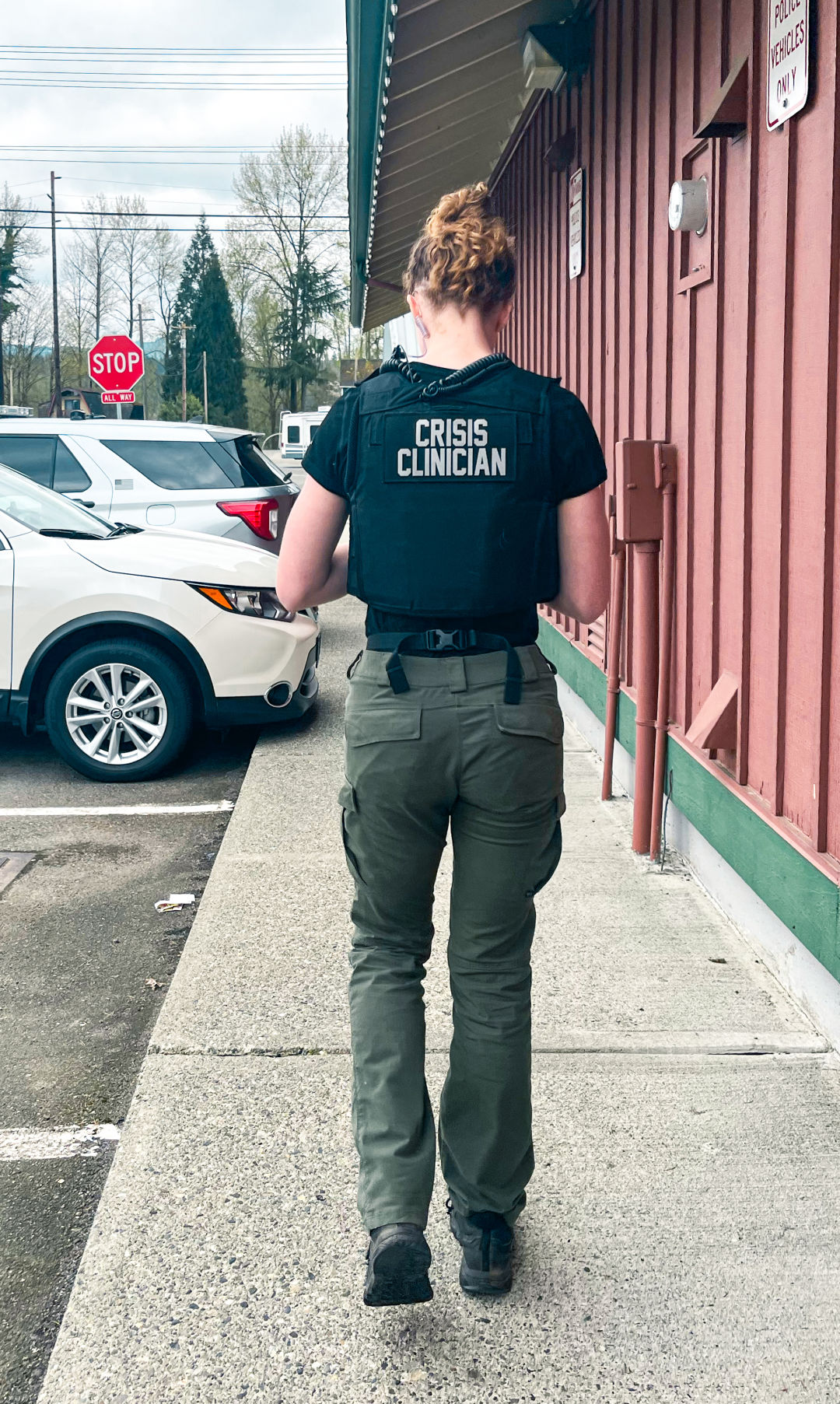
Every day on the beat as a crisis clinician is a little bit different.
Today, Beyer is embedded with the Monroe Police Department, the Snohomish County Sheriff’s Office, and the fire districts in East Snohomish County to respond to 911 calls that have a behavioral health component. Every day is different, but she might respond to calls that include people who are experiencing drug-induced psychosis, suicidal ideation, or the aftereffects of sexual assault. She could spend five minutes or five hours on a call, depending on what’s needed.
I tag along on a shift with Beyer and her partner, seven-year-old Brittany spaniel Phoebe, whose role is primarily focused on finding belly rubs. (She’s compensated in kibble.) Most of the calls we hear come over the radio are not for Beyer’s skill set—there are the hikers who are unprepared to get down the Lake Serene trail after dark, the driver who attempts to hit another car multiple times, and the guy who’s been caught exposing himself in a park for the third time this week. But in late afternoon, Beyer gets a call to respond to parents who are struggling with their child’s behavior.
When we get there, a teen in a graphic T-shirt is calmly chatting with the deputies, having returned to baseline after arguing with his parents earlier in the day over internet access issues. Beyer listens to his frustrations and talks to him about ways he can regulate his emotions. She speaks separately with the parents, who have many questions about what resources are available to them, especially as he’s getting closer to adulthood. Beyer shares strategies for de-escalating in the moment and grabs their phone number to later text referrals to a youth crisis team and a mentorship program that seems like it could be a good fit.
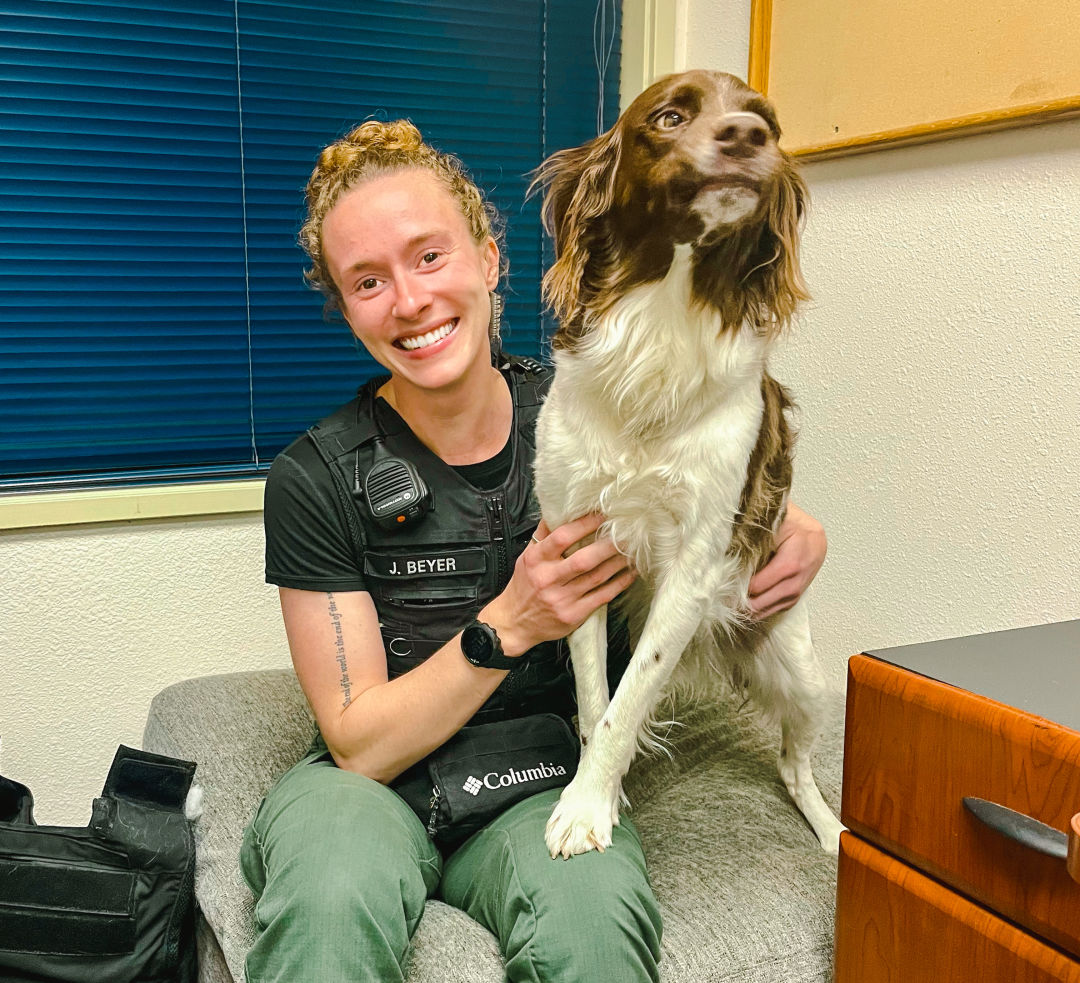
Beyer with her dog Phoebe.
Back at the Sultan Police Department, I talk to the deputies on duty that night. One tells me that he thinks Beyer has been a real asset to the team—especially because she has a collaborative approach.
Beyer jokes that like a vampire, she has to be invited in when it comes to calls. That means she has to cultivate a good relationship with the law enforcement personnel she works with, and she emphasizes that it really is the combination of the two forces that’s powerful.
“Law enforcement are experts in human behavior just as much as I’m an expert in human behavior,” she says. “I understand the nuances of schizophrenia and depression and things like that, and they understand the nuances of law enforcement and safety and body language and things like that.” The broader perspectives allow for a broader range of interventions, and Beyer can focus on her work with people, knowing the team has her back.
“Listening is one of the most important things that you can do for someone in crisis.”
While Beyer works in Snohomish County, there are similar services in King County, where, in addition to 911, people can call 988 to speak to trained crisis counselors. If necessary, a crisis team can respond in-person to these calls, but the response team is only clinical and not part of law enforcement. In 2025, the crisis teams conducted more than 5,500 instances of outreach. Additionally, there are post-crisis teams that can follow up with someone for up to 90 days, including mental health professionals and peers with lived experience, to help with things like scheduling appointments, arranging transportation, and connecting people to additional resources.
For all the complications that come with starting a new program, as Beyer has been part of in East Snohomish County since 2023—“You’re kind of building the plane as you’re flying,” she says—she’s learned that, ultimately, her role is really about the basics.
“Listening is one of the most important things that you can do for someone in crisis,” she says. “I definitely came into this being like, ‘I will solve the problem. I will say the perfect thing, or I will provide the perfect referral to the perfect resource that’s going to get them in right away.’” She quickly realized that she worked in a system and region with waitlists, admission requirements, and insurance limitations; all are the kinds of things that could and did prevent perfect referrals. “But you can get 80 percent of the job done by listening and being there with that person,” she says. “Because for so many folks in crisis, isolation and feeling alone and feeling unseen and unheard are often the core of what’s going on.”
In early December, Beyer’s program was awarded a $270,000 state-funded grant that will allow them to expand both their team and coverage area. “Something that I’ve learned from this job is just how similar people’s stories are despite their life circumstances,” she says. “It’s heartbreak, it’s loneliness, it’s abandonment, it’s trauma, it’s fear, it’s failure, it’s all of these things that we can relate to no matter what our life looks like on the outside.” But she also sees that it’s strength, resilience, and hope. “It’s beautiful, in a weird way, to be in these moments with these people and just see how many similarities there are and how much common humanity there is amongst us all.”
Haley Shapley is the wellness columnist for Seattle Met. She’s the author of Strong Like Her: A Celebration of Rule Breakers, History Makers, and Unstoppable Athletes and the forthcoming Night Owl: Staying Up Late in a World Built for Early Birds.