
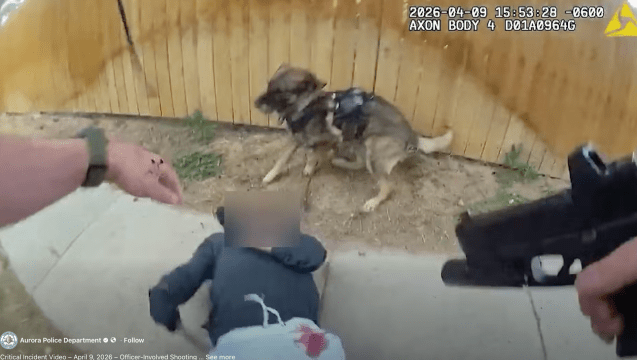
 The body camera from Aurora officer Mark Moore as he shoots Amare Garlington during a confrontation April 9 in Aurora. SENTINEL SCREEN GRAB
AURORA | Police on Friday released body camera footage of an April 9 fatal shooting of 23-year-old Amare Garlington, who was experiencing a mental health crisis and stabbed a responding officer and a police dog.
On Friday, the Aurora Police Department posted an eight-minute video with audio recordings of the 911 call and police communications, video of the police’s initial response and body camera footage of the shooting from two officers. The video is narrated by Sgt. Matthew Longshore and is edited, including blurring Garlington’s face for privacy.
Around 3:15 p.m. on April 9, officers were called to an apartment complex in the 14000 block of East Stanford Circle after receiving a report that Garlington was threatening to harm himself with a knife, according to police. Police were also told that Garlington could be attempting suicide by cop, where a suicidal person is intentionally trying to get police to kill them.
CLICK HERE TO SEE THE POLICE VIDEO
Police, the department’s Crisis Response Team and mental health clinicians arrived on scene around 3:30 p.m. and spoke with Garlington for about 20 minutes, attempting to de-escalate the situation, some of which is seen in the released body camera footage.
The video shows police and clinicians asking, first over the phone and then through Garlington’s window, that he put the knife down and come outside, telling him that he’s not in trouble and that they want to help him and keep anyone from getting hurt.
Additional body camera videos show a group of officers, including Officer Mark Moore and his police dog, Cyrus, standing a few units down from Garlington’s apartment moments before he comes outside. Garlington runs from his apartment with a knife in hand begins to run away from him. Moore releases Cyrus, who runs at Garlington. Garlington stabs the dog, which runs back toward the officers, and then Garlington runs back toward Moore.
As Garlington approaches Moore, the sound of the less-lethal launcher can be heard at least twice on the video. Garlington then stabs Moore and Moore shoots Garlington multiple times, at the same time another officer tases Garlington. Both Moore and Garlington fall to the ground and the videos end.
A timeline released by police says three minutes elapsed between the end of the conversations between Garlington and the Critical Incident Response Team and the stabbing and shooting.
The 18th Judicial District Critical Incident Response Team is leading the investigation into the shooting and the Aurora police is conducting a parallel administrative review.
Police said both Moore and Garlington received medical care on scene and were transported to the hospital, where Garlington died. Moore needed multiple surgeries and is still recovering. The dog also received surgery and is expected to make a full recovery.
As part of the police department’s reform efforts under a 2021 state-imposed consent decree, de-escalation training has been an area of focus. The consent decree stems from a state attorney general investigation that revealed “patterns and practices” of officers using excessive force, especially against people of color. Since 2021, Aurora’s contracted police monitor, IntegrAssure, has found that the police and fire departments have made significant reforms to reduce use of force incidents.
Following the shooting, IntegrAssure released a special report that calls for more investment in mental health services to prevent incidents from escalating to police response.
Garlington’s family members told 9News that they’ve repeatedly tried to get him help for his mental health — he was diagnosed with bipolar disorder at 19 — and that he attempted suicide by cop in 2022.
Garlington’s mother, Michelle Garcia, described him as kind, loving, smart and quiet.
Garcia said Garlington had tried to seek help at a mental health facility the day before the shooting but was turned away. She told 9News that she doesn’t understand how her son didn’t qualify for a mental health hold.
Garcia said she hopes the officer recovers and that mental health supports are expanded so people can access the treatment they need.
“People lose their lives, officers are injured. You know, the poor canine, it’s just, it’s not fair for anybody. There’s so many victims just because our system will not help people. It needs to change,” Garcia said. “Something has got to change.”
Related