
Lily Huynh/The Cougar
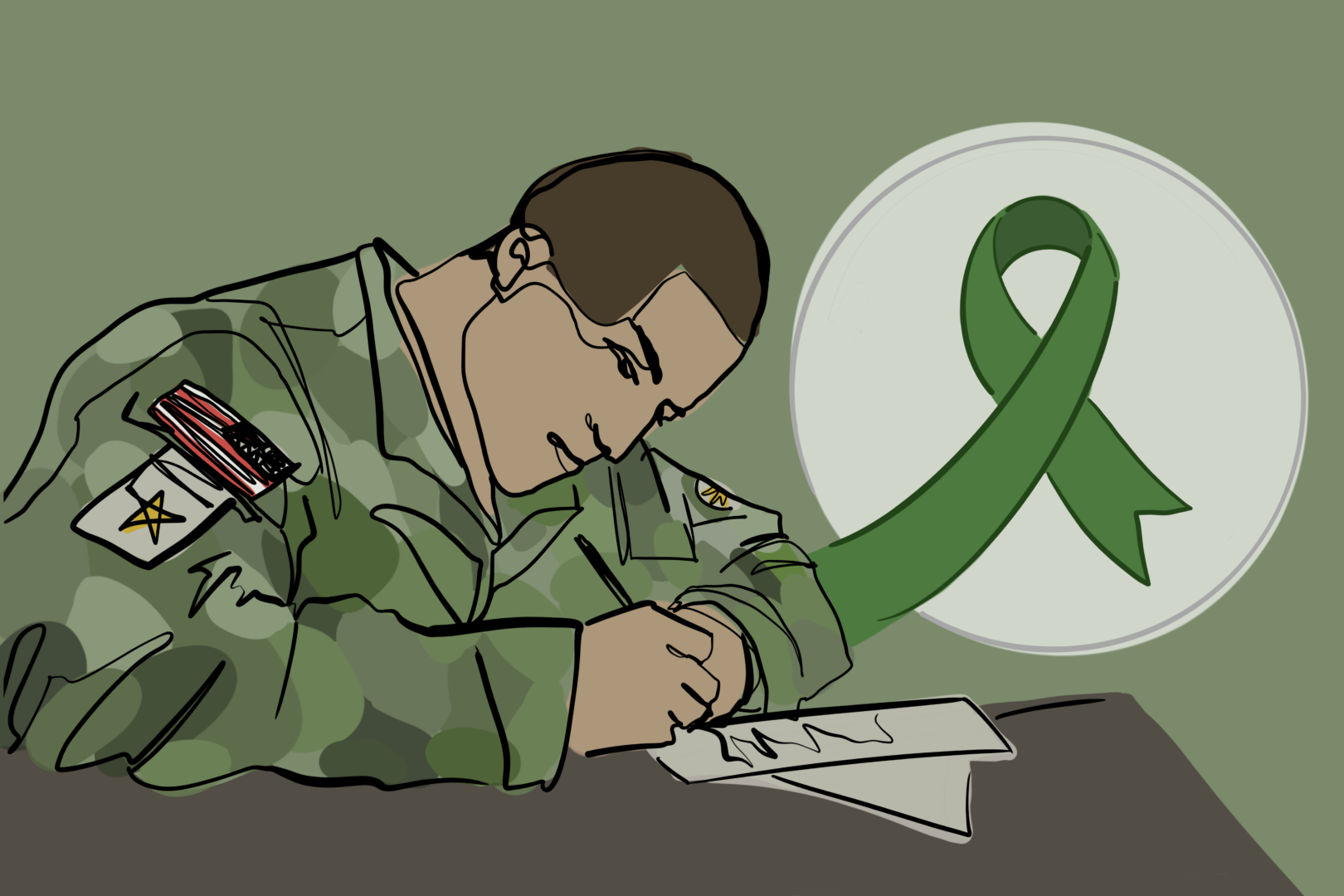
May is both Military Appreciation Month and Mental Health Awareness Month. For over 1600 students served by UH Veteran Services, including student veterans, active duty military students, Reserve and National Guard students and military spouses or dependents, mental health runs parallel to experience with the military.
Assistant Director of Veteran Services LaKeshia Villegas, herself a former student veteran, often hears students express a feeling of being alone after getting out of the military.
“A lot of our students don’t feel connected to anyone else, they feel like they can’t relate to other students, they just feel left out,” Villegas said. “So they’re just quiet, they go to class and then they go home.”
Students in the veteran services office can trade stories about the places they’ve served and bond over their memories of the highs and lows of military life.
But outside those four walls, there are few at UH who can relate to them. This isolation is compounded by the fact that student veterans as a group are typically older than traditional college students. 85% are between the ages of 24 and 40, with decades of life experience on their peers.
“Even if you’re trying to do a study group or something like that, you don’t realize it, but other students still might be under their parents’ rules,” said mechanical engineering senior Noah Mitchell. “They’re not even allowed to be in a study group that isn’t all boys or girls. Me and a couple other people ran into those situations when we first got to school and were completely taken aback by it.”
Mitchell served in the Navy as a nuclear engineer for eight years before enrolling in University to get a second degree. He recalls that his initial transition back to civilian life was far from easy.
“I went from being somebody that was a very vital or integral part of a team on a submarine to just being a civilian who had no task and no responsibility other than being a husband and a dad,” Mitchell said. “I didn’t really have any task or goal that I was supposed to do. That was pretty rough for me.”
Mitchell compares it to going from one hundred miles per hour to zero. And beyond the loss of that clear, primary mission provided by the military, there was also the lack of a team environment.
“Once you are in a situation where you are consistently working with a team in order to meet a standard or a task, it’s really hard to do anything else,” Mitchell said. “I like working in a team because I like leading that team and I like being able to use all of our strengths to achieve something, rather than just doing it solo. There’s not as much fulfillment in just doing it by yourself.”
Academics became Mitchell’s new mission. He drowned himself in school for his first year, and found a new team by working at the Veteran Services Office and by getting involved with Student Veterans of America.
Still, with a wife and kids, Mitchell describes his full-time academic career to running on “part-time time”: he has a fraction of the time that a regular student has to do the same assignments, write the same essays and study for the same exams.
“It’s a hard choice to make,” Mitchell said. “You don’t want to not spend time with your family because you have some small assignment that doesn’t feel like it matters. But at the same time, if you don’t take the time and spend that hour or two doing that assignment, then all of it adds up in the end and you don’t actually end up finishing.”
For tangible challenges like transportation issues or food or housing insecurity, the veteran services office is a hub of resources. When it comes to mental health, though, the solution isn’t always as transparent.
Computer science and mathematics junior Arzo Noorzad grew up in a military family and now works in the veteran services office, where she sees the invisible wounds of military service manifest in a range of ways.
“Some veterans come in with PTSD or anxiety, and then for the dependents, I’ve noticed a trend of all of us having some pretty high anxiety,” Noorzad said. “I think it’s just from the pressure of growing up in that type of household. It’s always high-paced.”
Noorzad’s father served in the Navy, and Noorzad names her upbringing as the reason for her tendency to micromanage and to sometimes take on more than she can handle.
For military dependents, there is an implicit expectation to overachieve, do well and show results.
“This semester was a pretty tough semester, and I just noticed I was feeling high anxiety all the time, and I put it on myself,” Noorzad said. “It just kind of sucks, because I feel like most of the other people that I was with in class, they were a little bit more lax. They were taking stuff at their time. I should have done that.”
Within the veteran community, though, Noorzad has noticed two separate and distinct attitudes toward mental health.
“There are some people that are more on the end that mental health is not real,” Noorzad said. “They’re just like, ‘you get tough enough’. These are usually the older vets we have in the office.”
On the other hand, younger veterans or those newly out of the military tend to be more willing to talk about mental health, and even encourage the military dependents to care for their own mental wellbeing.
“They’ll just talk to us and help us mentally, like ‘you’re taking a lot of classes, why do you have to do that?’,” Noorzad said. “I can take their advice, fully, because I’m talking to someone that’s already been through it. I believe them.”
Some students end up having to consult with Counseling and Psychological Services. But others are able to find solace in the group activities that Villegas organizes with Celina Dugas, the Director of Veteran Services: horseback riding, paintball and more.
“I know we had one student, his feedback was, it was like a mental break for him, and he needed the mental break,” Villegas said. “He said he never thought that riding a horse would actually help calm his anxiety down. So that’s what we aim to do. We aim to get the mental health right and just to let them know this is a family, we’re a community, you’ll be taken care of here.”
Veterans can be stereotyped as overly rigid, structured or hardheaded. But the rigor of their training also lends itself uniquely to an academic environment.
“If I were to draw a parallel between my first degree and my mentality then, and my second degree and my mentality now, prior to the military, I was operating at like a 3.0 level,” Mitchell said. “Getting out of the military, I’m operating at a 4.0 level, in a degree that is infinitely harder than the first one.”
news@thedailycougar.com