
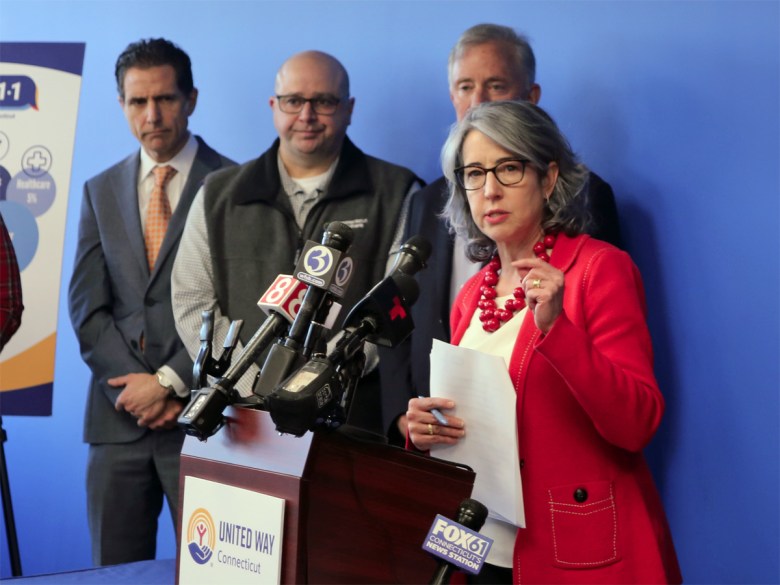
 FILE PHOTO — United Way of CT President and CEO Lisa Tepper Bates speaks about the state’s 211 program on Jan. 12, 2026 at the United Way offices in Rocky Hill, CT. Credit: Donald Eng / CTNewsJunkie
ROCKY HILL, CT — Since the launch of the 988 hotline in 2022, the country has seen an 11% decrease in suicide rates among people aged 15 to 34. In Connecticut, that decrease is 18%, according to the Journal of the American Medical Association (JAMA).
The decrease is especially encouraging because Connecticut is among the highest states in using the hotline, officials said recently.
“Every life saved represents hope and demonstrates the power of personal connection in a moment of need,” said Nancy Navarretta, commissioner of the Department of Mental Health and Addictions Services State Agencies. “Preventing suicide is a core goal of Connecticut’s health and human services state agencies, and we are encouraged to see data showing that 988 is making a meaningful difference for Connecticut residents.”
While the 211 line has been serving Connecticut residents for over 50 years, calls have increased by 350% since the launch of the 988 hotline, according to reports.
Crisis intervention is among many matters the 211 hotline attends to including housing, disaster relief, healthcare, childcare and more, said Tanya Barrett, senior vice president of 211 Health Services at United Way of Connecticut. The 988 hotline, on the other hand, specializes in mental health care and crisis de-escalation, with all calls being answered by crisis contact specialists who, she said, do heroic work every day.
“They meet each caller where they are, taking the time to understand each person’s needs, de-escalate the crisis and develop a stabilizing path forward,” said Barrett. “Often, this involves helping a caller to build a plan to r-connect to their existing supports, or to connect to new resources that can help.”
In November 2025, the United Way of Connecticut’s crisis center announced a new chat feature that operates on a 24-hour basis. The KFF, a center for health journalism, reported that in the first four months of 2026, 21% of these chats and texts came from residents under the age of 18.
“Anecdotally, many youth who contact us are experiencing interpersonal challenges, including issues with family members, friends or romantic partners,” said Barrett. “Common concerns also include academic stress and pressure, as well as supporting peers who are struggling — often due to negative experiences on social media.”
Barrett also said that the youth who utilize the hotline appear to come from a wide range of socioeconomic backgrounds.
United Way of Connecticut also reported that 97% of callers receive a response in less than five seconds and 95% of callers report feeling their state of crisis to be deescalated after calling.
“Our team knows that a quick response can save a life,” said Lisa Tepper Bates, president and CEO of United Way of Connecticut. Bates said the organization’s partnership with the state’s Department of Mental Health and Addiction Services’ has been especially impactful in ensuring that the state ranks highly on its crisis response.
“Since the launch of 988, Connecticut has led the nation in answering calls quickly and providing critical, immediate support,” said Luis B. Pérez, president and CEO of Mental Health Connecticut. “988 CT is a vital part of the continuum of services that help our neighbors experiencing a mental health crisis.”
This past legislative session saw increased attention given to disconnected youth, or adolescents and young adults not currently in school or work. Connecticut has the research, the community partners and the philanthropic investment needed to address the issue, said Amy Cassavina Hall, United Way CT’s senior vice president of strategic partnerships, development and communication.
“Now the state needs to provide the resources and coordination to bring proven community-based programs to every young person who needs help finishing school and starting their career,” she said.