
When Barb Buchanan walked into her first support group for family members of people with mental illness in Columbia around 2010, Heather Harlan greeted her with a “huge smile.”
Harlan started attending the meetings, run by NAMI Missouri, the statewide affiliate of the National Alliance on Mental Illness, in 2007. Her adult son, Micah Bacus, was living with serious depression, and the peer-led meetings provided space to share resources and “a buffet of coping skills and encouragement,” Harlan told The Independent.
Buchanan’s teen daughter, Kirsten, had been going to therapy throughout high school for what seemed like depression. But there was a disconnect between what therapists were saying — that Kirsten was doing fine — and what Buchanan saw.
“We could see her getting sicker and sicker and sicker,” Buchanan said in an interview with The Independent.
For Buchanan, who now co-facilitates family groups with Harlan, the services were life-changing.
“For the first time in many years, I felt, ‘I’m not alone in this,’” Buchanan said. “‘I am in a group of people who I can openly talk about what’s going on without feeling judged, ashamed, embarrassed, a failure — all those other adjectives you can use to describe yourself as a parent.’”
Now NAMI Missouri is bracing for the possibility that Gov. Mike Kehoe might cut state funding for the family support groups and peer-led courses that Buchanan credits with changing how she helped her daughter.
The budget passed by Missouri lawmakers in May restored $65,000 that Kehoe recommended cutting for NAMI Missouri’s Family to Family program. Kehoe has until July 1 to decide whether to leave the money in place or cut it back to his original proposed budget.
Eliminating funding for these free services would break a two-decade streak of NAMI Missouri offering them in fulfillment of a contract with the Missouri Department of Mental Health, said Gena Terlizzi, the nonprofit’s executive director.
“It wasn’t something that was just for us,” Terlizzi said. “It was something the Department of Mental Health was saying, ‘This is a worthy service that we need to be offering.’”
The budget passed by lawmakers does not include $62,482 for two other department contracts with NAMI Missouri — a help-line and support groups for parents of kids with mental health conditions and training sessions allowing mental healthcare professionals to confer with people living with mental health conditions who aren’t their patients.
Arguing for the restoration of that funding during budget negotiations last month, Democratic state Sen. Maggie Nurrenbern of Kansas City emphasized the effectiveness of the longstanding programs.
“We’re talking about essentially $62,000 for something that we have had in the state budget for over 20 years,” Nurrenbern said. “This is not something that just popped up last year and they’re just trying to get started. This is something that has been proven effective. It’s statewide.”
State Rep. Betsy Fogle of Springfield, ranking Democrat on the House Budget Committee, also asked to restore the funds.
“I know every dollar we should look at and that these are two of the smallest line items in the budget, but I think they have very significant impacts across the state of Missouri,” Fogle said.
House Budget Chairman Dirk Deaton, a Seneca Republican, said that despite the modest dollar amounts in the scope of the state’s $48.7 billion operating budget, cutting the funding was part of striking a “balance” as the state taps into its reserves to make up for the end of federal COVID-19 funds.
“We’re entering some tough budget times,” Deaton said. “I think we’re going to see some more difficult times, and hard decisions have to be made irrespective of the dollar amount.”
Senate Appropriations Chairman Rusty Black, a Chillicothe Republican, sided with Deaton in the conference committee, referring to outstanding questions at the time about where to source public education funding.
In an interview with The Independent, Nurrenbern said she was “disgusted” to hear that “it’s time to tighten our belts” as lawmakers approved funding for what she described as “pet projects,” pointing to $20 million to move a road at the State Fairgrounds in Sedalia — a project requested by the governor’s office.
Terlizzi said NAMI Missouri will seek alternative funding sources to sustain family groups and education courses. But she said an upcoming training for mental healthcare providers in June will probably be the last.
“We don’t have any prospective funding sources for that,” Terlizzi said.
Gaps in the system
Harlan said NAMI Missouri services support family members who often find themselves stepping in to care for adult loved ones and fill gaps in the mental health system.
Many people with mental illness experience anosognosia — a lack of insight about their condition — and refuse to seek medical attention, Harlan said.
“Often family members are told, ‘If they don’t want treatment, there’s nothing you can do,’” Harlan said. “Versus NAMI gives them something they can doTo go, ‘You know what? I need help for me. Whether or not you need or want help is your choice.’”
There is no age limit for NAMI Missouri’s family groups, and they are open whether or not a loved one is getting treatment. They’re available online and in-person in seven locations throughout the state.
Family members, Harlan said, are often well-positioned to help individuals navigate a mental health condition.
“Who is there that may help them stay fed, housed, insured, transported, clothed, keeping appointments?” Harlan said. “Family.”
But there are limits to what family members can do.
“Then we encourage each other to go, ‘Well, that’s all you can do,’” Harlan said. “You can look in the mirror and feel okay about yourself.”
Buchanan said Kirsten’s diagnoses of bipolar II and pre-menstrual dysphoria disorders saved her life and that NAMI gave her “the support and skills to better help me help her.” Kirsten Buchanan, now 31, works full-time as a special education teacher.
NAMI Missouri support groups are also there when the mental health system fails.
Harlan said there’s been a movement in her lifetime away from hospitalization for serious mental health conditions, but there hasn’t been a build-out of outpatient support services for patients and families.
“I am not for just hospitalizing people,” Harlan said. “But we as a society have not answered the question, then what do we do?”
Bacus, Harlan’s son, kept his psychiatry and therapy appointments and was working well with his counselor. He was working as a paraeducator and studying at Columbia College to become a teacher. Harlan described his gift for explaining concepts in different ways until he hit on the one that clicked with a student.
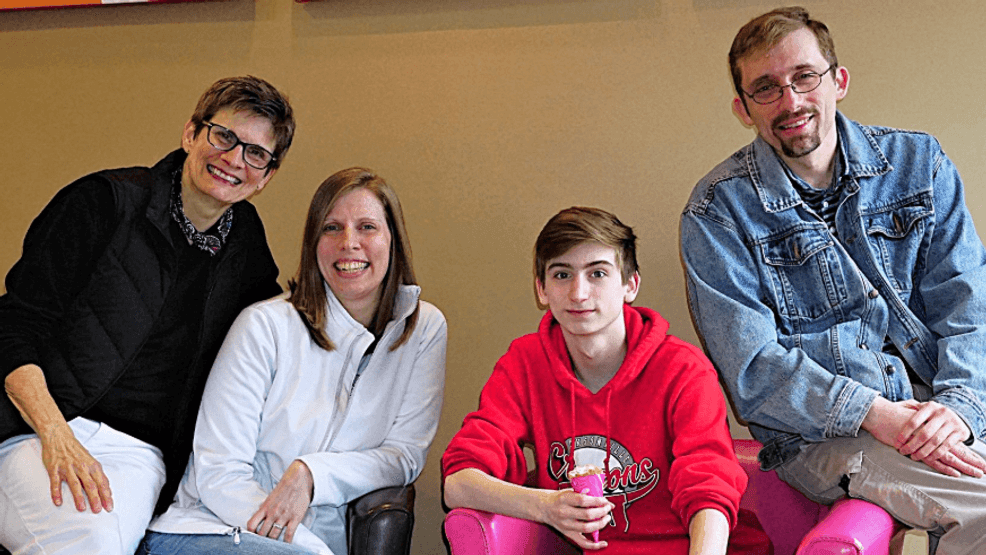
Heather Harlan, left, and Micah Bacus, right, enjoy family time and ice cream with Bacus’ sister, Robin Bacus, and nephew, Ethan Foster, in March 2018 in Columbia. “I think it’s a reminder it wasn’t just me as a mother who still feels the loss,” Harlan said (photo submitted by Heather Harlan).
But when his counselor went on an extended period of leave, he struggled to find a replacement. He showed Harlan a list of counselors he had called, but no one was taking new patients.
When Bacus was discharged from a hospital stay in May 2018, he was told, “Don’t call us. We’ll call you when we have an appointment for you to get started with a counselor.”
It was November before he started seeing a new counselor.
In February 2019, Harlan said, “time just ran out for him,” and he passed away by suicide at 37.
“There was just too much pouring in on him, and he didn’t receive enough help,” Harlan said. “So he died waiting for help.”
Harlan said that when she first started attending NAMI Missouri family groups, she felt anger, worry and exhaustion. There’s a history of mental illness in her family, but she had never experienced it. She couldn’t understand certain things, like what it’s like to be too depressed to take a shower.
“NAMI helped us work together more as a team,” Harlan said. “To understand what he was going through, to understand where I might be able to step in and help and how to listen. So I think that made a world of difference.”