
As conversations over mental health continue to expand, language barriers can make it difficult for some to begin speaking about their struggles.
Pedro Infante and Wilson Feliz, both 36-year-old natives of New York City, are working to combat that problem through their mental health app, PatternMD, which allows users to converse anonymously between themselves or with a medical professional in both English and Spanish.
Along with allowing users to make posts to PatternMD, Feliz — who lives in Bethlehem, where PatternMD’s operations are headquartered — created a dedicated artificial intelligence for the app, called the Pattern Engine, to help users search for posts with certain keywords and make suggestions based on a user’s own posts.
“Language shouldn’t be a barrier,” Infante, who has degrees in medical informatics from Stony Brook University and SUNY Downstate Health Sciences University, said. “I want my parents to use this app and they only speak Spanish. I want them to go in and find symptoms where my parents can go in their native language and write what they want and how they’re feeling and find other people with their symptoms.”
According to the National Alliance on Mental Illness, about 35% of Hispanic/Latinx adults receive treatment for mental illness each year, compared to the U.S. average of 46.2%, due to language and other access barriers.
Infante, who is still based in New York City, said there are plans to add more languages to PatternMD to continue what Feliz describes as the “killing of the language barrier.”
According to Feliz, who has a master’s in business administration from DeVry University’s Keller Graduate School of Management, PatternMD has gained over 160 users since its launch in April across Apple’s App Store and Google’s Play Store.
“Easily one of the best health apps out there,” one user said in a Play Store review. “I love how everything is integrated to make it for a user-friendly experience.”
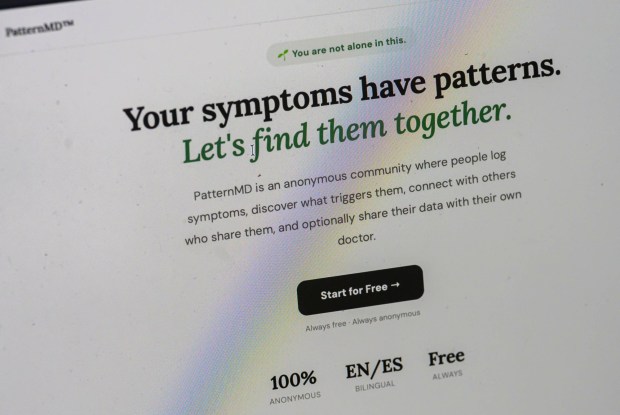 Screen of PatternMD. PatternMD co-founders Wilson Feliz and Pedro Infante stand Tuesday, June 2, 2026, in Bethlehem. The pair created an app to offer a space with translation capabilities where people can communicate anonymously with others, including medical providers, about mental health problems. (April Gamiz/The Morning Call)
Feliz said the decision to make users anonymous was meant to make it easier for them to discuss their mental health.
“People are more likely to share how they feel when there’s not an identity attached to it and I think that’s what makes us special,” he said. “Someone in another country can post something and you won’t know where they’re posting from. You just know that this person might be feeling the same thing that you’re feeling.”
Infante said medical professionals have their own portal on PatternMD to communicate among themselves, with these communications also being anonymous.
Feliz said PatternMD is focused on fostering partnerships with health systems and clinical practices to bring providers onto the platform “in a structured way.”
While Infante is aware that keeping medical professionals anonymous potentially could let them overshare information about patients without facing consequences, he believes there are benefits to not exposing medical providers’ names.
“I feel like providers are not open when they see their name out there like, ‘Oh, this doctor told me to try the following and then we got the following consequences,’ ” Infante said. “They’re not open to doing that unless it’s documented on a research document but when it’s anonymous, a provider is more willing to share more facts and research on what they did to help out.”
Feliz, who has battled anxiety attacks that have caused him to visit the emergency room, said he wished resources like PatternMD were available for disabled veterans such as himself, especially following his eight years of service in the Army.
“I had problems opening up with how I felt after my time in service and I had friends who never found that person to talk to who, sadly, ended up taking their own lives,” Feliz said. “When you have crises with mental health, it’s very easy to feel like it’s just you.”
That was part of the reason he and Infante approached Veterans Affairs to offer PatternMD to veterans.
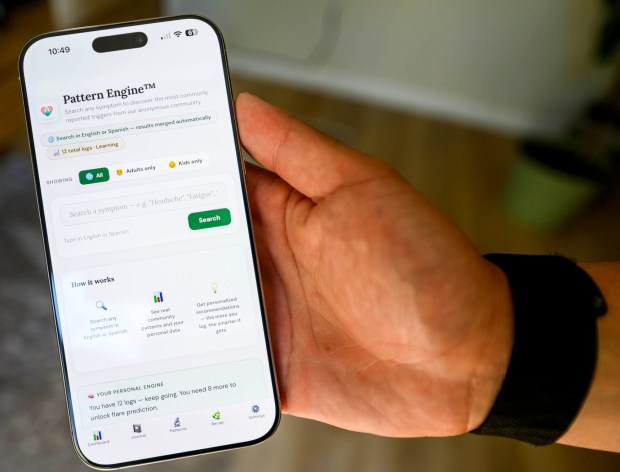 Screen of PatternMD. PatternMD co-founders Wilson Feliz and Pedro Infante stand Tuesday, June 2, 2026, in Bethlehem. The pair created an app to offer a space with translation capabilities where people can communicate anonymously with others, including medical providers, about mental health problems. (April Gamiz/The Morning Call)
The app has been accepted into the VA’s Innovation Repository through the Veterans Health Administration’s Innovation Ecosystem, which Feliz said makes PatternMD nationally accessible to VA medical centers.
Feliz and Infante said privacy is a top priority for PatternMD. They are only outsourcing services for language translation, and implementing measures to best protect user data, such as using different login credentials to minimize the potential access a hacker would have to user information.
Feliz also said he and Infante feel it is important for users to be in control of what they want on PatternMD, such as choosing to cut off communication with a medical professional at any time.
This control also extends to whether users want to keep their information on the app or delete it.
“The choice is truly up to the person who signs up to our application,” Feliz said. “We felt it was important for them to know from the moment that they onboard, this is your data. We are not selling your data. We are not doing anything with your data. It is yours.”