
Ketamine is a drug often clouded by misunderstanding. While many associate it with illicit use, the pharmaceutical version has been part of modern medicine for decades. First synthesized in 1962 and approved for medical use in 1970, ketamine has long been used as an anesthetic. In recent years, however, it has emerged as a promising treatment in mental health care.
At the Cairn Center in Las Vegas, psychiatrist Dr. Shaily Jain and licensed clinical social worker Caasi O’Day are among a growing number of practitioners offering ketamine-assisted psychotherapy to patients struggling with severe depression, PTSD, anxiety disorders and more.
Isn’t ketamine a party drug?
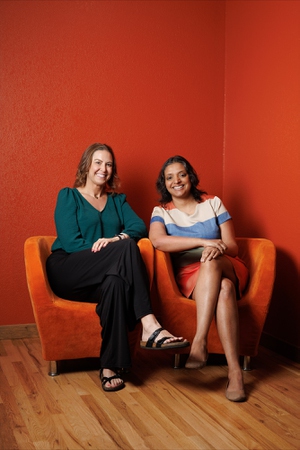
Caasi O’Day, licensed clinical social worker (left), and Dr. Shaily Jain
Photo by: Wade Vandervort
Despite its reputation, ketamine is classified as a Schedule III controlled substance by the U.S. Drug Enforcement Administration, meaning it carries accepted medical uses and a lower potential for abuse than substances in Schedules I or II.
“Ketamine has been available in medicine for over 50 years. It’s one of the 50 most essential drugs that were designated by the [World Health Organization]. … It’s an anesthesia medicine, but in mental health we use it very differently,” says Jain.
Mental health practitioners began exploring ketamine’s psychiatric applications in the early 2000s, particularly for treatment-resistant depression. Jain says the treatment has shown promise for carefully screened patients who have not responded to traditional therapies.
For O’Day, she too was under the impression that ketamine was just a street drug. In 2020, she began unpacking those misconceptions and started working with Jain to become licensed to provide ketamine therapy for her social work clients.
“Ketamine can be found on the streets, which is scary. But when you’re working with a client it’s about educating them and making sure that they’re ready to go on a journey.”
How does it work?
There are two primary forms of ketamine treatment used in mental health care—racemic ketamine, commonly administered through intravenous infusion or intramuscular injection, and esketamine, a nasal spray sold under the brand name Spravato.
Spravato is the FDA-approved esketamine treatment that is covered by many insurance plans. The Cairn Center uses racemic ketamine, an off-label generic version commonly administered at infusion clinics. Both forms are prescribed and monitored in controlled clinical settings.
“Ketamine is an NMDA receptor antagonist. It works on glutamate pathways which are unique pathways in the brain that help with depression,” says Jain. “I always tell people it’s not a psychedelic, it’s a dissociative anesthetic.”
Researchers believe ketamine may help repair neural pathways damaged by chronic stress and depression while increasing neuroplasticity, the brain’s ability to form new connections and adapt. For some patients, that can make psychotherapy more effective by helping them move beyond emotional barriers and entrenched thought patterns.
Treatment schedules vary by patient. Some may benefit after a single session,while others require ongoing care.
What are the benefits?
Patients often describe feeling lighter or more hopeful after treatment sessions, providers say, marking a significant shift for people who have struggled for years with severe mental health symptoms.
“A lot of times when I’m working with my clients and they’re stuck …They’ve gone through therapy, they’ve gone through other treatments, and they get right there and they’re afraid, don’t want to talk about it out loud, or somatically, their body will freeze,” says O’Day. “The medicine gives people an opportunity to let that go by the side and let some of those things come forth in a gentle way.”
Clinicians say ketamine is not a cure-all, but rather a tool used alongside psychotherapy and other mental health treatments.
Who is this medication for?
Jain and O’Day explain that ketamine-assisted psychotherapy is primarily considered for patients struggling with severe or treatment-resistant mental health conditions, including depression, PTSD, anxiety disorders and suicidal ideation. Most patients have already undergone extensive therapy or other interventions before being considered for treatment.
“We don’t always rush into it. There’s work to be done,” says O’Day.
The providers also avoid ketamine treatment for individuals with a history of psychosis or active substance use disorders because of potential risks and safety concerns.
As ketamine therapy becomes more visible nationwide, public understanding is slowly evolving alongside the science, clearing the way for more efficient treatments for those struggling with mental health.
Click HERE to subscribe for free to the Weekly Fix, the digital edition of Las Vegas Weekly! Stay up to date with the latest on Las Vegas concerts, shows, restaurants, bars and more, sent directly to your inbox!