
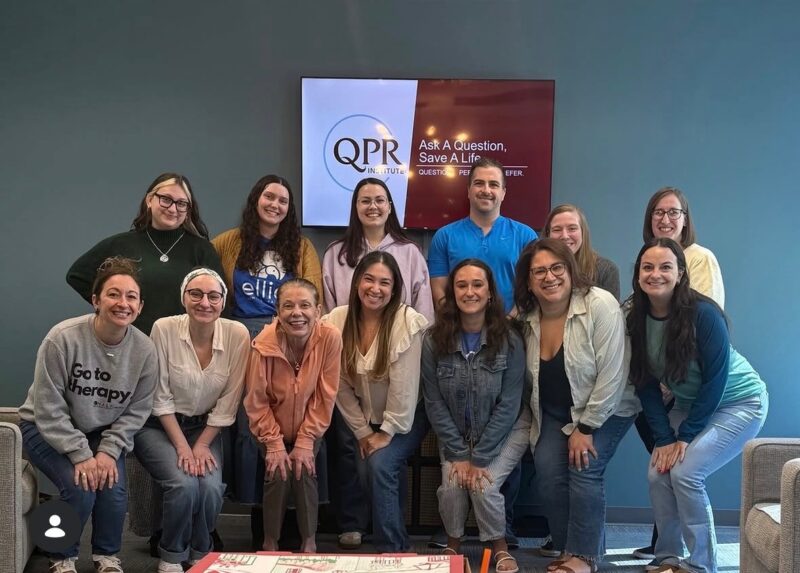
HELP IS ON HAND: Ellie Mental Health of Central NJ offers therapy for those coping with mental health issues. Independently-owned franchises in the Princeton area are located in Skillman, Somerville, and Flemington. Shown are staff members in the Skillman location.
By Jean Stratton
Peace of mind, a sense of well-being, hope. All feelings that contribute to a positive outlook for today and tomorrow.
Instead, anxiety, depression, even despair, seem to be in control of the lives of many individuals. These negative emotions affect all ages, including increasing numbers of children, teens, and young adults.
Fortunately, more people are seeking help, and Ellie Mental Health of Central NJ is available with experienced, trained therapists ready to help those in need of their services.
Opened in 2024 at 50 Vreeland Drive, Suites 1-3, the Skillman location is a franchise independently owned and operated by Andy Garcia and his father Ruben Garcia. They also own franchises in Somerville and Flemington.
Unusual Significance
The original Ellie Mental Health company was founded in Minnesota in 2015, and now offers 250 franchises across the U.S.
Its name has an unusual significance, points out Andy Garcia, who with his father (and partner) oversees the business operation of the three clinics.
“The name Ellie in Ellie Mental Health is a playful and symbolic play on the word ‘elephant.’ The clinics use elephants as a core metaphor for mental health, drawing on the cultural symbolism of elephants representing mental strength, peace, and the popular phrase ‘the elephant in the room’ which represents the stigma that has surrounded mental healthcare.”
The father and son team became part of the Ellie Mental Health franchise because of their strong belief in the need to help those struggling with mental health issues.
“For the past 13 years, I’ve been in the franchising industry, which is how I got wind of the Ellie franchise opportunity,” explains Garcia. “With the growing mental health crisis in the U.S., my father and I wanted to find a franchise that could not only help us operate a successful business but also solve real problems in our community. We felt it was very important to be part of the solution to this growing crisis.”
Indeed, studies indicate that the prevalence of mental health disorders — such as depression, anxiety, and burnout — has significantly increased in recent decades, exacerbated by factors such as urbanization, digital dependency, and the COVID-19 pandemic.

CUSTOMIZED COUNSELING: Personalized and compasionate care is the priority at Elllie Mental Health of Central NJ, with three locations in Skillman, Somerville, and Flemington. Shown is one of the comfotable therapy rooms where counselors and patients meet in a welcoming atmosphere to determine the best treatment for the patients’ needs.
Talk Therapy
Ellie Mental Health in Skillman offers help in many areas, points out Ruben Garcia. “We provide therapy for a variety of conditions, including anxiety, depression, grief, anger, and addiction. We also provide marriage and family counseling.”
The Skillman staff of 24 consists primarily of licensed social workers. “Common credentials are LCPs, LCSWs, LACs, and MSWs,” adds Andy Garcia. “Our counselors typically specialize in talk therapy. Each therapist has specific specialty areas, and many will have several specialty areas to provide support for those they are working with. On our website, all of our therapists have a detailed profile that specifies their specialties.”
He notes that for psychiatric needs, the staff will direct patients to one of the clinic’s local referral partners.
Ellie Mental Health Center treats all ages, he continues. “We see patients from 5 all the way to 105. There is a pretty solid mix of age ranges across the board.”
Among the most common conditions treated at the clinic are depression, anxiety disorders, substance abuse, and ADHD (attention deficit hyperactivity disorder), he reports.
 Christina Schairer
LCSW, Skillman clinic manager
Both individual and group therapy are offered, and this is considered talk therapy, explains Skillman clinic manager Christina Schairer, LCSW. “In the vast majority of cases, we offer one-to-one therapy sessions. Occasionally, we offer group sessions on topics ranging from dealing with grief and loss to social and emotional regulation for young children.”
Intake Sessions
Intake sessions are typically one hour, and subsequent sessions are 50 minutes, she adds. The average patient seeks therapy for six to nine months, although some may come for several years.
 Jordan DeGroat
LPC, clinic director for all Garcia franchises
Patients are often referred by physicians, explains Jordan DeGroat, LPC, who oversees all clinical operations for the Skillman, Somerville, and Flemington clinics.
“We also receive referrals from higher, more intensive levels of care such as IOP which stands for intensive outpatient care. Many people also find us by doing general Google searches, and due to our strong online presence, it makes it relatively easy for patients to gain access to our services.”
DeGroat believes that more people are seeking therapy because of a reduction of the stigma related to mental health issues. “In the past, people would not seek help due to a negative perception of finding help.”
Schairer agrees, pointing out, “There has been greater accessibility and more attention around mental healthcare over the last few years, which is driving more and more people to seek help. Also, there is less stigma around the topic compared to decades past when it was very much taboo to discuss mental healthcare, let alone seeking it and being open about it to friends and family.
“I believe there is still a lot of work to do when it comes to minimizing the stigma, but it appears to be improving day by day. I also see that our healthcare system has a lot of catching up to do when it comes to mental healthcare.”
Addictive Habits
There have been many reports in the news lately about the possible damaging aspects of smart phone technology, in particular contributing to addictive habits for younger participants. Much of this information is supported by mental health studies.
For example, “mental health issues in youth are increasing due to various factors, such as changing social and academic pressures, digital landscape, and overwhelmed healthcare systems that struggle to provide adequate support,” states one study.
Andy Garcia has also become aware of the technological implication relating to mental health.
“I strongly believe that the internet age has created, or at least contributed to, unprecedented mental health struggles, especially for children, teens, and young adults. There is a constant barrage of information, opinions, unrealistic/inflated lifestyles, body image comparison, and unhealthy consumerism that I believe plays a major role in how people are seeing the world and their place in it.
“I certainly think technology has played a part in increasing social anxiety due to always being connected,” says Garcia, reinforcing his belief. “There is an increase of individuals comparing themselves to what others have or are doing, which results in heightened levels of pressure on themselves. Technology has also made it difficult for some to balance work and home roles resulting in higher levels of stress overall.”
News stories have recently been providing information about schools curtailing phone use in the classroom and a growing trend of young adults choosing to take time off from these ubiquitous devices
Harmonious Balance
Garcia is noticing the beginnings of a step back from this high-tech world. “I think there is a general trend starting to form where phone addiction is being studied more and more as it relates to the association with our mental health. I regularly see apps and devices that limit screen time, block certain apps, and tools that that block apps after a certain amount of time, etc. I think those are great tools to help curb phone addiction and all the negatives that come along with it.
“When there is a disconnect from the technology,” he continues, “teens and young adults have been able to find a more harmonious balance to increase the ability to relax. Stepping away from technology also increases individuals’ ability to communicate face-to-face rather than behind a screen.”
Regarding Ellie Mental Health’s youngest patients from age 5, Garcia points out that “based on my experience over the past three years seeing the trends directly, the type of therapy provided for children really revolves around play, developing healthy communication skills, and social/emotional development.”
As he looks ahead, he hopes even more people will take advantage of the services at Ellie Mental Health of Central NJ, and he strongly believes in the expertise of its staff of therapists.
“Our biggest focus is hiring and retaining the best talent in the area. We pride ourselves on having highly talented therapists who have been with us since we opened. That is a testament to our culture as a company and the quality of care our clinical team is implementing.
“I especially enjoy the positive community impact we are having, and I feel very encouraged for the future despite the lingering challenge in the healthcare field as a whole.”
For further information and appointments, call (609) 793-9507. Visit the website at elliementalhealth.com/locations/skillman-nj.
Written by: Jean Stratton