

17-year-old Niamh Devlin was one of 25 young people taking part in New Zealand’s second ever Bergen 4-Day Treatment
Photo: Supplied
17-year-old Niamh Devlin was one of 25 young people taking part in New Zealand’s second ever Bergen 4-Day Treatment
Clinical psychologists are hoping a new kind of OCD therapy, known as the Bergen 4-Day Treatment, will become part of the public health system.
The four-day course of intensive exposure therapy currently costs thousands of dollars, but seven in ten participants report continued success a month after treatment.
The treatment was developed in Norway, and was delivered for the first time in New Zealand to 17 young New Zealanders in Auckland in January.
In May, 17-year-old Niamh Devlin was one of 25 young people taking part in New Zealand’s second ever Bergen 4-Day Treatment in Christchurch.
Her OCD manifested as constant checking – on relationships, details, plans.
Often, it would manifest as a need for neatness, cleanliness or order, or compulsions like turning light switches on and off or tapping objects a certain number of times, sometimes in fear of consequences like a loved-one dying.
But Niamh constantly worried about getting sick, hurting others, losing friends, or not getting good enough grades.
“Rumination,” she explained. “I’d be reading people’s emotions all the time, having to replay conversations in my head.”
“I just thought it was normal to think that way, or do those things.”
Strategies she had learned through weekly therapy sessions helped a little, but the Bergen course had been a game changer, she said.
Day one was spent sharing experiences in groups. It was a validating experience to hear from others of a similar age who were experiencing the same feelings.
Day two was exposure day, with participants putting themselves in situations where they were forced to confront their compulsions, with a psychologist next to them.
One of Niamh’s tasks was to start conversations with strangers, something that would normally cause a lot of anxiety and overthinking.
By the end of more than twenty conversations, she felt like anything was possible.
“I realised that I am capable, and I can have a life without OCD.”
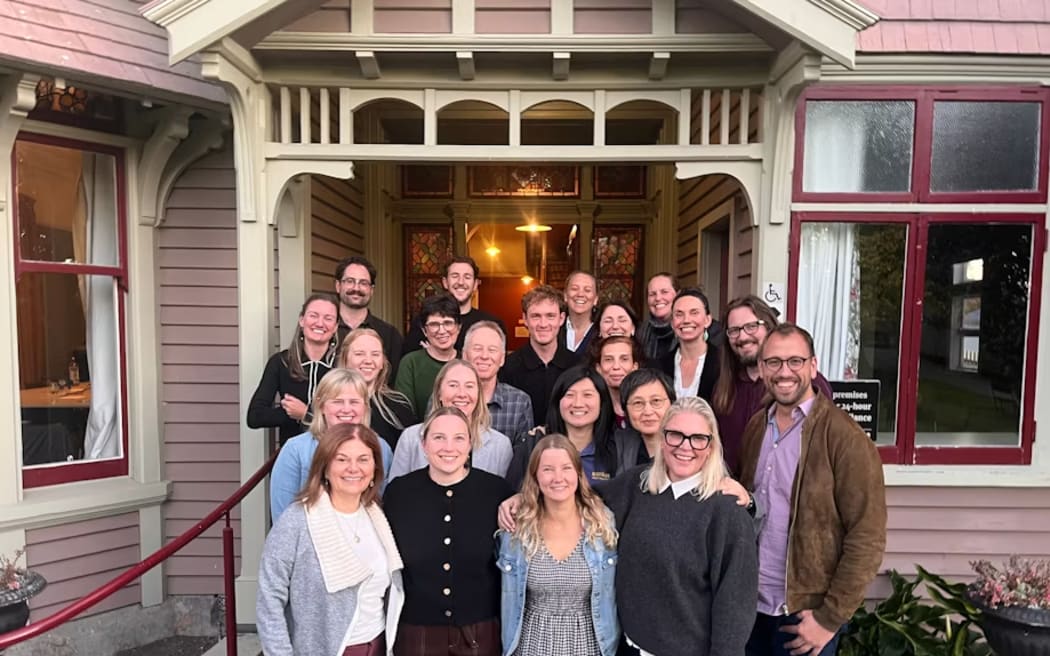
The psychologists and observers during the first week of the Christchurch treatment (Emma Chapman pictured front right).
Photo: Supplied
The psychologists and observers during the first week of the Christchurch treatment (Emma Chapman pictured front right)
Child psychologist Emma Chapman, clinical lead at the charity bringing the treatment to New Zealand, Open Closed Doors, said the results internationally spoke for themselves.
The current gold standard for OCD treatment, Chapman explained, was an hour-long session of exposure and response prevention (ERP) therapy a week. The remission rate for that kind of treatment was forty percent.
By comparison, data from other countries where the Bergen treatment was common showed seven out of ten Bergen participants remained in remission three months on.
Chapman said so far, 81 percent of their total of 43 participants across Auckland and Christchurch had shown a strong improvement in their symptoms within 10 days of completing the programme, and just over half had achieved remission.
Early follow-up data suggested those improvements were largely maintained at three months, and no participants had dropped out of treatment to-date.
Te Whatu Ora did not address specific questions about the Bergen treatment, but told RNZ it supported a range of support in treatment options in the community.
Attending a Bergen treatment programme could cost between $6000 and $8000 per person, Chapman said.
The goal of Open Closed Doors was for it to become part of the publicly funded system – as it was in its origin country Norway – and they were slowly training up clinicians and spreading the word.
In the meantime, its website would soon feature a list of Bergen-trained therapists who could see people one-on-one, and there would be further group treatment rounds this year in Christchurch for those aged 11 to 15, and Auckland for over-18s.
Meanwhile, Niamh’s treatment, and that of eighteen others, was funded by donations from the Rātā Foundation, which gave $120,000, and the Wayne Francis Charitable Trust, which gave $60,000.
There had also been a large private donation from a family whose son had benefitted from the Auckland treatment earlier this year.
The Rātā Foundation’s head of community investment, Kate Sclater, said the investment aligned with their focus on removing barriers to effective mental health support and expanding access to a wider range of options, including innovative approaches.
Jenn Chowaniec, general manager at Wayne Francis Charitable Trust, said it supported the initiative because the Bergen model offered an opportunity for treatment in an undeserved area, as well as providing valuable insights and support for the wider mental health sector.
“Our hope is that this initiative creates real improvements in accessibility to OCD treatment services that ultimately create lasting positive change for those who need it most,” she said.
Niamh said it had made a huge difference in her own life.
“Even by the first day I could really notice a difference, and I think now my family definitely can notice such a huge change,” she said. “Just happier and more carefree, really. I’ve learnt uncertainty is not your worst enemy – but the control OCD has is.”
Sign up for Ngā Pitopito Kōrero, a daily newsletter curated by our editors and delivered straight to your inbox every weekday.