
Google.org and Active Minds came together June 12 to celebrate Youth Mental Health Advocacy Day and launch the Active Minds movement in Pasadena. The event, hosted by The Collaboratory in Altadena, focused specifically on the mental health of young individuals impacted by the 2025 Eaton Fires. Community organizations, such as Pasadena Unified School District (PUSD), the Eaton Fire Collaborative and Foothill Family, tabled at the event, offering resources, support and gifts. The event was sponsored by Google.org, which is helping to expand Active Mind’s reach and provide additional support for youth mental health worldwide.
Brandi Pretlow, the Vice President of Community Initiatives with Active Minds, said the We Mind Mental Health Advocacy Day is striving to recognize both the challenges that came with the fires as well as struggles unrelated to the 2025 catastrophe.
“The Pasadena Unified School District was able to connect us with the Eaton Fire Collaborative,” Pretlow said. “We know their work in the community over the last year has been really important and impactful, and they’ve been able to rally support from the local community.”
Angelina Henry is a rising junior at Blair High School, and served as one of five panelists at the event.
“One thing that’s unique about growing up in the Pasadena area is that there were so many community events, and that has definitely helped, helped to strengthen my personal perception of the community that I live in and what a community should be like,” Henry said.
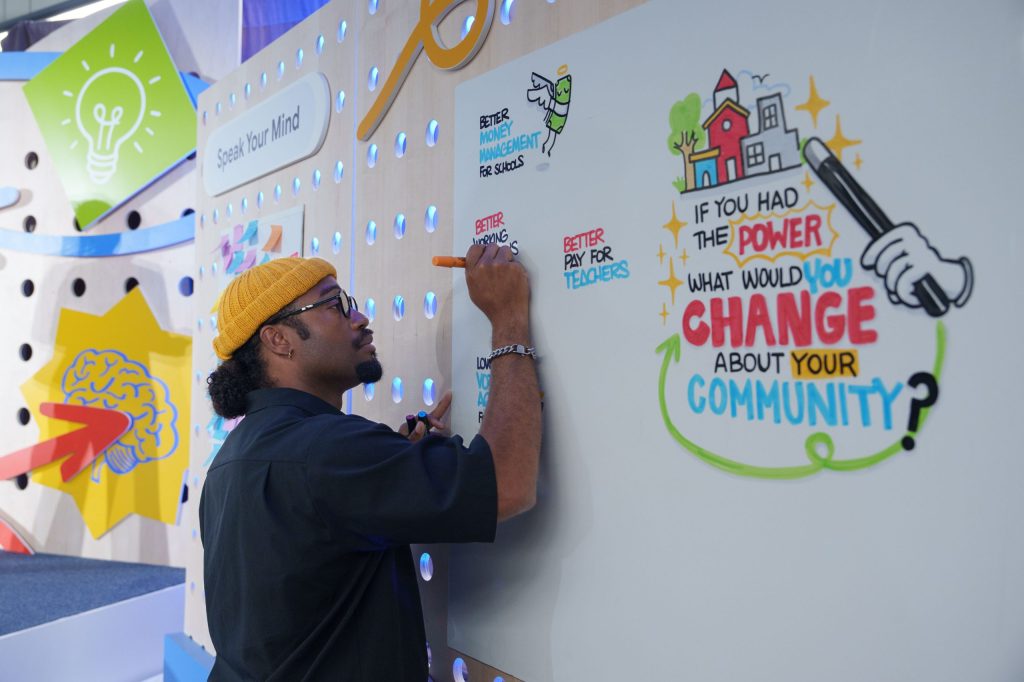 The mural at the We Mind event June 12. Photo: Active Minds
Henry said she and other students have attended PUSD School Board meetings, which she said have served as a place for students to protest, listen and speak. Henry also serves on the Student Think Tank, which hosts an annual Youth Leadership Conference each April. The Student Think Tank is very community-oriented, Henry said, and works with local organizations, such as the Western Justice Center.
“A thing that I hear a lot is that [students] all have value; we all have power, but Student Think Tank is a way to actualize the power that we all have, and to actually make decisions, and to make change in the world,” Henry said.
Henry served as a representative from the Student Think Tank on the We Mind panel, alongside Pretlow, Bell, Assemblymember John Harabedian, moderated by Audrey Bonavich.
“This isn’t my first time speaking on a panel, but I wanted to come here because I think it would be a really good experience in the sense that it’s basically everything that the Think Tank does,” Henry said. “It was right up my alley. I just love being in spaces like these, where students are encouraged to share our voices, and so this was one of those opportunities.”
According to Dr. Megan Jones Bell, Senior Director of Clinical at Google.org and a Palisades Fire survivor, Google has provided $5,000,000 to launch a national youth peer support movement.
“Google is interested in supporting mental health at a local and national level,” Bell said. “We have worked for years to support youth learning and applying digital literacy skills, and that’s ever more important in this age of AI.”
Bell said Google’s Gemini Artificial Intelligence model is working with clinical psychologists, developmental psychologists and experts in youth online safety to inform its programming. According to Bell, Google Gemini works with Reflex AI, an Active Minds partner.
“AI has this amazing opportunity to help build skills through practicing and training people and delivering peer support,” Bell said. “While we, in our products, want to encourage youth to reach out to someone they trust when they need support for their mental health, there also has to be help available.”
Pretlow, a Southern California native, said she has had opportunities to travel across the nation and interact with youth and young adults thanks to her work with Active Minds, and the contributions from Google.org will allow the 501c3 charitable organization to continue its mission to mobilize young people.
“With the supportive funding from Google, we are planning to reach 100,000 K-12th-grade young people over the next few years to really connect them to a network of champions, equip them with tools, and activate and amplify their voices,” Pretlow said.