
Under a bridge along Interstate 35, in a park near Airport Boulevard, on a bench downtown — on any given night, thousands of Austin residents call these and other unsheltered areas throughout the city home. More than 65% of those residents have self-reported to Integral Care that they are grappling with a substance use disorder and mental illness. At the same time.
To address behavioral health issues among Austin’s unhoused population, the city recently extended its Homeless Health and Wellness program, adding almost $500,000 to the budget for that purpose. The program launched in 2021 as a partnership among Downtown Austin Community Court (DACC), the Homeless Outreach Street Team and Integral Care.
The collaborative effort aligns with Austin’s goal that “persons experiencing homelessness have access to recovery services, mental healthcare, and other healthcare services,” as stated in the city’s Action Plan to End Homelessness. The unhoused population’s lack of access to medical and mental health care leaves these issues untreated, which can lead to chronic health issues.
Integral Care, which operates as the local mental health authority throughout Travis County, regularly administers behavioral health services at its Oak Springs Clinic in Central East Austin. The Homeless Health and Wellness Center is one of many health care programs the clinic manages in Travis County that are sponsored by the local, state, or federal government.
 Kristi Kaiser
“As the number of individuals experiencing homelessness with complex conditions continues to increase, the need for additional behavioral health care services that are fully integrated with primary care was growing,” Kristi Kaiser, the practice administrator overseeing housing and health care for the homeless initiatives provided by Integral Care, told the Austin Free Press.
According to Kaiser, most of the people served by the Homeless Health and Wellness Program are men age 40-64, and people of color make up 58% of those served. She said that Black and Indigenous people are overrepresented within the program, which is consistent with the disproportionate number of people from these demographics among all experiencing homelessness in the region.
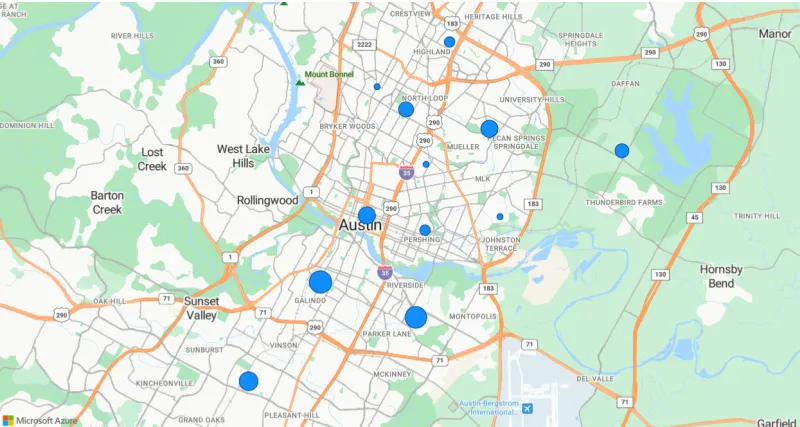 Homeless Health and Wellness center program map; dots indicate service locations.
Credit: Integral Care
Mental health diagnoses and substance use disorders vary across those served by the program, though the most common conditions are PTSD and trauma-related disorders, bipolar and major depressive disorders, and schizophrenia and other psychotic disorders. Kaiser said these data are not surprising and are consistent among the overall unhoused population, adding that the experience of homelessness is itself traumatic and can lead to mental health issues.
“Individuals served by the Homeless Health and Wellness Center often have a substance use disorder as well,” Kaiser said. “The presence of having a mental health disorder triples your risk for having a co-occurring substance use disorder.”
People who have both substance use and mental health disorders are the program’s target population. DACC has a sign-up list for people to self-apply for Intensive Care Management and the Homeless Outreach Street Team identifies additional people needing care.
People requiring the highest level of care are given priority, with consideration taken for how long someone has been on the waitlist. All participants are evaluated based on strengths, needs and diagnoses and develop a unique path to recovery with the help of Integral Care staff, according to the program. Types of care vary depending on what each person is going through and range from social work programs and therapy to mental illness and addiction treatments and primary care, Kaiser told the Austin Free Press.
The Homeless Health and Wellness Center operates “an intensive behavioral health service team that meets with individuals in the community at least once weekly,” she said.
Funding supports six full-time employees, including qualified mental health professionals and a peer-support specialist as well as one part-time nurse. Though the team is mobile and often works one-on-one in the community, participants can come to the Oak Springs Facility for in-patient psychiatric or medical care.
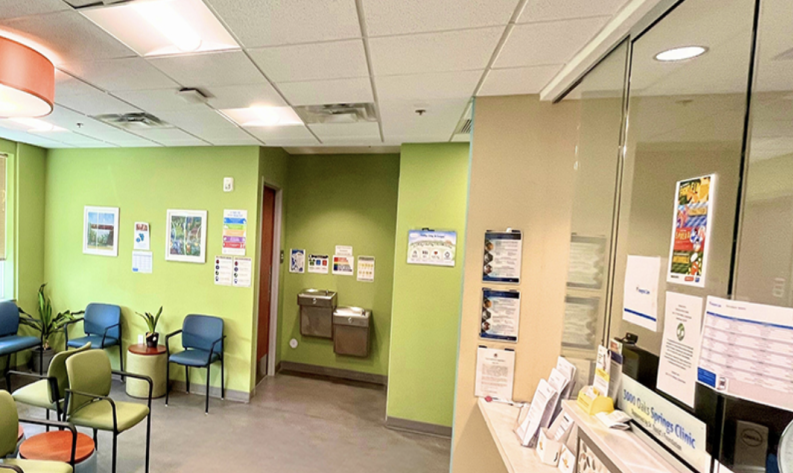 The waiting room at the Oak Springs Integral Care facility.
Credit: Integral Care
The program can provide services for up to 100 patients at a time, with hundreds more waiting for care — DACC has 780 people on its waitlist. The extension of funding will “allow business to continue as usual” but does not “provide capacity to bring on additional resources and serve more individuals,” said Robert Kingham, court administrator for DACC.
The Homeless Health and Wellness Center has served 444 people since inception. It has a 90% retention rate, meaning those who begin receiving care voluntarily continue to participate in the program. In addition to behavioral and medical services, participants have improved access to SNAP and disability income, connections to health care, employment, recovery services and reduced criminal justice involvement.
Existing patients are discharged from the program, and new patients are enrolled on a case-by-case basis. This process is a balancing act between “enrolling new clients without compromising housing stability or health outcomes by prematurely graduating or transitioning someone to a different service program,” Kaiser said.
Digging into the root cause of homelessness while administering behavioral health services and primary care to vulnerable Austinites creates a safer community overall, according to Kaiser. “By prioritizing health care and housing solutions, the community can reduce system strain, improve public safety and support healthier outcomes for everyone,” she said.
Kaiser also spoke to the value of de-stigmatizing mental illness and substance use disorders. Doing so encourages those experiencing these conditions to seek care and allows funding to continue for programs such as the Homeless Health and Wellness Center.
“I think we’re making some strides there, where we can show the community some of the return on investments of money that’s invested into behavioral health care and the corresponding outcomes,” Kaiser said.
Piper Guinn is the health equity reporter for the Austin Free Press, covering the disproportionate health burden carried by our city’s most vulnerable. Piper is a native Texan and recent graduate of Whittier College, where she received a B.A. in political science.
Support for Austin Free Press reporting on health equity comes from the St. David’s Foundation. Sponsors do not influence AFP’s editorial decisions.