
There is a rising mental health crisis happening in the United States right now, but it’s a difficult one to name for many. People are experiencing degrees of overwhelm and freeze in the face of extraordinary political chaos. All the while, the social constraints of needing to carry on with the business-as-usual of our lives creates a kind of dissonance that’s deeply disturbing. What I think we’re witnessing is not an increase in individual pathology, but the emotional and nervous system consequences of living through conditions that are genuinely overwhelming without meaningful recourse to respond.
We’re watching attacks on democracy, rising authoritarianism, climate catastrophe, economic instability, escalating social fragmentation, and the ongoing collapse of trust in institutions. Many people feel deeply disturbed by what they’re seeing, but also unsure what to do with that disturbance. The result is a kind of paralysis where people collapse into doomscrolling, numbing, dissociation, exhaustion, or private despair because the scale of what’s unfolding feels so enormous that the individual nervous system struggles to metabolize it. Yet despite the profoundly social and political nature of this distress, the dominant response continues to individualize the problem.
People are encouraged to manage their anxiety privately, to self-regulate their dysregulation. Optimize their self-care routines. Take medication. Go to therapy. Download another mindfulness app. And to be clear, none of these things are inherently bad, but that’s also not the point. We should be asking a deeper question about what happens when perfectly reasonable responses to collective conditions become framed exclusively as individual mental health problems. What happens when the solution to political overwhelm becomes adaptation rather than collective action?
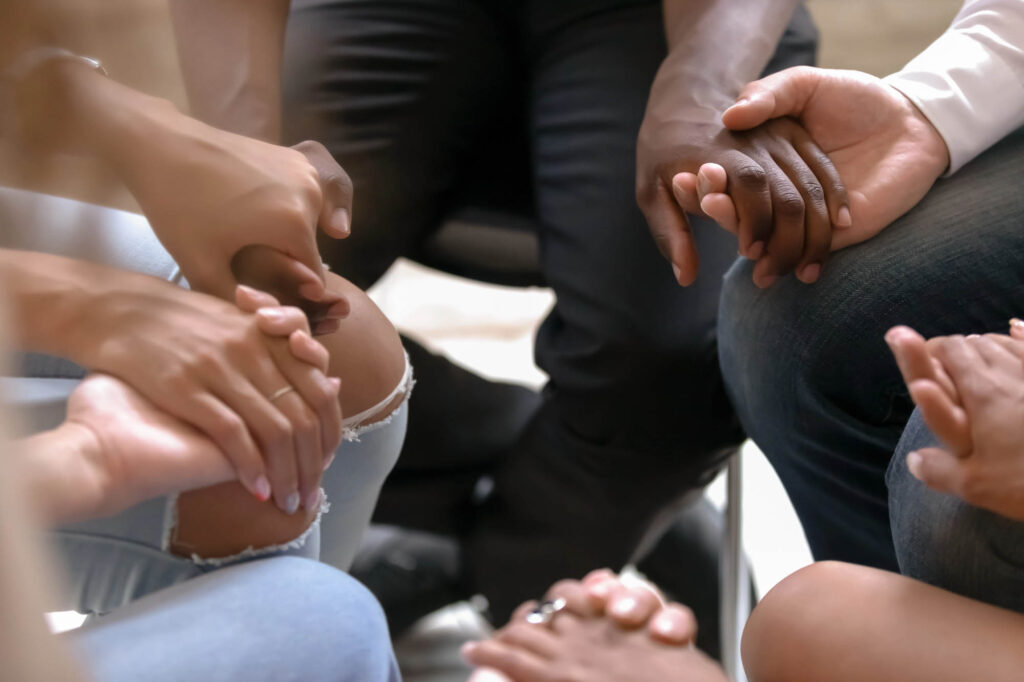
The freeze many people are experiencing right now isn’t simply personal dysfunction. It’s also a social and political condition. Human beings aren’t built to metabolize massive societal instability alone and in isolation from one another. I think one of the great failures of our current mental health discourse is that it often stops at the level of the individual nervous system without asking what kinds of worlds and social realities those nervous systems are responding to. Of course people are anxious. Of course people feel overwhelmed. Of course many people feel helpless watching the scale of what’s unfolding politically while simultaneously feeling disconnected from meaningful forms of collective participation.
I’m writing this as someone who, alongside others on our team at The Outer Work Project, has spent years steeped in trauma healing, somatic practice, and nervous system education. What we’re witnessing right now feels important to name because so much of what people are experiencing makes sense in the context of the conditions we’re living through. From our perspective, this doesn’t primarily look like individual pathology, but like human nervous systems responding to prolonged instability, overwhelm, fragmentation, and helplessness.
The answer can’t be more privatized coping. And I worry that in some cases we’re medicating people through conditions that should also be mobilizing us. I don’t mean that people should simply “push through” overwhelm or abandon care for themselves. Quite the opposite. I think we need a much more nuanced understanding of how trauma and overwhelm operate, while also recognizing that action itself can become part of how freeze begins to shift. There’s something psychologically devastating about witnessing immense harm while feeling unable to respond alongside others. And helplessness deepens when people feel isolated inside their fear.
Historically, human beings have metabolized fear, grief, uncertainty, and instability collectively. Through ritual, gathering, movement, mutual aid, song, resistance, spiritual practice, storytelling, and shared meaning-making, people found ways to move emotional energy together rather than carrying it and processing it alone. Dominant culture in the U.S. and elsewhere, however, is profoundly individualized. We’re encouraged to experience and resolve our suffering privately. Even many healing spaces unintentionally reinforce this dynamic by focusing almost entirely on personal healing detached from social and political realities.
At the same time, many political spaces fail to understand trauma and nervous system overwhelm. They often operate through urgency, performance, productivity, and information saturation without recognizing the emotional and physiological states people are carrying. This is part of why I believe we need a different bridge right now: spaces that help people understand the relationship between individualized responses, political despair, and collective action. We need spaces where people can move from isolation toward participation and where they can begin to understand that freeze is not failure. Freeze is a human response to overwhelm. But freeze also deepens when people feel alone with what they’re carrying and disconnected from pathways of meaningful engagement.
Collective action doesn’t only change external conditions. It can also interrupt helplessness. It can restore agency, meaning, connection, and a sense of possibility. One of the things movement organizers have understood for a very long time is that people often become more psychologically resilient when they’re connected to shared purpose and collective struggle. Collective action doesn’t magically remove grief or fear, but participation can change the relationship people have to those emotions. Despair can really fester in isolation, while action creates movement, and movement matters psychologically, emotionally, socially, and spiritually.
Right now, many people are carrying enormous amounts of fear and uncertainty in their bodies. But instead of only asking how to soothe individuals enough for them to continue enduring increasingly destabilizing conditions, perhaps we should also be asking how to create the social conditions where people can move together. Not all anxiety is pathology! Not all distress should be immediately medicated away! Sometimes distress is information. Sometimes overwhelm is an appropriate response to what’s happening around us. And sometimes healing requires not just self-regulation, but reconnection to collective life, collective care, and collective action.
I think many people are hungry for this, even if they don’t yet fully have language for it. They don’t simply want to “feel better” while the world burns around them. They want meaningful pathways out of their experience of immobilization. They want to feel that their lives matter in relationship to something larger than themselves.
Perhaps part of addressing the mental health crisis of this moment is recognizing that people need more than coping mechanisms. They, and we, also need each other.
In Solidarity,
Karine Bell, with Kai Cheng Thom, Nkem Ndefo and Staci Haines
The Outer Work Project
***
Mad in America hosts blogs by a diverse group of writers. These posts are designed to serve as a public forum for a discussion—broadly speaking—of psychiatry and its treatments. The opinions expressed are the writers’ own.