
T-L Photo/GAGE VOTA
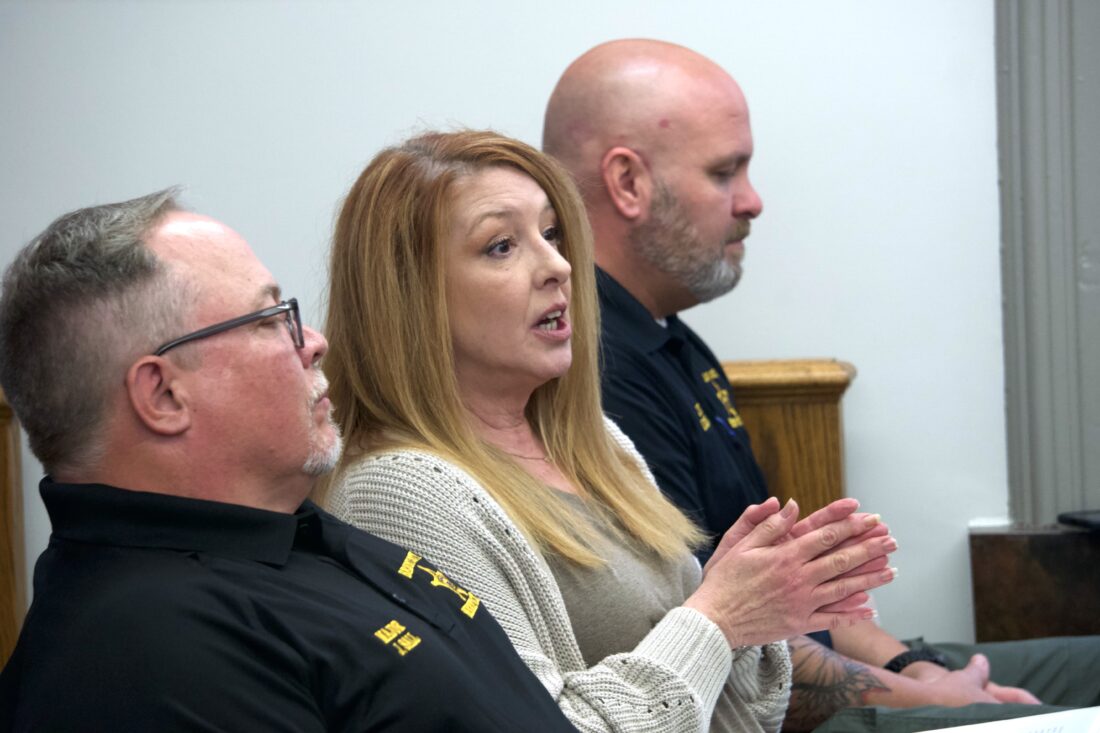
Belmont County Mental Health and Recovery Board director Patty Allen, in center with Belmont County jail administrator Jim Sall, on left, and jail Lieutenant Jarrett Weeks on right speak with Belmont County board of commissioners about the importance of the county becoming a Stepping Up county.
ST. CLAIRSVILLE — The Belmont County Board of Commissioners adopted a resolution supporting the Stepping Up Initiative.
The initiative is intended to reduce the number of people with mental illness in the Belmont County Jail.
The initiative is a partnership between the county, the Belmont County Mental Health and Recovery Board and the jail.
Mental Health and Recovery Board Director Patty Allen said the resolution is simply a way to formalize what the county is already doing.
“Stepping up is really just formalizing a system that we already have in place. Several years ago, the mental health board partnered with the county commissioners and the Belmont County Jail to fund and place a social worker within the jail,” she said.
According to the Ohio Department of Mental Health and Addiction Services, the Stepping Up Initiative is a national initiative targeted at reducing the number of people with mental illnesses in jails.
“Without change, large numbers of people with mental illnesses, many with co-occurring substance use disorders will continue to cycle through the criminal justice system, often resulting in missed opportunities to link them to treatment,” according to the agency’s website.
Allen added it’s known that the majority of people in the jail struggle with mental health or substance use disorders.
“Stepping Up’s philosophy is to provide services and supports while people are in the jail and upon release, so that their mental health and substance use disorder needs are addressed, that they have recovery supports in place, so that they can become healthier, and it’s also an opportunity to reduce recidivism, which then makes the community safer,” Allen said. “It’s important to cut the recidivism rate because we want our communities to be safe. In order for our communities to be safe, our people need to be well. In order to be well, they need to receive many times mental health services, drug and alcohol treatment support, such as pro-social activities, housing, connection to positive role models that can help support them and offer them hope.”
She added that county jails have become the largest mental health providers in communities due to the number of people who have mental health and substance use disorders.
“The goal of Stepping Up is to help people with mental illnesses get connected to clinical services and aftercare so that they can get well, make positive life changes, be connected to services and support with the ultimate goal of one, their wellness,” Allen said. “And two, reducing recidivism for Belmont County, passing the resolution so that the county formalizes many of the services we already have in place within the jail.”
Lt. Jarrett Weeks added that the Mental Health and Recovery Board has long been a strong supporter of the jail.
“We do have consistently a large number of individuals that are incarcerated that have mental health issues, and some from substance abuse. Everybody at the mental health board has really helped us out, especially when we have certain cases that are emergency cases of people that need immediate hospitalization, and the mental health board has always been very good working with us on that,” Weeks said.
Commissioner Jerry Echemann added that he recently spoke with Sheriff James Zusack, who applauded the partnership between the jail and the Mental Health and Recovery Board.
Commissioner Vince Gianangeli said that, as the former principal of St. John Central Academy, he has seen firsthand the need for mental health services.
“My experience working with individuals with mental health was in a school setting. I worked for a few years in a private school, and it’s very prevalent these days. Jerry (Echemann) and I were in school roughly the same time and we didn’t hear too much about mental health,” Gianangeli said. “I always say that I’m sure it existed, but most likely stayed in the home most of the time. Kids didn’t bring it to school with them, and we just didn’t care about it a lot like we do today. So I’m very glad to see that you guys are partnering with some of those that are incarcerated that are having these mental health issues.”
Today’s breaking news and more in your inbox