
U.S. Department of Health and Human Services (HHS) Secretary Robert F. Kennedy, Jr. came to Easterseals MORC in Clinton Township to announce new funding to fight the ongoing drug addiction epidemic.
Specifically, he announced a $96 million funding opportunity for the Safety Through Recovery, Engagement, and Evidence-based Treatment and Support (STREETS) program, along with $612 million in funding opportunities for additional behavioral health programs.
The STREETS program, housed within the Substance Abuse and Mental Health Services Administration (SAMHSA), will award eight communities up to $3 million a year for four years. That $96 million over four years will be used to develop multisector, state-of-the-art care systems for people who are homeless and have substance use disorders, serious mental illness, or co-occurring disorders.
Wednesday’s press conference began with Brent Wirth, the CEO of Easterseals MORC, sharing an explanation of the organization’s work as one of the largest behavioral health providers in Michigan.
Last year, the organization served more than 26,000 Michigan residents, with 14,000 of them going through the behavioral health clinics.
After being introduced by Wirth, Kennedy shared some statistics about drug use in the United States.
“Since 2000, drug-related deaths have claimed more than a million American lives. On any given night, more than 770,000 Americans are experiencing homelessness in communities across our country,” he said.
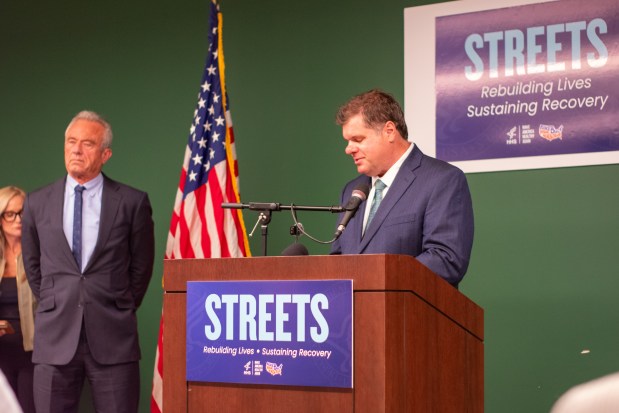 Brent Wirth, the CEO of Easterseals MORC, introduces Robert F. Kennedy Jr. in Clinton Township June 17.
(Sophia Lada / MediaNews Group)
Kennedy took issue with management of addiction by former President Joe Biden’s administration, saying they focused on harm reduction, or needle exchanges/safe sites for injections, which he said led to more open-air drug markets. He also said the previous administration discouraged states from supporting faith-based organizations, adding their programs are also evidence-based.
“These are the programs that are proven, evidence-based. It’s the only place where you can come and find large collections of recovered alcoholics and addicts who have 40, 50, 60 years of sobriety and that is evidence that they work,” he said.
Kathryn Burgum, co-chair of the Great American Recovery Initiative, shared her own story about her recovery from addiction, concluding that God intervened in her life and helped her. She shared what she said is the most important part of her work.
“The most important thing, in my opinion, that we treat addiction like the chronic disease it is,” she said.
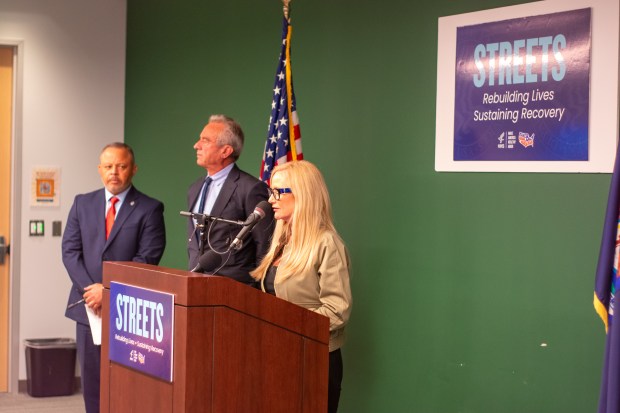 Kathryn Burgum, who is the co-chair of the Great American Recovery Initiative, talks at a press conference in Clinton Township June 17. (Sophia Lada / MediaNews Group)
Monty Burks, the director for the HHS Center for Faith, said that they are inviting faith communities to be part of the Great American Recovery Initiative.
“We are going to make sure that barriers are removed, opportunities are available and their voices are heard. In previous models and previous years, the faith community was systematically removed from the healing process in their own communities,” he said.
Wirth said the conversation he had with Kennedy prior to the press conference was solely to highlight the work of Easterseals MORC and was not related to the STREETS announcement.
He said that he found out about the STREETS funding on June 15, just two days before the press conference.
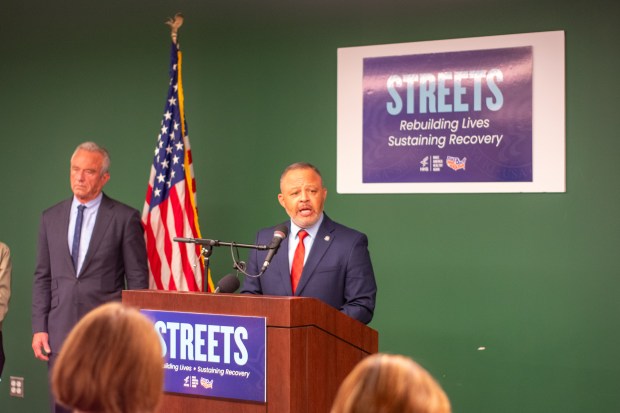 Monty Burks, the director of the HHS Center for Faith, talks at a press conference in Clinton Township June 17. (Sophia Lada / MediaNews Group)
“If it’s another tool for somebody to get healthy then it’s a great option, but I don’t have, I don’t know enough about it to really speak about it,” he said.
When asked if Easterseals MORC would benefit from the funding announced, Wirth said, “I don’t know.”
Funding is expected to go toward the following:
$96 million is expected to go to the STREETS Program.
$223.1 million of it is expected to go to community-based behavioral health care, or CCBHCs.
$238.6 million is expected to be used to for 988 and Suicide Crisis Lifeline.
$80 million is expected to go toward substance use prevention, treatment and recovery.
More than $70 million is expected to go toward mental health services and supports.
While Kennedy did not mention Michigan specifically, the approach he outlined stands in contrast with what has been put forth by Gov. Gretchen Whitmer’s administration that includes prevention, harm reduction, treatment and recovery. One of the most recognizable outcome of that effort has been naloxone kits, better known as Narcan, that reverse overdoses and drug test strips that allow users to detect additives such as fentanyl. In many communities, those are made available through free-standing boxes from which they can be easily accessed.
The approach employed by the Whitmer administration appears to have had an impact. Fatal drug overdoses in the state have seen a substantial decline in recent years. In Macomb County there has been a decline of nearly 25%, dropping to 234 deaths in 2023 from 311 in 2022. According to a previous Macomb Daily report, this marks a 41% decrease from a record-high of 394 fatal overdoses in 2017.
The Wednesday announcement was Kennedy’s second appearance in the Great Lakes State this week. On Tuesday, according to Politico he appeared with U.S. Rep. Tom Barrett and members of the Michigan Farm Bureau to discuss the importance of Michigan’s agricultural industry and Kennedy’s food-as-medicine approach to health.