
Legislation addressing behavioral health transport received testimony in the House Health Policy Committee during the week of June 15, while other key healthcare bills advanced in the Legislature.
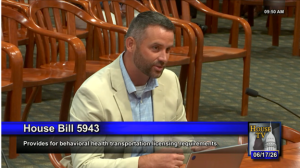 Kyle Hoffmaster, director of patient access, Pine Rest Christian Mental Health Services, testifies before the House Health Policy Committee in support of legislation establishing a licensure framework for behavioral health transportation services in Michigan.
House Bills (HB) 5943–5944, sponsored by Reps. Steve Frisbie (R-Battle Creek) and Amos O’Neal (D-Saginaw) received a hearing before the House Health Policy Committee. The bills would establish a licensure framework for behavioral health transportation services in Michigan and require Medicaid coverage for those services. Kyle Hoffmaster, director of patient access, Pine Rest Christian Mental Health Services, testified on behalf of hospitals and discussed how behavioral health transport services reduce patient wait times and provide a safe, secure alternative for transporting individuals experiencing a behavioral health crisis. Kelsey Ostergren, senior director, health policy, MHA, also testified before the committee and emphasized that the legislation would expand access to care while generating significant Medicaid savings. The MHA looks forward to the House Health Policy Committee advancing this legislation.
The House Health Policy Committee also considered HBs 5728–5738, which would relieve hospitals of administratively burdensome and duplicative requirements for substance use disorder program licensure. The MHA supports this legislation. The committee also voted unanimously to advance several bipartisan bills addressing medical debt. HBs 5254–5255 and 6071–6073, along with Senate Bills (SB) 449–451 and SBs 701–702, are companion measures that would codify hospital financial assistance programs (FAPs), establish reporting requirements for FAP benefits and prohibit medical debt from being reported to credit bureaus. The legislation would also modify medical debt collection practices, including restrictions on the sale of medical debt and limits on interest charges. These bills have now been referred to the House floor for further consideration.
The House Rules Committee voted to advance HB 4864, sponsored by Rep. Julie Rogers (D-Kalamazoo), which would revise the definition of elevated blood lead levels for lead abatement purposes. The Senate Health Policy Committee also approved SB 1011, sponsored by Sen. Kevin Hertel (D-St. Clair Shores). The bill would create a small-business health pool, allowing employers with 500 or fewer employees to establish state-regulated multiple-employer welfare arrangements that provide health coverage for eligible employees and self-employed individuals.
Lastly, the Michigan Senate passed SBs 973–978, led by Sen. Kevin Hertel (D-St. Clair Shores), which would create a state-based health insurance exchange in Michigan. The bills would allow the Department of Insurance and Financial Services to seek a federal waiver to establish the exchange and maintain contracts with participating health plans. The MHA supports HB 4864, SB 1011 and SBs 973-977.
Members with questions may contact the MHA advocacy team.