
Mental health professionals, educators, first responders, nurses, students and community members gathered at the University of Utah on June 17 and 18 for the Post-Traumatic Growth and Suicide Prevention Conference, an event focused on helping individuals find growth and resilience after trauma.
Hosted by the Post Traumatic Growth Project, a Utah-based nonprofit founded in 2024, and held at the S.J. Quinney College of Law, the two-day conference focused on suicide prevention, trauma recovery and evidence-based approaches to post-traumatic growth. The organization works to support veterans, first responders, teachers, healthcare workers and others who regularly encounter trauma in their personal or professional lives.
This year, the organization sponsored free attendance for students in the U’s social work, nursing and physician assistant programs, as well as members of the Salt Lake City Police Department and University of Utah Police Department.
Meet the Creators
For Executive Director Hugh Watt, the organization’s mission is deeply personal.
Watt, a licensed clinical social worker, said his interest in post-traumatic growth began after the death of his brother by suicide forced him to confront his own childhood trauma. “When my brother died by suicide, and then I was confronted with some of my traumas, being sexually abused as a child at that funeral, then it started my journey for post-traumatic growth,” Watt said in an interview with The Chronicle.
As he continued working as a therapist and federal probation officer, Watt said he noticed that many people understood trauma but lacked guidance on what comes next. “We’re teaching them about trauma, teaching about the effects and grief,” Watt said. “But when we give them more than the diagnosis and trauma, and give them some new mission or purpose or direction, that’s where people start finding growth.”
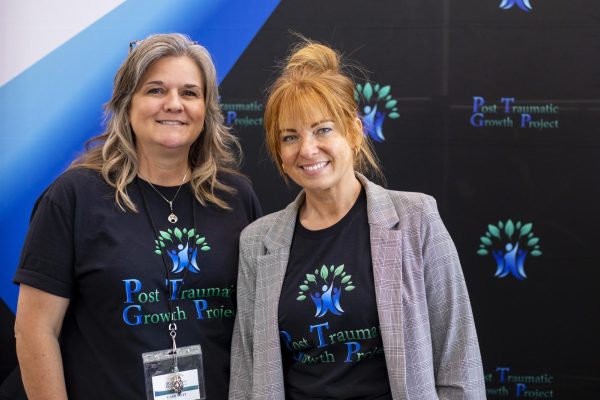
Cami Watt, a physician assistant and co-founder of the organization, told The Chronicle that the nonprofit grew out of conversations the couple had about gaps in mental health care. After surviving a stroke several years ago, she became increasingly aware of the challenges people face when navigating recovery and trauma. “We really recognized that our system’s broken,” she said. “If someone comes in and sees me as a medical provider, there’s usually no communication with a therapist.”
She said the organization’s goal is to bring professionals from different fields together to support those experiencing trauma.”We focus on bringing those interprofessional people together and giving them a skill set that can help people get through the tough things they’re going through,” she said.
 Speakers at the Post Traumatic Growth Conference at the University of Utah on Thursday, June 18, 2026.
(Margaret Mower | The Daily Utah Chronicle) (Margaret Mower)
The conference
One of the conference’s keynote presentations focused on suicide prevention and the biological, psychological and social factors that contribute to suicide risk.
Edwin E. Nyambi, a physician assistant and psychiatric specialist, explained to the audience that suicide is rarely caused by a single factor. Instead, he said a combination of genetic, environmental and psychological influences can increase a person’s vulnerability.
Among the risk factors Nyambi identified were previous suicide attempts, family history of suicide, psychiatric disorders, chronic illness, abuse, incarceration and access to firearms. He also noted that exposure to suicidal behavior among family members or friends can increase risk, emphasizing that the effects of suicide often extend far beyond the individual.
During his presentation, Nyambi discussed how the body’s response to stress differs from person to person. He explained that elevated cortisol levels, often associated with prolonged stress, have been linked to depression and increased suicide risk. He also highlighted research suggesting low serotonin levels play a role in suicidal behavior. “There is science behind depression and suicide,” Nyambi told attendees.
While acknowledging the biological factors involved, Nyambi emphasized that recovery is possible and that treatment should involve more than medication alone. “We cannot medicate our way out of this,” he said. “As soon as I prescribe, my next question is, ‘When is your appointment with your therapist?’”
He encouraged individuals struggling with depression to seek both therapy and medical treatment, stressing that support systems, meaningful relationships and access to resources can serve as protective factors against suicide.
The importance of language
Jessica Garcia, a therapist with Willow Creek Counseling Center, attended both days of the conference and said one of the most valuable aspects was learning practical language and approaches she can apply with clients. “The language was one of the biggest things that stuck out,” Garcia said in an interview following the conference. “The different terms that are recommended to use versus not use.”
Garcia also said hearing similar themes reinforced throughout the conference helped her think about how to apply the concepts in real life. The nonprofit’s approach centers on post-traumatic growth, a psychological theory that examines positive changes people can experience after adversity. According to the founders, the concept helps individuals move beyond seeing themselves solely through a diagnosis or traumatic event.
Those ideas aligned closely with the conference’s broader message of post-traumatic growth.
As the conference continues to grow, organizers hope to expand the nonprofit’s reach through additional training opportunities and volunteers. “Our ultimate goal is that when people recognize that they’ve gone through post-traumatic growth, they can become an expert companion to other people,” Watt said.