
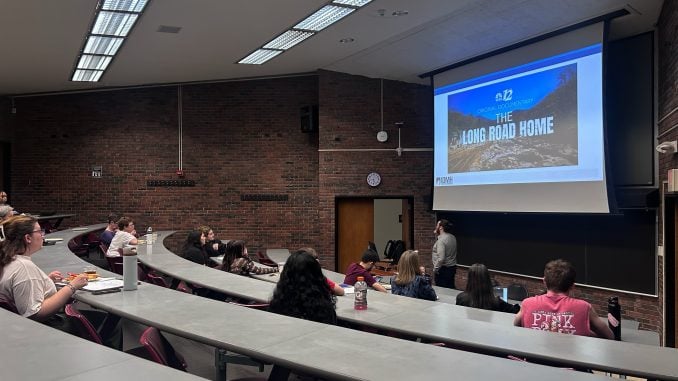
A presentation and screening of “The Long Road Home” in the Lecture Center. Photo courtesy of Patrick Kelly
Shari Cummings, owner of gift and garden store The Hickory Nut in Chimney Rock, N.C., never expected it to happen. Her store, which was also her home, had been around since 1945. She had been operating it for 28 years. On her lunch, she would watch the turtles in the river behind the store.
It took only 30 minutes for all of that to go away. Her house, her business, her life as she knew it, all gone in only 30 minutes. Destroyed by Hurricane Helene, a category four hurricane that devastated parts of the southeastern United States and the deadliest hurricane to hit the mainland United States since Hurricane Katrina in 2005.
Cummings’ story is just one story of the devastation wrought by Helene, captured by Winston-Salem, N.C. based news studio WXII 12 in an hour length documentary entitled, “The Long Road Home.” The river, the one where the turtles were, flooded under a torrent of rain, destroying Cumming’s home and business.
“The entire building collapsed where we were standing,” Cummings said in the documentary. “We’re lucky to be alive.” Cummings hasn’t seen a turtle since.
“The Long Road Home” was screened on Wednesday, April 15 by the Institute for Disaster Mental Health, an institute located at SUNY New Paltz that works in the field of trauma response and mental health. The institute also worked with the organization All Hands & Hearts to bring students down to outside of Asheville, N.C. to help rebuild people’s homes over spring break.
“What we did mostly, is individual homes,” said Andrew O’Meara, the program manager for IDMH who led the screening. “That includes booking and gutting, so taking away any of the debris that’s in the house … ripping out drywall, insulation, sub flooring. All the way up to rebuilding effort, which is most of what we did. Installing insulation, installing drywall, maintaining, putting up trim, those kinds of things,” O’Meara said.
After the documentary was screened, O’Meara brought up New Paltz students Lilliana Hapke, Anna Szarka and Isabella Saladino, all of whom went down to Asheville with the IDMH. The three outlined how important their work was and the incredible impact of their efforts, even if it wasn’t the most glamorous work.
“We weren’t doing any flashy recoveries or putting out fires, but we were doing really essential work of helping restore people’s normalcy,” Hapke said. “Headlines weren’t really going to cover a bunch of sweaty people hanging around like learning new skills”
“They definitely didn’t rush things, but they also didn’t slack on doing anything,” Saladino said of her time down in North Carolina. She went on to outline how everyone involved with the project took extra time to make sure every detail was perfect.
“They wanted it to be perfect for the person living there,” she said. “They finished a house a couple months previously, and they were still driving back to that house just to make sure they have the right materials to finish it.”
“They wanted to make sure things were done perfectly,” O’Meara said. “There was a day and a half I spent cutting the same piece of trim because I could not get it to line up.”
Houses affected by the hurricane also affected the surrounding communities. O’Meara described a home that due to the confluence of two rivers became a popular hangout for local youth.
“There was a home with a very beautiful interior, beautiful gardens, [a] really nice area,” O’Meara said. “We were talking to the homeowner, and she was saying how, for her, it’s not just her home, it’s almost like a center for the community.”
That status as a community hub was challenged by the devastation left after Helene. The wire and debris now litter the river, making it unsafe.
“A telephone pole had come down, and nobody would take responsibility for clearing it out,” O’Meara said. He continued to say that the property owner “said some of the kids were playing with the wire, and they’re going to get hurt.”
“She was worried about her home, but it was almost less because she was worried about herself, and more so she was worried about being able to provide a safe space for the rest of the community.”
The opportunity to be on the ground and in these communities affected by natural disasters was a learning opportunity for the students who participated. Some took away what actually is involved in the process of rebuilding after tragedy, others took away the lack of funds and attention this work gets paid.
“We hear about disasters and we hear about what response [looks like],” Hapke said. “But to actually do it … it was all important.”
“This is really necessary work, and there’s not enough funding for it,” Szarka said of disaster relief efforts.
“I’m very lucky to be in this position and be able to take students down and do this kind of thing,” O’Meara said. “[They] get under a house, get dirty, get covered in paint and really see what this work is.” O’Meara said that previous trips have inspired students to continue working with the organization All Hands & Hearts, describing the trip as “perspective changing” for the students that went.
“We’ve had students before come through our program go to All Hands trips and keep going once they graduate. [We] have one student that became an All Hands staff member.”
Recovery efforts are still ongoing at the Hickory Nut. According to a Facebook update posted on April 17, a concrete foundation has been poured and a wooded frame is up.
“Everyone that’s here, that lost their homes, they want to go home. [They want to] come back to their lives,” Cummings said. However, hope is not lost, and there is resilience in the communities affected by Helene’s deluge. Even the small things, like the turtles coming back, signal that while things may never be the same again, there still is hope for the future.
“These are the big boys that have been there since I’ve been there,” Cummings said. “If the turtles come back, we can [too].”
Post Views: 155