
At 5280 Recovery High School in Denver, students gather on so-called “Winning Wednesdays” to celebrate each other’s achievements — but not academic ones. Rather, they are sobriety milestones that mark how long they’ve abstained from using drugs or alcohol.
Billed as the nation’s largest recovery high school, 5280 Recovery serves about 100 teenagers who deal with substance abuse and addiction. The school uses strategies such as coaching and group meetings to help kids get sober — and stay sober — one day at a time, said Keith Hayes, who served as the school’s director of recovery from 2020 to 2026. Many of the staff are also recovering addicts with their own past troubles and life lessons to share.
On one “Winning Wednesday” last May, Hayes stood in front of bleachers full of students and handed out chips to those marking monthly milestones of continuous sobriety. It was the last Wednesday of the 2024-25 academic year and one well worth celebrating. That year, the student body boasted an average of 440 days sober from drugs and alcohol, the highest average since the high school’s opening in 2018.
“There is no chaser with anything that we do here at 5280. It is raw, it is uncut and it is real,” Hayes said in an interview. “The ability to be vulnerable with each other without judgment, without shame, is a beautiful thing. And I think the only way that real recovery works is that we can have difficult conversations about difficult things.”
After the presentation, recovery coach Brittany Kitchens then led a group discussion to talk about the challenges of staying sober during the summer without the structure and accountability of school weeks. She asked the teenagers in the room how they would fill their free time and who they would surround themselves with in the absence of their classmates.
5280 Recovery High School is unabashed in its approach. And while the cohort of kids it serves is unique, many of its methods reflect how other Colorado schools are seeking to intervene in adolescent drug use. Instead of relying exclusively on abstinence-only models, these schools are trying to help students by investing in their mental health and connecting them with services outside of school, such as food banks or specialty health professionals.
Educators say it’s critical to build trusting relationships between students and adults, and to entrust student leaders to help shape the culture in their communities. For some, this also means working closely with students who get into trouble as well, and instituting deeper forms of development than simple discipline or punishment.
But approaches remain a patchwork across Colorado since the state’s “local control” form of governance leaves it up to individual school districts to determine curriculum content. When it comes to drugs, state law only requires that some type of prevention education must be taught, though it lacks specifics about what that should look like.
That means the breadth and depth of information covered varies “dramatically” between districts, said James Hurley, comprehensive health and physical education content specialist at the Colorado Department of Education.
This is the second story in The Denver Post’s three-part series examining how drug education has evolved alongside changing cultural attitudes towards substances like cannabis and psychedelics, both of which are now legal in Colorado.
The Post spoke with five districts, both urban and rural, about their approaches; we also attended classes, virtually and in-person, at two. Prevention and intervention efforts within these districts are fairly new. Denver Public Schools, the state’s largest district, developed its programming in 2015 in response to marijuana legalization. Comparatively, the small Gunnison Watershed School District in southwestern Colorado hired its first student wellness coordinator in 2024 to oversee health programming and partnerships.
Normalizing sobriety
Educators said nicotine, cannabis and alcohol are the most common intoxicants they see and hear about among school-age kids, though awareness about opioids and psychedelics is growing.
In a three-part series, The Denver Post is exploring what youth drug education looks like in Colorado’s era of drug reform.
In 2023, 20.5% of high school students reported they currently drink alcohol, according to the latest data available from the Healthy Kids Colorado Survey, issued every two years by the Colorado Department of Public Health and Environment. The survey found 12.8% of high schoolers use marijuana, 8.7% vape nicotine and 3.1% smoke cigarettes.
Additionally, 3.5% of respondents said they take prescription pain medicine not prescribed to them or differently than prescribed. (The 2025 Healthy Kids Colorado survey results are expected to be published in June.)
Some of those statistics mark a notable decrease from the prior survey issued in 2021, when 23.6% of high school-aged kids reported drinking alcohol, and 16.1% reported vaping. The percentage of students who reported abusing pain medication also dropped, from 5.9% in 2021. Marijuana and cigarette use remained flat.
Despite concerns that underage marijuana use would skyrocket after legalization in 2014, rates largely remained stable before decreasing significantly in recent years. In 2019, the use rate among high schoolers was 20.6%,compared to 21.2% in 2015, according to the survey.
The 2023 survey added a new question asking high school-aged kids if they had ever used psychedelics, and 3.8% reported that they had.
The data underscores that most local teenagers are not using drugs and alcohol — even though they often overestimate the number of their peers who are. For example, 42.8% said they thought a majority of their peers binge drank — defined as four or more alcoholic drinks in one night — compared to just 12.1% who reported having done so in the previous 30 days, according to the 2023 survey.
“We need to normalize sobriety,” Hayes said. “We need to normalize that it’s OK to be comfortable in my own skin, I don’t need a social lubricant.”
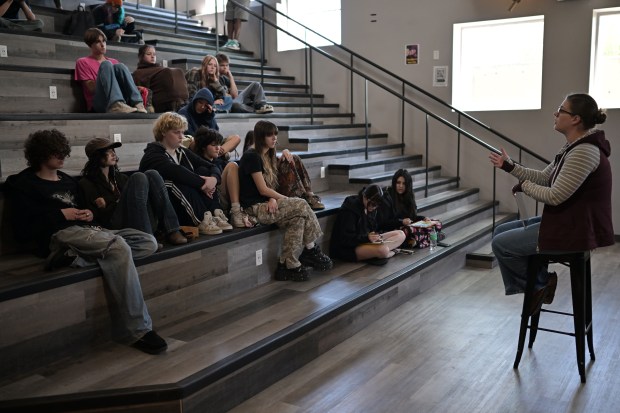 Peer recovery coach Brittany Kitchens, right, speaks during a group therapy-style discussion called B.O.A.T., which stands for “Being Open and Authentic Together” with the students at 5280 High School in Denver on Wednesday, May 21, 2025. (Photo by Hyoung Chang/The Denver Post)
A focus on trust and transparency
When talking to students about drugs, Colorado educators said transparency and trust are key to making an impact, especially for a generation with the world’s information at its fingertips.
During his tenure at 5280 Recovery High School, Hayes sought to create a judgment-free zone so kids felt comfortable being honest with their recovery coaches.
“Let’s stop telling people drugs and alcohol are bad because that’s not true. Because if they were so bad, would anybody be out here doing them?” Hayes said. “So we tell kids, ‘We love drugs, we know they’re phenomenal. We love alcohol. But if I truly work in an active program of recovery, that can be even more phenomenal.’ And that’s the messaging. Kids dig that.”
In more traditional high school settings, the tone is typically more tempered. But educators still aim to create an environment where trust and honesty are reciprocal with their students. Having trusted adults to confide in is one critical factor that ultimately supports youth emotional and physical well-being, experts said, and well-being is inextricably linked to substance use and abuse.
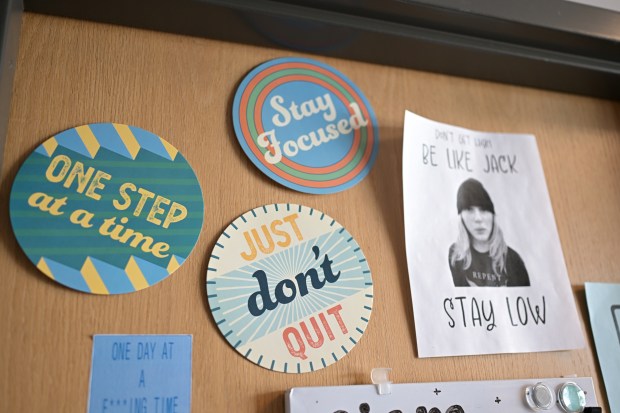 Signs at 5280 High School in Denver on Wednesday, May 21, 2025. 5280 High School is billed as the nation’s largest recovery high school, enrolling kids who experience substance abuse and addiction. (Photo by Hyoung Chang/The Denver Post)
At Ridgway Secondary School, where enrollment in grades six through 12 totals just 150 pupils, Shawnn Row has a unique opportunity to build a rapport with students and their families. In addition to being a health teacher, Row serves as the athletic director, an English teacher and outdoor education coordinator, so he sees the same kids in numerous capacities for many years.
As the ninth graders filed into health class on a chilly February morning last year, it was clear they were immediately engaged. For one, Row was speaking their language. The first slide on the day’s presentation about marijuana featured a meme with a picture of a young boy smiling, his head flanked by text. “4/20? Puff puff pass? I’d rather pass today’s math quiz, thanks.”
As the kids repeated the punchline and giggled, Row stood at the front of the room with a welcoming smile. “Today we’re gonna talk about weed,” he said.
Health is a year-round class here, though the subject matter varies with the semester. Students receive sex education in the fall and drug education in the spring. Row began creating all the lessons himself several years ago after finding that out-of-the-box curricula didn’t resonate. His presentations combine scientific information about the adolescent brain, the known benefits and risks of various substances, and personal anecdotes from his own life.
Row appreciates that his school leaders believe drug education should be a continuous conversation, instead of something that’s relegated to a specific timeframe or initiative. That also gives him the flexibility to address what specifically interests students.
“Usually at the beginning of eighth grade (and) ninth grade health, I say, ‘Hey, write down topics you’re curious about or you’ve seen somewhere or you’ve heard about,’ and I’ll try to integrate them into the lessons I have planned already,” Row said.
Row’s lecture about cannabis didn’t sugarcoat the fact that it is widely available in Ridgway, a town of about 1,200 residents and three recreational dispensaries near downtown. The students were well aware of that, of course. You can smell it “walking around on any given Tuesday,” one said during class.
Row broke down the differences between cannabidiol and tetrahydrocannabinol, explaining the psychoactive effects and how those distinguish the CBD products in grocery stores from the THC products in pot shops. He also shared a study tracking youth use and later life outcomes, and a story about how Kansas police once pulled him over and searched his car because of his Colorado license plate.
After class, then-freshman Izzy Katz said she learned a lot from the presentation, but still wasn’t sure if she considered marijuana good or bad. Some drugs, like fentanyl and heroin, have very clear harms, she said. Cannabis didn’t seem similarly dangerous, but it also didn’t seem benign like Vitamin C.
“I feel like marijuana is kind of put in that grey area where people don’t know how to categorize it,” Katz said. Her sentiment exemplifies the challenge of discussing once-demonized drugs that are now being reframed in light of legalization.
“I really hammer away on (the fact that) the teenage brain is not fully developed, and no matter what substance it is you put in your body, it’s going to have a bigger effect on you than it will on a 25-, 30- or 35-year-old,” Row said in an interview. “That is kind of the challenge with the legalization of weed and now psychedelics is, if adults don’t see it as harmful, the kids are less likely going to, as well.”
Row navigated this again when he tackled psychedelics during an April health class. While substances like psilocybin and LSD aren’t as popular as vaping, cannabis or alcohol, Row believes kids have been exposed to them enough through movies, social media and the news to warrant a discussion. And he’s probably right.
The freshmen were noticeably excited the morning they arrived and saw a presentation titled “psychedelics/hallucinogens.” After discussing the role of the brain’s thalamus and how psychedelics suppress its ability to filter all the sensory experiences of the world, one student suggested that this may be a good thing in moderation. After all, The Beatles “took LSD all the time and they had fire music during that timeframe,” she said. Another said she has read that microdosing ‘shrooms can help with anxiety.
Yes, psychedelics could boost creativity in some cases, and yes, research has shown they can be beneficial in therapy, Row responded. But the effects are not all just fractals and rainbows.
“If our thalamus wasn’t working, we would be in sensory overload all the time, and when people do acid, do mushrooms, usually once they wear off, they are completely depleted,” Row told the class. It can take a day or more to recover from a single 8- to 12-hour trip, he added.
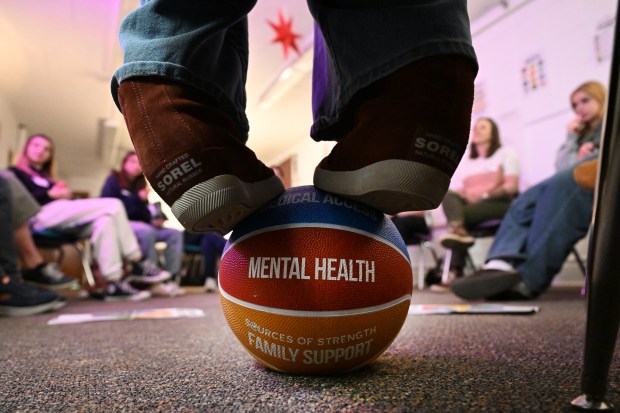 Leah Raffa, prevention specialist and grant coordinator on Denver Public Schools’ Substance Use Prevention Program Team, puts her feet on a ball that shows sources of strength for the students to think about during a Sources of Strength workshop at South High School in Denver on March 19, 2025. (Photo by Helen H. Richardson/The Denver Post)
Youth leaders cultivate culture
Three hundred miles away, substance prevention specialist Leah Raffa is tasked with disseminating drug education to the 89,000-plus Denver Public Schools students. There’s no one-size-fits-all solution here. Instead, Raffa and her colleagues in the Exceptional Student Services sector, which addresses mental health and student well-being, curate a menu of prevention resources and give each school autonomy over the best ways to serve their unique student populations.
Offerings include curricula that focus specifically on vaping, cannabis, prescription drugs and opioids, as well as programming designed to help students cope with stress and create meaningful connections with peers and adults at their schools. Where intervention is needed, DPS will deploy school social workers and psychologists to work directly with individual kids.
Perhaps one of the more interesting ways the district seeks to address whole child well-being is through a program called Sources of Strength. The program, which resurfaces throughout elementary, middle and high school, teaches kids to identify and draw upon their personal strengths as a means for creating healthy habits and lifestyles.
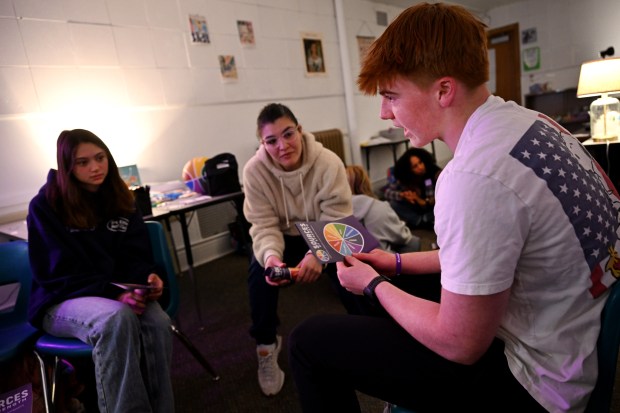 Dylan Vitale, 16, right, talks about his personal sources of strength in a breakout group with student engagement specialist Jenavi Sauceda, center, and student Jun Logue, 15, left, during the Sources of Strength workshop at South High School in Denver on March 19, 2025. (Photo by Helen H. Richardson/The Denver Post)
At the high school level, Sources of Strength is an extracurricular activity intended to cultivate a group of peer leaders who effectively act as positive influences in their schools. At Denver South High School, the group includes about 10 students, freshmen through seniors, who work with onsite social workers on initiatives that amplify inspiring stories and build community within the student body.
While this program doesn’t directly educate kids about drugs, it works as a prevention mechanism by empowering students to shape their school’s culture and build a peer support network for those who might be struggling, Raffa said.
Rose Negler, who graduated from Denver South last spring, spent several years participating in Sources of Strength and said the most impactful projects were often some of the smallest. For one initiative, students wrote down the name of a positive friend on a slip of paper and then collectively linked them into paper chains that decorated the hallways. The skills she learned also benefited her theater class once when a student went missing. Negler was able to talk to other students who were stressed and help diffuse the situation.
“A lot of my Sources skills came in handy there because I knew what to do in that kind of crisis and I was able to handle it,” she said.
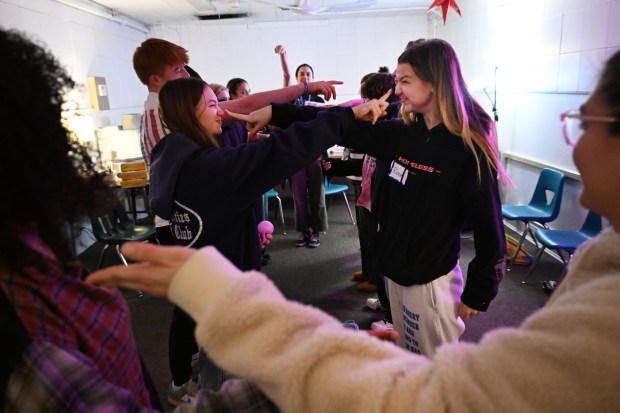 Jun Logue, 15, left, and Rose Negler, 17, right, participate in a creative exercise during a Sources of Strength workshop for students at South High School in Denver on March 19, 2025. (Photo by Helen H. Richardson/The Denver Post)
At 5280 Recovery High School, the students even sponsor one another. “We can talk to the kids ‘til we’re blue in the face about what we did to get sober, but it hits different when it’s a 16-year-old who has your same experiences and got their way out of that hole,” Hayes said.
Whole child solutions
In some districts, the most significant evolution has come in how educators react and intervene when students are caught using. In the Montrose County School District on Colorado’s Western Slope, strategies revolve around identifying environmental or circumstantial factors, such as food insecurity, that may be causing students’ drug use and connecting them with community organizations to help remedy those, said Megan Farley, the district’s manager of student health and safety.
“What we find is (a student) might be using nicotine or something, but that’s the tip of what’s actually happening,” Farley said. “We go in with a whole person, whole family approach. Like if it’s food that you need from the food bank, we hook you up with deliveries from the food bank.”
The district began shifting its approach in 2018, in the wake of the Parkland, Florida, mass shooting that killed 17 people at Marjory Stoneman Douglas High School and injured 17 others. A decade ago, Montrose had no school social workers in a district serving roughly 6,000 students. Today, Farley manages a team of up to 20 nurses, therapists, social workers, behavior coaches and school resource officers to support students’ needs.
The district also maintains partnerships with local organizations, like Hilltop Community Resources, so that young people can be connected to specific groups or specialists they may need for support. All someone within the district has to do is express concern about an individual kid and Farley’s team will jump into action.
This ethos applies if a student gets in trouble for something other than drugs, too, said district spokesperson Matt Jenkins. “A child who is in crisis is not going to go away. We’re not going to expel our way out of that problem. We have to find an intervention and find the solutions in concert with that family to turn the corner.”
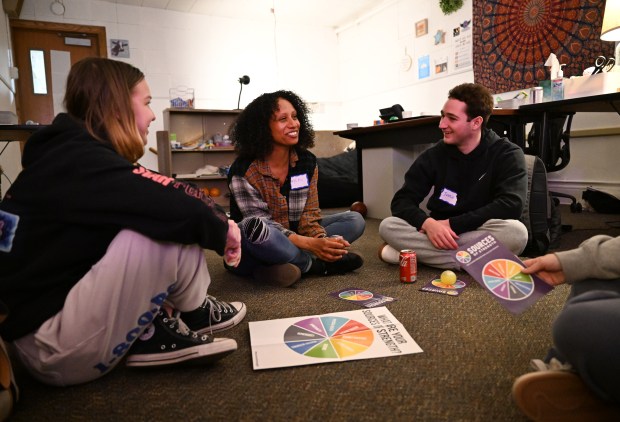 Teacher and mentor Neelah Ali, second from left, works with students Rose Negler, 17, left, Jesse Chapman, 17, second from right, and Reeve Pawlowski, 16, right, in a breakout group during Sources of Strength workshop at South High School in Denver on March 19, 2025. (Photo by Helen H. Richardson/The Denver Post)
Most of the educators who spoke to The Post said they were reevaluating discipline methods in hopes of finding long-lasting solutions. Instead of pushing kids away with punishments like suspension, these educators want to bring the students closer.
Here, again, is where trust comes into play, said Hayes. Given that students at 5280 Recovery High School are in recovery, relapse is a real possibility. When that happens — as it sometimes does — the staff works to comfort and support the individual, connect them with groups and assure them they are not a moral failure.
“A lot of us come into recovery with so much guilt and shame for the things that we’ve done. These kids need love — lots of love and lots of grace and lots of understanding,” Hayes said. “Being able to be there for them and supporting them and encouraging them to keep going is very important.”
This series was reported with support of the Ferriss-UC Berkeley Psychedelic Journalism Fellowship.
Get more Colorado news by signing up for our Mile High Roundup email newsletter.