
There’s a line that often gets attributed to my former Chicago mayor, Rahm Emanuel: “You never want a serious crisis to go to waste.”
For me, that quote always sounded like the kind of ruthless statement a political tactician would make, or something you’d read on a motivation poster, probably under a picture of a little cat in a yellow raincoat hanging on a clothesline in a thunderstorm.
Right now, the autism therapy industry can probably connect with that quote.
There are serious headwinds in the autism services space, from reimbursement pressure and workforce strain, to regulatory scrutiny and ongoing debates over utilization. At the same time, many leaders in the space see room for growth and are fairly bullish about 2026.
Crisis – but also opportunity.
In this week’s exclusive, members-only BHB+ Update, I pause to reflect on where the industry is at, using data from our recently conducted Autism Investor Summit survey to help paint the picture. Read on to learn:
– What challenges are defining the industry
– How executives are planning to grow revenue
– Why this crisis moment could fuel new opportunities
A crisis moment
Behavioral Health Business conducted our survey in April and early May as part of its Autism Investor Summit pre-conference outlook. Nearly 90% of respondents said they are employed by an autism services company or are independent clinicians providing care.
The group included a large share of clinic owners/founders and upper-level executives.
Basically, it’s a snapshot provided by the people living and working in the space every day.
If you work in autism therapy, you don’t need me to explain why 2026 feels like “a moment.” Take a brief walk with me outside BHB land – because when national outlets like The Wall Street Journal start focusing on your industry, it’s usually not for good reasons – to appreciate recent headlines:
– From North Carolina Health News | “NC moves to rein in soaring autism therapy costs amid fraud concerns”
– From Indiana Capital Chronicle | “State coming down on autism therapy providers that potentially abused system”
– From WSJ | “The Boom in Autism Therapy Is Medicaid’s Fastest-Growing Jackpot”
– From Colorado Sun | “Colorado wrongly spent $78M on autism therapy, Office of the Inspector General says”
Those aren’t great optics, as Rahm Emanuel might say. But industry insiders don’t seem too concerned about it, our survey suggests. Instead, survey respondents pointed to longstanding, systemic issues – pain points they’re very familiar with – as their top challenges
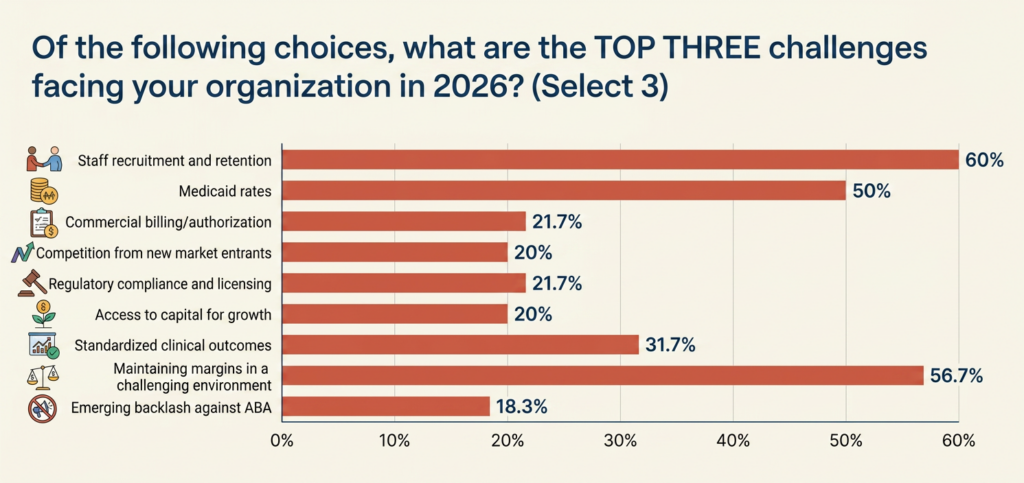
In our survey, the most frequently identified top challenges were all about staffing, reimbursement rates and operating margins.
Among our respondents, staff recruitment and retention was the most frequently selected challenge, with about 60% of respondents identifying it as a top pain point. Maintaining margins in a challenging environment wasn’t far behind at about 57%. Medicaid rates landed in the top tier as well, selected by 50% of survey respondents.
That all makes sense because you can’t grow without people, you can’t pay people without rates, and you can’t keep the doors open if the math doesn’t math.
Interestingly, standardized outcomes measurement and quality metrics was also an area selected by a fairly large number of survey respondents as a top challenge (32%). That’s significantly more than those who pointed to the emerging backlash we’re seeing in headlines.
What to measure, how often to measure it, who collects it and what it actually means operationally are all still big questions – without a doubt. But outcomes in 2026 will be critical for value-based care conversations, and as a defense against all the fraud, waste and abuse chatter.
Based on that feedback and our recent reporting here at BHB, I think the providers most insulated from this crisis will do three things simultaneously. They’ll explore ways of protecting their margin in the face of tighter reimbursement (maybe using AI to identify or unlock new efficiencies), they’ll embrace new methods to expand access and they’ll dedicate themselves to demonstrating value.
‘The madness of maintaining that everything is right’
I started this Update with a quote from Rahm Emanuel. I’m now going to throw you for a loop by evoking Voltaire. I have a hunch my colleague Laura Lovett is going to appreciate it.
In Voltaire’s 1759 satirical novella Candide, protagonist Candide travels the world encountering war, disaster and suffering while clinging to his philosopher-tutor Pangloss’s doctrine that “all is for the best in the best of all possible worlds.” Here’s one exchange Candide has with his companion, Cacambo, that I enjoy.
“What is this optimism?” asked Cacambo. “Alas,” said Candide, “it is the madness of maintaining that everything is right when it is wrong.”
When we asked survey respondents about 2026 revenue expectations compared to 2025, the responses were surprisingly optimistic. And, yes, many of you pointed this out on LinkedIn.
“The data seems incredibly inconsistent with the current [payer] landscape and regulatory constraints,” one LinkedIn commenter chimed in.
About 83% of respondents said they expect revenue to increase by 11% or more, with roughly 42% of that group projecting growth of 11% to 20% and another 42% forecasting growth of more than 20%. Only a small share anticipated flat performance or a modest decline.
Yes, that kind of optimism amid this crisis moment can sound naïve (maybe even Candide-like) – until you remember that autism therapy is still demand-rich.
Put simply, the services and care that providers deliver are so severely needed, and that’s not a factor that’s going to change any time soon. As of April 2025, the CDC reported that 1 in 31 children is identified with autism spectrum disorder (ASD) – an increase from the previous 1 in 36 estimate.
I’m betting many leaders believe they can translate that demand into sustainable volume, even as reimbursement pressure and scrutiny intensify. It’s an idea that’s echoed in stories on our sister publications such as Hospice News, Home Health Care News and HME Business; there are serious challenges in those spaces, but the “silver tsunami” means long-term tailwinds for senior care and post-acute care.
What’s more, respondents are planning for growth by thinking strategically about service-line expansion.
Among those who answered BHB’s survey question on service-line diversification, about 68% said they are considering service line diversification or expansion in the next year. About 25% said they are not, and about 7% said they are unsure.
Identifying opportunity
When asked to pick their top opportunities for growth in 2026-2027, BHB’s survey respondents most often selected:
– Geographic expansion into underserved markets (selected by 50% of respondents)
– Workforce development and training programs (38%)
– Value-based care contracts and outcome-based reimbursement (37%)
– Technology-enabled care delivery (telehealth, AI-assisted therapy) (33%)
– Partnerships with schools and educational institutions (32%)
I’m encouraged to see workforce development and training programs identified frequently as an opportunity.
For me, it’s a sign operators understand staffing isn’t just a recruiting problem. It’s a pipeline problem, a retention problem and, increasingly, a clinical problem. If utilization and outcomes measurement are under scrutiny, then, in many ways, variation in staffing becomes a business risk.
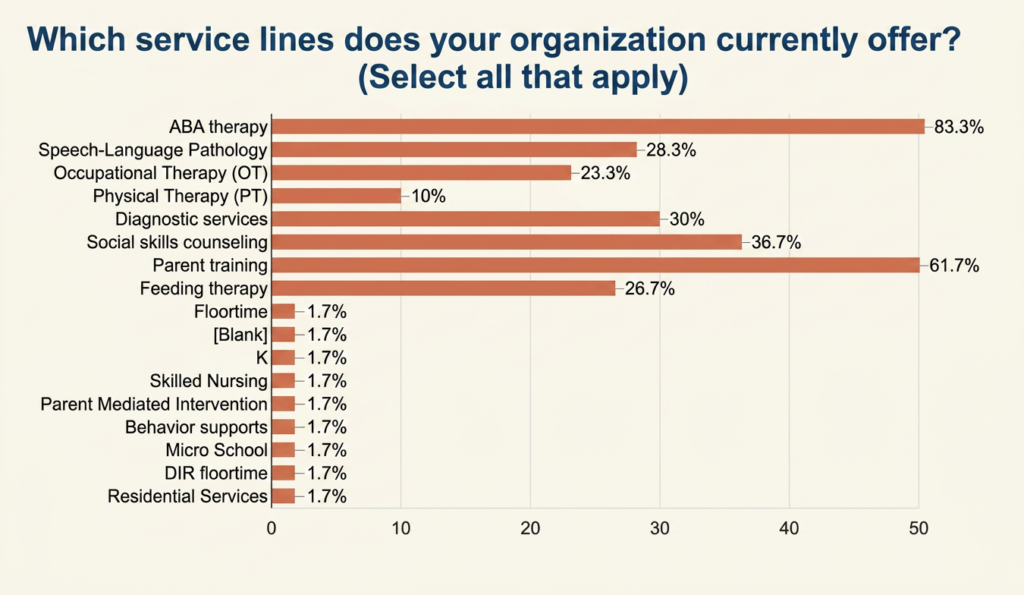
For context, among survey participants, 83% said their organizations offer applied behavior analysis (ABA) therapy, 60% offer parent training, 37% offer social skills counseling and 30% offer diagnostic services. Another 28% offer speech-language pathology (SLP), with 27% offering feeding therapy, 23% offering occupational therapy (OT) and just 10% offering physical therapy (PT).
It’s also worth noting what else respondents flagged as an opportunity. Many respondents said strategic M&A and consolidation would be an opportunity for operators.
Specifically, when asked about M&A and investment activity in autism therapy over the next 12 to 18 months, about 48% of respondents said they expect it to increase. Most predicted a moderate increase.
PwC’s 2026 global M&A outlook describes a market that is increasingly selective and K-shaped – with the top end of the market more active than the middle, and big, well-capitalized buyers having an easier time getting deals done than everyone else.
That framework fits autism therapy pretty well, too. You can see the logic for consolidation and platform-building – especially when operators are dealing with reimbursement pressure, heightened scrutiny and a workforce that doesn’t magically replenish itself. But the same pressures also raise the bar for diligence.
If this M&A market is “moderately increasing,” in my view, it’ll be because operators have built enough operational credibility to look like safe bets in a riskier world.
The ‘appropriate hours’ question and what’s up in Washington
Now, let’s talk about the elephant in the room.
The survey asked respondents to weigh in on appropriate weekly therapy hours for most clients, in the context of recent reporting casting a negative light on ABA billing practices and utilization.
About 77% said therapy hours vary significantly by client needs and should be individually determined.
About 13% said 20 to 30 hours per week is the optimal range.
Very small shares selected 10 to 15 hours, 30 to 40 hours, or said the question wasn’t relevant to their role.
This “right-sizing” debate has been around forever, but the tone around it has shifted. Even in the few years I’ve been working with BHB covering the ABA space, it seems like the conversation has gone from “what’s the ideal dose?” to “what’s the defensible dose?”
The survey also touched on a topic that has become unavoidable: politics, perception and the kind of “public narrative” risk that operators increasingly have to consider.
When asked whether patient families have asked staff about actions or statements by elected or appointed federal officials (I’m looking at you, Secretary Robert F. Kennedy, Jr.), about 38% said they’ve received questions about cause-of-autism research. About 28% said they’ve received questions about acetaminophen during pregnancy, and smaller but meaningful shares flagged topics like framing autism as an epidemic, actions around leucovorin and NIH funding priorities.
Bringing it back to Rahm Emanuel
So yes, this is a crisis moment. It’s a moment when staffing strain, reimbursement pressure, utilization scrutiny and outcomes expectations are all intersecting.
But it’s also a moment where the industry’s next iteration is becoming visible – a point BHB has repeatedly made (in headlines like this one and this one).
And to borrow that Rahm Emanuel line one more time: If this is a serious crisis, plenty of operators are determined not to waste it.