
BIRMINGHAM, Ala. (WBRC) – Organizations across Alabama are highlighting children’s mental health during Mental Health Awareness Month in May, emphasizing that children’s emotional health is just as important as their physical health.
Nearly 20% of children ages 3 to 17 have mental, emotional and behavioral disorders, according to the American Academy of Pediatrics.
 Experts say more children have been struggling with mental health issues since the pandemic.(WDBJ7)
According to the Alabama Department of Mental Health (ADMH), in 2021, the American Academy of Pediatrics, the American Academy of Child and Adolescent Psychiatry and the Children’s Hospital Association declared a national emergency for children’s mental health. That emergency is still ongoing.
Screen time impacts development
ADMH points to technology as something that greatly impacts children’s mental health. The department based the 2026 Children’s Mental Health Acceptance Week around the theme “Beyond the Screen: Education, Prevention, Connection.”
Too much screen time at a young age can affect thinking skills, language development and emotional well-being, according to a study titled “Effects of Excessive Screen Time on Child Development: An Updated Review and Strategies for Management.”
 Screens—especially when overused—are proven to disrupt developmental progress in children(Yuri Arcurs peopleimages.com | N F/peopleimages.com – stock.adobe.com)
ADMH says recognizing those impacts is important because early childhood experiences play a large role in how children learn, build relationships and handle challenges.
“Our children deal with some of the same challenges that we deal with as adults, and they are still learning how to deal with those challenges that they may face throughout the rest of their lives,” said Brandy Reeve, vice president of Behavioral Health Services at Children’s of Alabama. “Focusing on it early helps them to develop those tools for how they will cope with things that may come their way as they grow older.”
Device use starts early for many children. By age 2, about 40% have their own tablet, according to “Media Use by Kids Zero to Eight,” a study by the Common Sense Census.
By their teenage years, ages 13 to 18, between 88% and 95% have a smartphone.
Researcher Jonathan Haidt, in “The Anxious Generation,” connects the rise in youth anxiety and depression with increased screen use. He points to less in-person interaction, poor sleep, shorter attention spans and addictive patterns as possible reasons.
Steps parents can take
ADMH says parents and caregivers can take simple steps to support healthy technology habits. ADMH recommends keeping all devices out of bedrooms, which can help children sleep better and reduce overuse.
While excessive screen time can worsen children’s emotional health, mental health can be complex at any age.
ADMH continues to expand access to care for young people. More than 120 school districts and all 19 community mental health centers are part of the School-Based Mental Health Collaboration, serving approximately 12,000 students each year.
 Alabama Department of Mental Health: School-Based Mental Health Collaboration(Alabama Department of Mental Health)
The School-Based Mental Health Collaboration’s goal is to ensure that children and adolescents, both general and special education, enrolled in local school systems have access to high-quality mental health prevention, early intervention and treatment services.
ADMH provides the Alabama State Department of Education training, resources and support for school staff, including mental health service coordinators, and assists with programs like the Turnaround Schools Initiative.
Coordinated care programs
ADMH also partners with the Department of Human Resources and the Department of Youth Services through the Our Kids Program. This program helps coordinate care for young people with complex needs.
Youth in the program must receive, or have recently received, services from at least two local agencies, such as a community mental health center, a county Department of Human Resources office or a juvenile court. Teams from these agencies meet in person, review progress and track outcomes to make sure each child is getting the right support.
 Children’s of Alabama(WBRC)
Children’s of Alabama says it has been a leader in child and adolescent mental health treatment, education and research. Its multidisciplinary team includes psychiatrists, psychologists, therapists, nurse practitioners, nurses and expert support staff.
One resource Children’s offers is the Psychiatric Intake Response Center (PIRC). The free, confidential service links adult callers and community providers to the most appropriate mental health resources for children and teenagers. Therapists at the PIRC are licensed mental health professionals who can quickly assess what’s going on and direct an adult caller to the right resources.
“We offer education and an opportunity for that person to process what’s going on, ask questions and then clearly understand what the next steps are,” said Cindy Jones, director of the PIRC. “Our goal is to make sure the call is calming for the caller, which helps alleviate any anxiety, frustration or fear he or she may have.”
 More help is on the way for children and teens navigating the mental health system. The Psychiatric Intake Response Center at Children’s Hospital is now available statewide.(wsfa 12 news)
Jones said the PIRC is constantly updating its database with a list of providers across the state, working to assist everyone it can.
The PIRC is available to families across Alabama seven days a week, year-round, from 8 a.m. to 11 p.m. The number to call is 205-638-PIRC (7472). They also advise anyone experiencing a crisis to call 911 or go to the nearest emergency room.
ADMH also has a provider directory which can be found by clicking or tapping here. There is also a list of Alabama’s Crisis System of Care which can be found by clicking or tapping here.
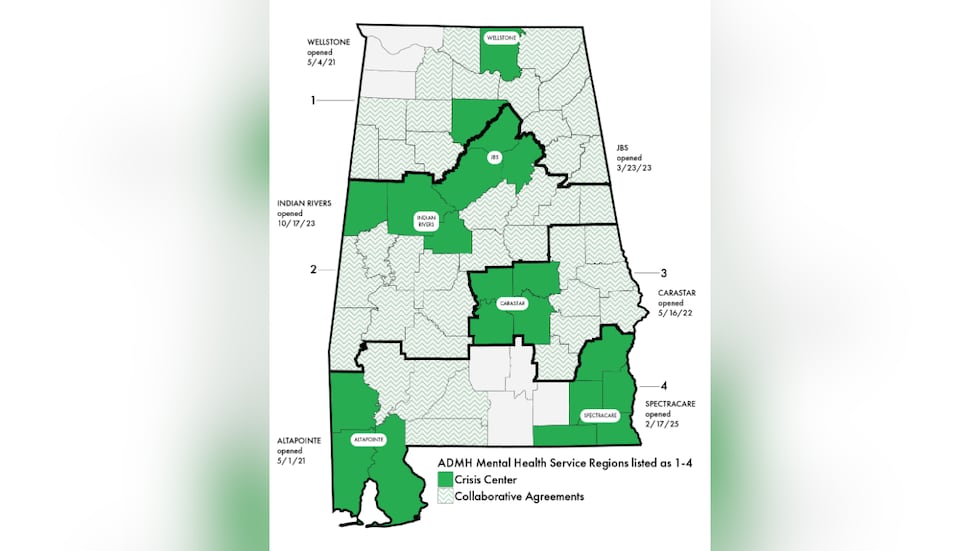 Alabama Crisis System of Care: Crisis Centers(Alabama Department of Mental Health)
Get news alerts in the Apple App Store and Google Play Store or subscribe to our email newsletter here.
Copyright 2026 WBRC. All rights reserved.