
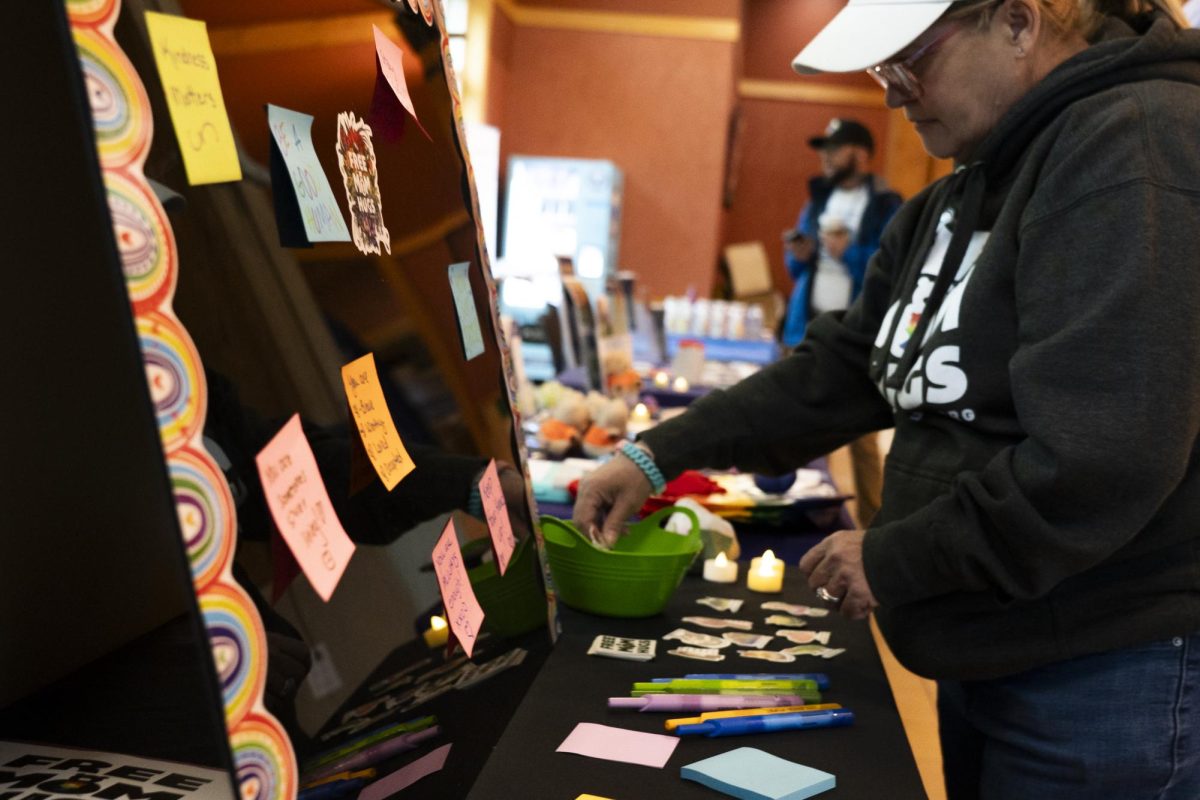
A volunteer sets up a booth before the Out of the Darkness Walk begins at the Bertolini Student Center at Santa Rosa Junior College on April 11, 2026.
Santa Rosa Junior College held an Out of the Darkness walk, to remember those who have been lost to suicide and provide resources for students who are struggling with mental health, on April 11 at the Bertolini Student Center.
The Rotaract club and the Rotary Center for Student Leadership partnered with the American Foundation for Suicide Prevention, not only to raise awareness about suicide and mental health, but to celebrate AFSP’s 30th anniversary.
Founders, directors, coordinators and staff of local mental health resources sponsored the event and provided tables full of resources, affirmations, gifts and colored beads to represent attendees who struggled, are struggling or have lost someone to suicide.
According to the AFSP the event raised a total of $16,500, to help continue to provide resources, care and support for those struggling with mental health crises. AFSP, established in 1987, researches, educates and advocates for actions against suicide, a leading cause of death in America.
In addition to financial support, the foundation supports survivors of suicide loss and those affected by suicide. Simone Ray, a 19-year-old English major at SRJC and volunteer for AFSP, discussed the importance of gathering for community healing.
“I think there’s nothing more precious than finding like-minded people, because community is how growth happens, and growth is both individualistic and also nationwide, worldwide,” Ray said.
Ray appreciated all of the resources offered at the event, especially the Zane Foundation and Free Mom Hugs. She and her family have struggled with mental health throughout her life. She felt very moved by the event and what it stands for, especially at a time when many are overwhelmed and need support.
“If you look around, the entire world is in a kind of dire situation right now,” Ray said. “Which I think definitely leads to a lot of hopelessness.”
Ray believes that SRJC has a good starting point for mental health but could use some improvements, especially when it comes to the number of therapists and counselors available and the amount of free sessions students are given.
Fran Templin, the founder of the Zane Templin Foundation, received a bouquet of flowers for her $10,000 donation and attended the event to support those struggling with mental health challenges. The Zane Templin Foundation is a nonprofit organization established in 2021 by the parents of Zane Templin, who they lost in 2016 to suicide. His parents decided to establish an organization to help support mental health awareness and suicide prevention for children, teens and young adults in Sonoma County.
Zane Templin’s parents have participated in local Out of the Darkness walks for 10 years, and have raised over $200,000 for AFSP. Fran Templin takes pride in the ability for her organization, despite being small, to support those in need immediately, unlike the average three-month wait period seen in Sonoma County.
“Our biggest goal right now is therapy if a teen or young adult is not able to provide funds for therapy,” Templin said.
The importance of listening and hearing people in distress cannot be overstated for Templin, who believes people must pay attention to engage and connect with the community and their struggles.
“Everybody’s going through it, and I just want to be a part of it,” said Templin, who attended the event in her son’s memory. “My son was an amazing young man, and had so much life going on. It was being turned in so many different directions.”
Buckelew Programs, established in 1970, is the largest North Bay-based nonprofit provider of mental health and substance treatment services. The program also provides housing, suicide prevention, and public education and prevention. They are also a major operator of the 998 Suicide and Crisis Lifeline, which provides 24/7 confidential support in over 147 languages through call, text or chat with trained crisis counselors.
Skyler Jayne, 37, program manager for family service coordination with Buckelew Programs, held a table at the event, and believes suicide awareness and prevention are crucial, especially in Sonoma County.
“Sonoma County actually has a higher than average rate of suicide than the state average,” Jayne said. “So we’re here to honor those we’ve lost and also to try and provide life-affirming services now to help people stay.”
Emily Murray, an outreach and education coordinator for Buckelew Programs, emphasized the importance of awareness about suicide and the resources available to address it.
“We as a community need to make sure the people that we love are feeling supported and seen,” she said. “There’s a lot of research that shows that when people are given appropriate resources and support, they almost always choose to live.”
According to Murray, it is also very important for the community and institutions to provide resources for students and loved ones, highlighting that the implementation of providing the 998 suicide hotline on student IDs is a great way to spread awareness.
Murray has seen underlying societal and systemic factors that contribute to the rate of suicide, especially noticing the rates of men and the societal pressures they face.
“I think that has a lot to do with the cultural stigma around men expressing emotions and feelings,” Murray said. “We see a lot of our suicide rates are over the age of 65, and so we have a large loneliness epidemic where our older people aren’t feeling supported and connected.”
Santa Rosa Behavioral Healthcare Hospital, which was formerly known as Aurora Santa Rosa Hospital, opened in 2016 and offers inpatient and outpatient mental health services for all ages, as well as substance use treatments. The hospital is connected to the Behavioral Healthcare Hospital in Sacramento.
Ashley Thompson, the director of Clinical and Community Partnerships at Santa Rosa Behavioral Healthcare Hospital, expressed the importance of more funding and resources for mental health.
“We have 144 beds, and there’s still more people calling and needing services that we can’t provide because we’re already at capacity,” Thompson said. “And that’s just in Sonoma County, so that tells you how big the need is in the Bay Area, and in the whole state of California.”
David King, a 20-year-old chemistry major at SRJC, attended with a friend to help him connect more closely with those who are struggling.
“I really wanted to come and experience and talk to people who have gone through that, and also try to spread awareness,” King said.
King has not personally accessed the mental health resources available on campus, which he said could be for a number of reasons, including pride, fear or a belief that he simply didn’t need it. He has found that having a small community of friends who support him is much more beneficial than counseling.
King found the event very informative and has influenced his mindset.
“I need to show my appreciation for the people I love even more, because you never know when they’ll be gone,” King said.