
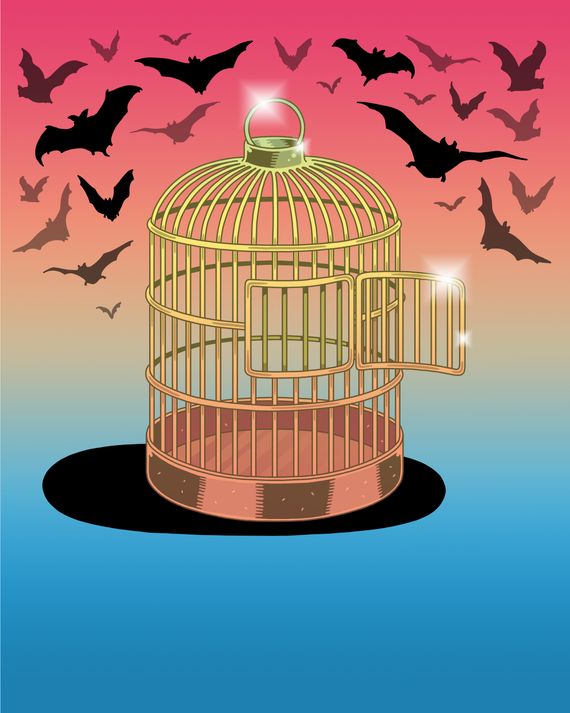
Illustration: Olivier Heiligers
Not everyone with a phobia can pinpoint the moment theirs began, but for Kelly, 36, the origin is clear: At age six, she came home from school to find her pet bird had escaped its cage. Kelly had one of those Barbie heads with hair you could style, which she kept in its original packing. In her bedroom, she found that the bird had gotten into the plastic box and was so badly entangled in the doll’s hair it couldn’t free itself, despite its frantic flapping. Kelly tried to intervene but was too late; she watched her strangled pet convulse and die.
She’s spent much of her life since avoiding bird-laden places: the beach, outdoor cafes, city sidewalks. “It’s embarrassing,” she says, “especially in front of a client or on a date. When there’s just a little bird on the curb and I stop and wait for someone to shoo it away, or I have to walk to the other side of the street, that’s awkward.” In her twenties, Kelly underwent a three-day exposure program with a therapist, “going over my childhood, the background of everything I’d felt about birds over the years,” she says. It became clear that wings flapping was what really terrified her, echoing her bird’s dying spasms. On day three, the therapist took her to a parrot sanctuary where Kelly held and touched the birds, even allowing one to sit on her shoulder. It felt like a win.
Many clinics and providers offer similarly speedy exposure therapy programs: a weeklong workshop or a one-session intensive. You’ve likely seen ads for them on social media, among hundreds of reels and TikToks documenting self-led exposures: riding the tube on an empty stomach to address a fear of fainting, or doing the robot at a street performance to face social anxiety. And there’s plenty of clickbait about Nicole Kidman’s fear of butterflies, which she tried to treat herself by visiting the Museum of Natural History’s butterfly vivarium.
When undertaken with the help of a clinician, ET’s success rate is well-known to be high—estimated at up to 90 percent. But “success” in this context means feeling a reduction in fear upon completion of the program, a definition that belies a difficult and underpublicized reality of ET: Its positive effects frequently wane with time. “Return of fear,” the clinical term for when phobia patients backslide, occurs in as many as 62 percent of ET patients. Though few therapists lead with this truth, many patients chip away at their phobia for years, not days or weeks, and return to treatment on and off for the rest of their lives. Some are so disheartened that they give up on ET altogether.
Return of fear eventually came for Kelly. For a while after her triumphant trip to the parrot sanctuary, she passed pigeons on the sidewalk without concern. But she soon felt the old fears welling up, and within a matter of a few months, she was back where she started. She was a twentysomething in a new city, she says, and couldn’t afford a second round of therapy. The frustration and disappointment were immense, and she still avoids birds in her daily life.
A phobia is, in a sense, a set of expectations layered over a fear—not just the feared thing itself, but also fear of the way it will make the patient feel. A person with a phobia of dogs might think, If I see a dog, I’ll panic and I won’t be okay. “We call this affect forecasting,” says Matthew Free, co-founder of the Columbus OCD and Anxiety Clinic in Ohio.
The popular understanding of ET is that a patient can habituate to their phobic triggers via repeated encounters with it. But growing desensitized to what scares you isn’t actually the goal, says Kevin Chapman, Ph.D., founder of the Kentucky Center for Anxiety and Related Disorders in Louisville. Exposures are meant to show the patient that even if they do panic, they will survive it and return to feeling normal. “You want them to be anxious so their brain can learn that even if they’re uncomfortable, they can tolerate it, and their feared outcome does not happen,” says Chapman. The patient sees the dog, gets nervous, sees that nervousness isn’t the end of the world, and then their anxiety abates. Rinse and repeat. This is the “inhibitory learning model,” in which the patient eventually learns the safety of the trigger so thoroughly that it inhibits their fear.
Guiding a patient through ET in order to net this result requires vigilance and nuance, and Chapman posits that in many cases, return of fear is a result of poor clinical technique. For example, Kelly believes that because the parrot on her shoulder during her exposure therapy wasn’t flapping its wings, the experience didn’t address her phobia directly. Patients also need to be steered away from “safety behaviors” (actions that let them avoid their triggers) during their exposure. And these behaviors can be subtle. In an exposure, it might look like closing one’s eyes, hiding, or seeking reassurance. Outside of an exposure, it might involve avoiding thinking about the trigger (if they’re afraid to fly, they may try not to dwell on an upcoming trip) or avoiding things that make them feel similar to how they feel when confronted with that trigger (they get jittery on flights and coffee makes them jittery, so they avoid coffee). They do lots of checking (Googling “how safe is flying” six times before a trip), carry “safety aids” (a lucky charm in one’s carry-on), or engage in rituals to prevent disaster (“I ordered a ginger ale on my last flight and was okay, so I have to order ginger ale again”). They numb out with alcohol or Xanax or distract themselves with a book or music. Such maneuvers may bring immediate relief, but long-term, they increase the chances of entrenching a phobia more deeply, confirming to the patient that the trigger is worth fearing and that the safety behaviors were what forestalled disaster.
A prerequisite for effective ET is that the patient must collaborate on the nature of their exposures. Holly, 47, underwent a one-session intensive exposure session for her arachnophobia and found it unhelpful. “It was at a wildlife park,” Holly says, “and there was tarantula handling, and I got as far as allowing one to set a toe on my fingertip. But I wasn’t brave enough to let it walk onto my hand. It was too much too soon.” Varying the type of exposures is key, says Chapman. “Graduated exposure, where you come up with a fear hierarchy and you start confronting each item on the hierarchy step by step, is what most clinicians do,” he explains. If a patient is afraid of takeoff, they might first watch videos of planes ascending (imaginal exposure), then try virtual reality to experience it more directly (simulated exposure), then graduate to seeing planes take off at the airport before ultimately getting on a flight (in vivo exposure). Being pushed to take on too much—hopping onto a puddle jumper in a windstorm, for example—may cause a patient to shut down.
Another predictor of return of fear is how hectic the patient’s life is, says Martin Antony, professor and chair of the psychology department at Toronto Metropolitan University. He says that when people experience a stressful life event, like a big change in location or their job or a death in the family, it can trigger a sudden return of fear. Phobias are also roughly twice as common in women as they are in men, and some research suggests that return of fear is also more common in women.
One thing that isn’t as predictive of return to fear as you might think is length of treatment. It’s natural to assume that quick-turnaround therapies—the weeklong course, the one-day workshop—are less likely to provide durable results. But that’s not necessarily the case. Free describes a study centered on a single-day exposure for people afraid of public speaking, in which researchers “looked at what kind of changes occurred that would make it less likely that a month later people would have a return of fear,” he says. They had a theory: If the patients could alter their thinking about public speaking entirely, not just learn to tolerate it, they would see long-lasting relief. “That’s exactly what they found,” Free says. “It wasn’t just about overriding or gritting your teeth and bearing down but actually letting your mind be changed about public speaking itself.”
That’s why the nature of the phobia matters. A speech can go well, helping the phobic person to see public speaking differently, “but it’s hard to imagine people who are afraid of spiders or vomit going from a negative attitude about those things to a positive one,” says Free. Spiders will always be creepy, because they creep; vomit will always be gross. With disgust-based triggers—germs, blood, disease-carrying animals—the phobia is double-layered, with disgust at the core and the fear of encountering it laid over top of that disgust. “Research shows that when phobias are closely related to disgust, they can take longer to treat,” says Free. They’re also more prone to return of fear.
Carrie, 48, experienced the difficulty of treating disgust-based phobias firsthand. “I’ve had it as long as I can remember,” she says of her emetophobia, or fear of vomit. “One time my stepdad was vomiting and I had a panic attack. We were pulled over on the side of the road, and I was down in the area of the car where your feet go, crouched in a ball, covering my ears.”
It was during college—a time of high vomit potential, with its bars, parties, and Spring Break revelry—that she sought help. But Carrie only made it through one session of exposure therapy, in which the therapist told her to watch the worst vomit scene in a movie that she could think of. “She gave me no tools,” Carrie says. Carrie now has four kids, and when they get a stomach bug, she sleeps in a guest room, terrified one of them will enter her bedroom to say they’ve thrown up.
Experts in exposure therapy say that despite the pervasiveness of return of fear, it shouldn’t stop phobia patients from trying the treatment. Free says the 90 percent effectiveness stat exists because any progress, albeit temporary, is important: It shows the patient that they have the power to move the needle. Free also says that going back to therapy after a return of fear is less demoralizing than you might think. “When people experience a return of fear a year or two years or five years later, we almost never have to start at the beginning,” says Free. “We call them booster sessions. Usually, subsequent episodes of care are shorter because the patient has a good understanding of the condition, they’ve just forgotten how to apply the skills or don’t know how to apply them to a new situation.”
Several years ago, Ava successfully treated needle phobia, and now undergoes blood draws without incident. Though she does not recall being told she might experience a return of fear, it took her three tries to fully address the phobia. “I’d do a period of sessions,” she says, “and it would get better, but I didn’t feel like I got all the way there. A few years later, I would return and have another course of sessions.” The exposures were gradual, patient-informed, and well-suited to the aspect of needles that most triggered Ava: the moment the needle enters the vein. “We went from talking about blood tests, to looking at paraphernalia, to watching videos online,” she says. “And then the final, final thing was to go to the hospital to watch somebody get a blood test and have one done myself.” When she arrived, a stern but kind nurse made Ava draw blood from the nurse’s own arm. The pair still keep in touch. “It was a mix of her being this soft, motherly figure, but also being a strong woman and empowering me,” Ava says. She also now makes sure to get regular blood draw—a step she hadn’t taken after the first several rounds of ET.
That’s the key, says Free, who cautions that it’s not just the clinician who has to put in careful work to prevent return of fear. “People who practice the skills do a lot better,” he says. In other words, get the treatment, then continue taking flights and donating blood and holding spiders. Therapy is a beginning. It’s what follows—the living you do—that makes the difference between freedom and fear.
Stay in touch.
Get the Cut newsletter delivered daily
Vox Media, LLC Terms and Privacy Notice