
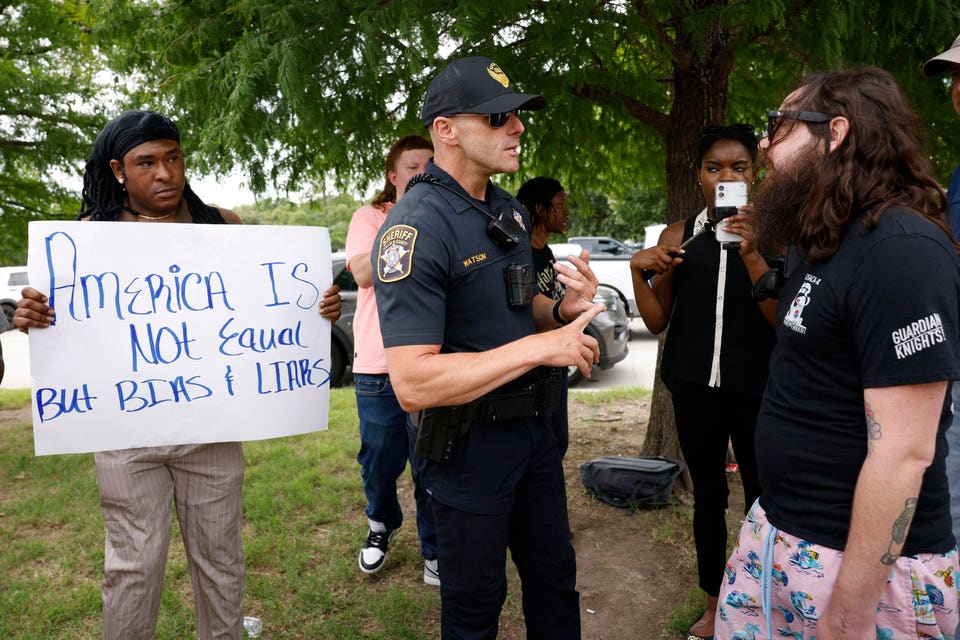
McKINNEY, TEXAS – JUNE 1: An officer from Collin County Sheriff’s Office, center, speaks to a Austin Metcalf’s supporter, right, as a Karmelo Anthony’s supporter, left, holds a sign outside Collin County Courthouse during Anthony’s trial, Friday, June 5, 2026, in McKinney. Anthony is charged in the stabbing death of student-athlete Austin Metcalf at a Frisco ISD track meet last year. (Chitose Suzuki/The Dallas Morning News via Getty Images)
The Dallas Morning News via Getty Images
The conviction and sentencing of Karmelo Anthony have generated intense national debate. Anthony, a Black teenager from Texas, was convicted of murder and sentenced to 35 years in prison On June 9, 2026, in connection with the fatal stabbing of Austin Metcalf, a white 17-year-old student-athlete, during a track meet in Frisco, Texas. During the trial, prosecutors argued that Anthony intentionally stabbed Metcalf during an altercation. Anthony’s defense team argued that he acted in self-defense, maintaining that he feared for his safety during the encounter. After hearing testimony and reviewing evidence, the jury rejected the self-defense claim and returned a guilty verdict.
Anthony, who attended Centennial High School, and Metcalf, who attended Memorial High School, were both 17 when they met during a Frisco independent school district track meet in April 2025. A rain shower began and some student athletes remained on the field, while others ran for cover under team tents. Centennial did not have a tent that day, and when Anthony sought shelter under Memorial’s tent, a confrontation occurred resulting in Anthony stabbing Metcalf, who was pronounced dead shortly after arriving at a local hospital.
The legal questions before the jury were ultimately narrow and centered on if the evidence support a murder conviction, and did Anthony’s actions meet the legal standard for self-defense? Yet outside the courtroom, the case became something much larger. The verdict sparked passionate public debate about race, fairness, accountability, and trust in the justice system. Some observers argued that factors such as jury racial and ethnic composition, venue, and public perception may have influenced how the case was understood. Others rejected those concerns and maintained that the verdict reflected the facts presented at trial.
Beyond the legal arguments and social media debates, this case illuminates broader conversations about adolescent development, conflict escalation, bullying, racialized experiences, and the systems that are supposed to help young people navigate difficult situations before they become irreversible. The purpose of examining these issues is not to explain away a tragedy or excuse harmful behavior. Rather, it is to ask what lessons we can learn when two teenagers become involved in a conflict that leaves one young person dead and another facing decades in prison.
Adolescence Is A Unique Developmental Period
One of the challenges in discussing cases involving teenagers is that public conversations often treat adolescents as though they process conflict the same as adults. Developmental science suggests otherwise. According to a 2025 study published by the American Psychological Association, the adolescent brain is still developing, particularly in areas related to impulse control, emotional regulation, decision-making, and risk assessment. Moreover, research by psychologist Laurence Steinberg, one of the leading scholars of adolescent development, has demonstrated that adolescence is characterized by significant differences in emotional processing, impulse control, and decision-making.
During this stage of life, emotional and reward systems tend to develop more rapidly than the brain regions responsible for self-regulation and long-term judgment. Consequently, research suggests that adolescents may be particularly vulnerable to emotionally charged decision-making during high-conflict situations, especially when peer dynamics are involved. This does not mean adolescents are incapable of making thoughtful decisions. Nor does it excuse harmful behavior, but it does indicate that young people often experience conflict, embarrassment, rejection, humiliation, and perceived threats differently than adults. As communities grapple with the aftermath of cases like this one, experts argue that developmental factors deserve consideration—not because they determine legal responsibility, but because they help us understand why prevention and early intervention matter.
Why Conversations About Bullying Continue To Surface
Although bullying was not established as a cause in the trial, conversations about bullying quickly became part of the broader public discussion surrounding the case. That reaction is not surprising. Many educators, parents, counselors, and mental health professionals have become increasingly concerned about the long-term effects of chronic peer conflict, harassment, exclusion, and humiliation among adolescents. Research suggests these concerns are warranted.
According to Dorothy Espelage an expert and researcher on adolescent bullying behavior, bullying is not simply a disciplinary issue; it is a public health issue with significant implications for mental health, school climate, and long-term well-being. Too often, bullying is framed as a temporary inconvenience rather than a serious mental health concern. For many young people, repeated harassment can have profound psychological consequences. Research has linked chronic bullying to increased rates of anxiety, depression, social withdrawal, academic difficulties, self-harm, and suicidal ideation.
Victims frequently report feelings of helplessness, isolation, shame, and hypervigilance. In fact, a 2023 BMC Psychiatry meta-analysis of 31 studies found that bullying involvement was significantly associated with depression among children and adolescents, with youth who experienced both bullying and victimization showing the greatest psychological risk. Similarly, a large systematic review published in the World Journal of Psychiatry found that bullying victimization was associated with increased rates of anxiety, depression, suicidal ideation, and other adverse psychological outcomes.
Although, these findings do not tell us what happened in this specific case. They do; however, remind us that experiences involving peer conflict, social exclusion, harassment, and humiliation can have meaningful consequences for adolescent well-being. “We often think of bullying as a normal part of growing up,” says Steinburg. Yet adolescence represents a unique period of brain development in which emotional and reward systems mature faster than the systems responsible for self-regulation and impulse control. In emotionally charged situations, that developmental imbalance can increase vulnerability to conflict escalation and risky decision-making.
Unfortunately, many students report that reporting bullying will not change anything. Others fear retaliation. Some simply stop asking adults for help. By the time concerns reach the attention of parents, counselors, administrators, or law enforcement, the emotional damage may already be substantial. When tragedies involving young people occur, it is understandable that communities begin asking broader questions about how schools respond to conflict, whether students feel safe reporting concerns, and what resources are available when interpersonal tensions begin to escalate.
Race, Perception, And The Public Conversation
Race also became a central part of the public discussion surrounding the case. Anthony is Black, and Metcalf was white. As a result, many observers viewed the case through a broader historical and cultural lens. Some questioned whether race influenced public perceptions of the incident. Others raised concerns about fairness, representation, and trust in the judicial process. Anthony’s family publicly expressed concerns about racial discrimination and unequal treatment throughout the legal proceedings and shared that they had to move to protect their safety due to racial attacks during the trial.
None of these concerns were questions the jury was tasked with answering. However, the public reaction highlights a reality that mental health professionals and educators have long recognized and highlights how race can shape how individuals experience institutions, interpret events, and understand fairness. That said, research has consistently shown that experiences of racial discrimination and racialized stress can have significant implications for adolescent mental health, contributing to elevated levels of anxiety, depression, chronic stress, and emotional distress. For Black adolescents in particular, experiences involving discrimination, racial harassment, and bias can create additional layers of stress that are often overlooked.
Mental health researchers in a 2025 study published in BMC Public Health have documented the psychological impact of racial discrimination on young people, including increased symptoms of anxiety, depression, chronic stress, and emotional exhaustion. Research by clinical psychologist Mitch Prinstein has repeatedly found that peer rejection and social exclusion can have profound psychological effects during adolescence, a developmental stage in which social belonging carries extraordinary emotional significance.
Schools cannot effectively support student well-being while ignoring the role that race may play in students’ lived experiences. Creating safe environments requires addressing all forms of harassment—including those rooted in race, ethnicity, religion, gender identity, disability status, or other aspects of identity. Students cannot thrive in environments where they feel persistently targeted, marginalized, or unsafe. Acknowledging these realities does not require reaching conclusions about the verdict itself. Rather, it requires recognizing that conversations about race remain deeply intertwined with how many Americans understand justice, belonging, safety, and opportunity.
Prevention Matters More Than Retrospection
Following highly publicized tragedies, much of the public conversation focuses on punishment. How many years should someone receive? Was the verdict fair? Was justice served? While those are important legal questions, they are not the only questions. Mental health professionals, educators, parents, and policymakers should also ask what happened before the tragedy occurred and reaches the courtroom.
What warning signs were present? Were concerns reported? Did students feel safe seeking help? Were adults aware of ongoing conflicts? Were intervention systems functioning effectively, and could mediation, counseling, mentorship, restorative practices, or earlier intervention have changed the outcome?
The reality is that punishment occurs after harm has already happened. Prevention occurs before lives are permanently altered. The most effective school safety strategies do not begin after violence occurs. They begin years earlier through relationship-building, mental health support, anti-bullying initiatives, social-emotional learning, conflict resolution education, and accessible counseling services. These efforts may not generate national headlines, but they often prevent them.
Looking Beyond The Verdict
Public discourse often encourages us to choose sides. To identify a hero and a villain. To declare one family deserving of sympathy and the other deserving of condemnation. But reality is often more complicated. A young man is dead, and another young man will spend much of his early adulthood incarcerated. Two families are grieving and two futures have been permanently altered. The legal process has produced a verdict, and the criminal justice system has rendered its decision.
Yet the broader questions remain, how do we better identify students who are struggling and how do we address adolescent violence. How do we intervene before conflicts become crises? How do we take bullying seriously without waiting for tragedy to force our attention, and how do we create school environments where young people feel safe enough to seek help before anger, fear, humiliation, or desperation reach a breaking point? Those questions may not change the outcome of this case, but they may help prevent future tragedies.